In The National Interest: UK launch exposes deep frustrations about Nigeria, by Olu Fasan
Last week, on October 7, the London School of Economics, LSE, hosted the UK launch of my book In The National Interest: The Road to Nigeria’s Political, Economic and Social Transformation. Two LSE faculties—the Department of International Relations and the Firoz Lalji Institute for Africa—collaborated to organise the book launch, which included a public lecture. […]


Bola Tinubu’s unfinished business
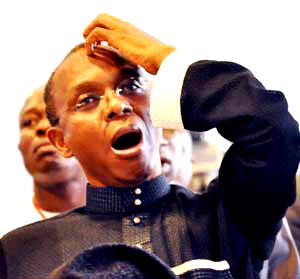
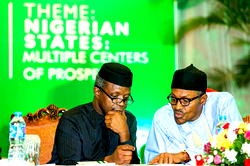
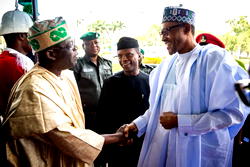
CHIEF Ahmed Bola Tinubu celebrated his official 64th birthday, symbolically, in the Presidential Palace (Aso Rock) Abuja, hosted by the President, Muhammadu Buhari, on Tuesday, 29th March, 2016. This was the very first time a private citizen’s birthday (Tinubu is not an elected or appointed officer of the Federal Government) was held in the nation’s seat of power, and it may not happen again any time soon.
Economic Summit: Elephant goes into labour, delivers a mouse (1)
In the three tears left to this administration, we have given ourselves the target of 10,000MW distributable power. In 2016 alone, we intend to add 2,000MW to the national grid.”
How Obasanjo’s Govt Looted Abacha Loot
Are you aware that in addition to the four refineries in Nigeria – Portharcourt I and II, Warri and Kaduna, this country also had a 30 per cent interest in West African Refinery, Sierra Leone which was handed over to President Obasanjo’s government in 1999? Are you also aware that has Obasanjo so far failed to account for that national assets and its disposal, he was handed a list of assets forfeited by Abacha to the Federal Government on May 26, 1999 – in the last decree –Decree No. 53 – which was the last signed by General Abdulsalami Abubakar as Head of State, Commander-In-Chief of the Armed Forces, Federal Republic of Nigeria? Are you also aware that other Abacha loot, returned between 1999 and May 2007, when Obasanjo was forced to step aside, remain unaccounted for and might have been re-looted? Prepare yourself for a shock – if it is still possible to be shocked in Nigeria by anything done by leaders of the PDP who had access to the corridors of power – especially the self-righteous Obasanjo. His administration established the template for looting Abacha loot. But, permit first a diversion – a necessary one.
The slippery slope of church-marketing
When Jesus multiplied loaves to feed the multitude, many concluded he was just the pastor they needed. As a result, they went to great lengths to relocate to his “church.” Some got into boats and crossed over from the Sea of Galilee to Capernaum in order to see him. But these people were not hungry for God. They came because they wanted bread. They came bringing their own five loaves and two fishes as offering in order that they might be multiplied.
How selective is Buhari’s anti-corruption war?
During the 2015 electioneering period, it was easy to see how corruption was established as Nigeria’s most intractable problem. Hence, the then opposition party, the All Progressive Congress (APC) vowed to deal with it head-long, if voted into office. Many people believed that the party could in reality fulfil its promise because of the antecedents of its flag bearer, General Muhammadu Buhari. In fact, many of those who opposed Buhari were ignored because they were seen by the public as corrupt officials who feared the likelihood of the exposure of their corrupt practices. Having won the election against that backdrop, one would expect that Buhari’s anti-corruption war would be fierce and that it would in turn be appreciated by all. Today, the situation is inexplicably shifting as those being interrogated have succeeded in convincing some people that the war is selective. Almost on a daily basis now, the criticism is getting louder as corruption is fighting back with groups being mobilized to condemn the policy