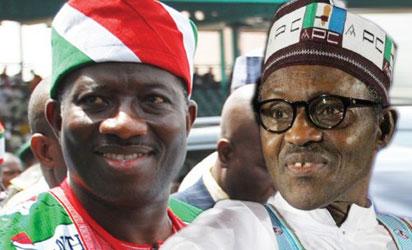
Jonathan and Buhari
By Ochereome Nnanna
THE ruling People’s Democratic Party (PDP) and the “wanna rule” All Progressives Congress (APC) have chosen their flag-bearers for the presidential election of February 2015. The PDP, through a ratification convention on Wednesday, December 10th, affirmed President Goodluck Jonathan at the Eagle Square, Abuja. The APC took their act to Teslim Balogun Stadium, Surulere, Lagos where Alhaji Muhammadu Buhari dusted four other contenders to the presidential ticket.
The PDP event was dull as ditchwater, since there was no contest. It is normal for an incumbent president seeking a second term in the presidential system to enjoy this political free-ride. Those who are badmouthing the president and the PDP for this are either ignorant or mischievous. If APC wins the presidency in 2015 it will stage an affirmation convention when Buhari goes for a second term in 2019. There will only be a contest if he, in an unlikely event, owns up to his promise to do only one term.
The real thrill was with the APC primaries. Three of the aspirants – Buhari, Alhaji Atiku Abubakar and Governor Rochas Okorocha – are serial presidential contenders. Governor Rabiu Kwankwaso and Mr. Sam Nda-Isaiah were the only newcomers to the game. Kwankwaso surprised many by edging past Atiku into the distant second place with 974 votes leaving Atiku third with 954 votes.
Buhari, as widely expected, scored a landslide win with 3,430 votes. It was a well-organised primary and it ended in success for the party. Why not? After all, it was based on the open-secret ballot system and a voting template which the PDP has perfected since their 1999 Jos primaries. Winners and losers watch events unfold before their eyes, and winners and losers are known long before the exercise is over.
At the end of it, former Vice President Atiku, who was losing the presidential bid for the fourth time, conceded defeat and congratulated Buhari. This was also a PDP innovation in Nigerian politics pioneered under the regime of the late President Umar Yar’ Adua and extended to the present under President Goodluck Jonathan.
PDP lost governorship elections in Ondo, Edo and Anambra and congratulated the winners. Atiku was the second APC politician who lost an election and congratulated the winner. The first was former Governor Kayode Fayemi of Ekiti State who initially congratulated Mr. Ayodele Fayose, the winner of the June 21 2014 governorship election in Ekiti State and pledged a smooth handover.
He was later overruled by his APC party, an act that set the stage for the current do-or-die power struggle, which has crippled activities in the Legislature and Judiciary in the state. The nobility of Fayemi’s concession of defeat was thus defeated and APC came out as a bad election loser. On this score, PDP is holding the higher moral ground.
Questions have arisen as to whether Atiku’s concession of defeat will result in a whole-hearted support of Buhari in the campaigns ahead. Will Kwankwaso offer his support? Will Okorocha do so? Only time will tell. But one thing is almost sure. Atiku, Kwankwaso and Okorocha are unlikely to leave the APC or return to PDP. They are likely to stay in the party. But will they bring out their resources and abundant energies to campaign for Buhari’s election as president?
That is something we watch to see. Politicians are selfish people. My guess is that Atiku will pipe down and roll in his tent, with minimal intervention. He will like to run again in 2019 when both PDP and APC are likely to source their presidential candidates from the North. Atiku knows that if Buhari wins, his own burning presidential ambition is buried forever. He is unlikely to vie for president at 77 in 2023. In any case, the Southern elements in the party may feel it is their turn. I, therefore, see Atiku and perhaps Kwankwaso fancying another opportunity to vie in 2019.
However, whether Atiku, Kwankwaso and Okorocha will throw their weights behind Buhari or not, Buhari is going to run his most successful presidential race ever in the next two months. Those who are saying the PDP has perfected ways of defeating him should take note that this time is different. In the past, Buhari failed because he relied on regional political parties, such as the All Nigerian People’s Party (ANPP) and Congress for Progressive Change (CPC).
Even though the APC started off as a regional gang-up between Arewa North and the South West mainstream, it has become more of a broad-based national political party today. It has grown beyond the original North West, North East and South West alliance. Right now, it has albeit tentative footholds in the South East (Imo) South-South (Rivers and Edo) North Central (Nasarawa and Kwara). It has strong candidates in Akwa Ibom, Benue and Kogi. It has made inroads into the Minorities’ heartlands. If APC wins the presidential election it will take over dominance from PDP.
I see a contest where the margin of victory will be thin. Whoever wins will not have a landslide. It will be by a couple of millions, or even thousands of votes. A close call will be a recipe for disaster. Such a close contest, given the prevailing atmosphere and threats of forming parallel governments, could set Nigeria on fire. It might spell doom for our democracy. Nigerian democracy has survived for sixteen years because there was a dominant ruling party. But with two parties of almost equal strength going for broke in a do-or-die manner, it might be a different story after February 2015.
We pray that the “blood of the monkey and baboon” will not mix, as a weeping Muhammadu Buhari had vowed before his ardent supporters shortly before he re-entered the race for the presidency some three years ago. Nigerian politicians threatened to make the country ungovernable if Jonathan won the 2011 polls.
He went on to win, and the Boko Haram insurgency blew out of control, losing us more than 15,000 citizens. We also hope that ex-militants of the Niger Delta, particularly Mujahid Asri Dokubo, will not unleash the arms and ammunition they have been stockpiling on the oil installations and cripple the economy if Jonathan loses. Nigerian politicians know how to make good their threats of violence. They have abundantly demonstrated their capacity to carry out their threats.
The only hope – a very distant one at that – is for Professor Attahiru Jega’s Independent National Electoral Commission (INEC) to eschew its regional bias, which was evident in the botched creation of additional 30,000 polling units, and give us a credible election. Only a credible election – seen to be so by the contestants and independent observers – will save Nigeria from the calamity that the strong two-party system may have foisted on us.
I congratulate APC for scaling all the hurdles to emerge as a strong national political party. Fears had been expressed that it would not get this far. But let its coming of age, its emergence into virile manhood, be a blessing to Nigeria and not a curse. Let it fertilise our democracy rather than bring on a scorched earth. Let the PDP and APC remember that if they destroy Nigeria there will be no country for them to govern.
Disclaimer
Comments expressed here do not reflect the opinions of Vanguard newspapers or any employee thereof.