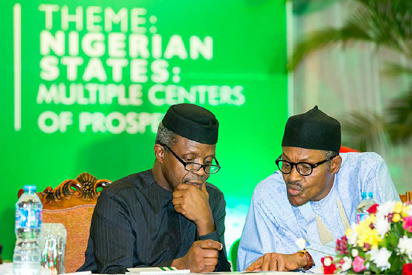
President Muhammadu Buhari and Vice President Yemi Osinbajo at the opening of a 2-day National Economic Council Retreat at the Statehouse Conference Centre on 21st March 2016.
By Tare Youdeowei
Some stakeholders in the public service and academia have identified justice to minority through the restructuring of the country and return to true federalism as key to solving its problems and attaining national development as enshrined in the United Nation’s Sustainable Development Goals, SDGs, agenda.

President Muhammadu Buhari and Vice President Yemi Osinbajo at the opening of a 2-day National Economic Council Retreat at the Statehouse Conference Centre on 21st March 2016.
These formed the thrust of discussions at an international conference on Revisiting the Structural Foundation of Nigerian Federalism, at the University of Calabar, organised by the Institution of Public Policy and Administration, IPPA, in collaboration with African Research Council for Sustainable Development, ARCSD.
Chairman of the conference and Senator representing Cross River Central District, Senator John Owan Enoh, said: “With the tidal wave of unrest and militancy in the Niger Delta and the quest by Lagos State Government to take ownership of the proceeds of Value Added Tax, VAT, around the state, it has become increasingly clear that the purported legal resolution of the matter of resource control will not suffice.
“After independence, the idea of federalism in Nigeria was well conceptualised and entrenched with the regional governments taking control of the management and utilisation of natural resources at their disposal.”
Case against true federalism—Fashina
The keynote speaker and past National President of Academic Staff Union of Universities, ASUU, Dr. Dipo Fashina, said the practice of true federalism will ensure that the majority would continue to steal from the minority in the society.
He said: “The biggest challenge is that the bigger ethnic groups will continue to dominate others, where there should be economic justice.
“The present system is a new kind of federalism that gives the right to economic injustice.”
He called on the authorities to practice economic justice, which ensures that those in the minority of a structure also have equal rights and real access to power as those in the majority.
In the same vein, another speaker, Mr. Paul Erokoro, a legal practitioner, charged youths to take charge by insisting on restructuring of the nation, just as he noted that too much power was concentrated at the centre.
Disclaimer
Comments expressed here do not reflect the opinions of Vanguard newspapers or any employee thereof.