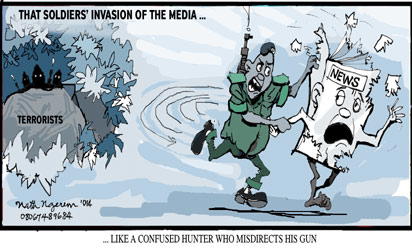
THE adage: “the pen is mightier than the sword”, sounded foolish to me the first time I heard it as a freshman at Nsukka over 30 years ago. How can anyone in his right mind make such a nonsensical assertion? Even the Great Dr. Nnamdi Azikiwe, the greatest media mogul Nigeria has ever produced till date who fought the British colonialists with his acerbic pen, reportedly once whispered to his disciples: “only a mad man can argue with a man carrying a gun”.
Zik’s alibi notwithstanding, the pen is mightier than the sword. It was not a mere psychological tranquiliser coined to give writers and journalists a false sense of importance when it was first deployed by Edward Bulwer-Lytton in 1939. Even Napoleon Bonaparte, one of the greatest military generals of all time, said so. The mind is mightier than the muscle. The muscle works for the mind.
The Nigerian armed forces had, for the first time in its illustrious history, become the butt of (mostly snide) comments over its apparent inability to destroy Boko Haram, an Islamic insurgent group that started like a rag-tag band of overgrown, over-excited almajirai in 2009. It has blossomed into the most savage, notorious and dreaded terrorist outfit in the world today. Our once feared armed and security forces seemed at a loss what to do, as we started hearing allegations of internal sabotages, alleged mutinies, poor equipment, “low morale” and unwillingness to confront the nation’s enemies. Boko Haram’s “exploits” are reported everyday on both the orthodox media and the new, unscrupulous social media.
The armed and security forces made the miscalculation of clamping down on the newspaper industry, confiscating and destroying some editions of newspapers, detaining the drivers of newspaper distribution vans and generally disrupting operations in the industry reminiscent of the dark days when the military was in power. Their action was described by some military sources as “routine security checks”. Later on, the spokesman of the Nigerian Army, Major General Chris Olukolade, explained that newspaper vans were stopped at the various checkpoints because Boko Haram had resorted to disguising their supplies, including armaments and logistics, in vans painted in media colours, apparently taking advantage of the privileges that the media are given on the highways by the security agencies. Boko Haram has resorted to all sorts of new tricks, including the abduction of girls and the enlistment of women as suicide bombers and informants, and hence the need for the armed forces and security agencies to be more thorough in their checks.
While the disruptions were going on, media practitioners started reading the action of the military as a declaration of war on the Press. It did not make any sense to seize and destroy newspapers and magazines because of the stories they carried in these days when most newspapers have their online editions which are read all over the world. It is futile and an un-winable war, as the history of the government-media relationships in Nigeria has shown. The Nigerian Press moves into its true elements when it is faced with dictatorship or impunity of any kind. The Zik Group of Newspapers set the tone in fighting the colonial masters, and the industry became the greatest obstacle to the perpetration of prolonged military rule in Nigeria.
When General Olusegun Obasanjo was elected president of Nigeria in 1999, he mounted a civilian dictatorship. He was determined to use rough-and-ready methods to force the legislative arm of government to dance to his tune. He changed the personnel running the ruling Peoples Democratic Party, PDP at will. He manipulated the affairs of the major opposition parties to make sure they did not become a threat to him. He intimidated state governors, got one of them abducted by the police and declared state of emergency or engineered the impeachment of governors in Plateau, Anambra, Ekiti, Oyo, Bayelsa and others. He also wired the judiciary and the concept of “black market judgements” became rampant during his eight years in power. He even tried to change the Constitution to give himself a third term in office.
But Obasanjo, a tested hand in running the affairs of Nigeria, stomped all over the political class but carefully and methodically desisted from harassing the media and civil society. He decided that the best way to deal with the media and civil society was to do nothing. The media was harsh and critical over his roughneck handling of our democracy. Writers often went beyond criticism and actually hurled insults at him. Baba Iyabo ignored them. In fact, he displayed his contempt by saying: “I don’t read Nigerian newspapers”. Writers and their readers got to a point where they wondered aloud whether the people in government read what was being written.
Something strange happened, shortly after Obasanjo came down from the presidency in 2007, which convinced me that Obasanjo did read Nigerian newspapers. His apparent refusal to engage them was deliberately meant to make them feel unimportant and irrelevant.
Shortly after he was appointed as the Corps Marshall of the Federal Roads Safety Commission, FRSC, Mr. Osita Chidoka invited me to his office in Abuja July 2007. He asked me to accompany him to see someone at the Transcorp Hilton. Not having much else to do that day, I agreed to go with him and we rode in his official car. My curiosity was stoked when we were taken to the top floor of the hotel where the super VIP’s usually stay. At the end of a long passage, we came to a door guarded by beefy, stern-looking security men in suits. I was told to wait outside while Chidoka went into the suite. He later got the security men to allow me in. Shortly, an elderly man in shabby dressing gown came out of an adjoining room. Everybody in the suite got up and Chidoka went to greet him, calling him: Baba.
It was then that it dawned on me that I was in the presence of former President Olusegun Obasanjo, the man I spent the last eight years bashing over his dictatorial handling of the polity! After greeting Obasanjo, Chidoka introduced me:
“Baba, this is my friend, Ochereome Nnanna of Vanguard Newspapers…”
President Obasanjo, who had extended his towards me for a shake, quickly withdrew it as though I had suddenly become a coiled black mamba, the most dangerous snake in the world. He gave me a baleful, withering look and walked away! I quickly walked out of the suite, went down and returned to my hotel. As I went, I kept telling myself: the man reads Nigerian newspapers!
However, the challenge the nation is facing is different. We are faced with a terrible enemy, Boko Haram, and military is putting its personnel on the line to save Nigeria and secure Nigerians. It is in our collective interests to cooperate with the military, rather than ridicule or embarrass them. Even when they make mistakes, such as the disruption of media business, we must be patient. Luckily, their leaders are willing to correct their mistakes and eager to work with the rest of society to succeed in the war on terror.
This is our army, and this is our country. The media and the Nigerian armed forces are NOT at war. We are comrades at arms in the service of our nation.
Disclaimer
Comments expressed here do not reflect the opinions of Vanguard newspapers or any employee thereof.