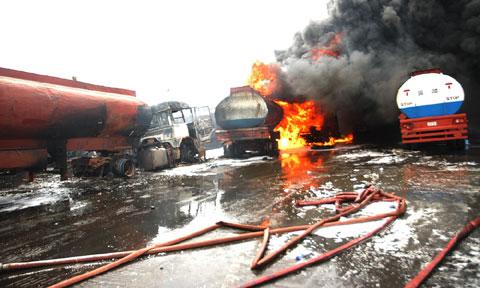
File photo: a tanker fire
By Chinedum Joseph
Precisely 20:36hrs on 15th February, 2017, I noticed two missed calls on my cell phone, two minutes behind. It was from Prof. Joe Asike, the Chief of Staff to His Excellency, Chief Willie Obiano, the Executive Governor of Anambra state.
The call was to ask for the mobilisation of fire fighters for the extinction of an on-going tanker exlosion fire at the upper New Market Road, Onitsha. I immediatly called the Deputy Controller Mbonu, the Anambra state fire service Adminitrative Officer, who had already mobilised his men at Awka to the scene.
Incidentally, the calls came in when I was writing on a topic titled “Where did the professionals go wrong?” a sub-title on the chapter “Market Fires” for the development of the second edition of my book on Nigeria Fire and Rescue Service.
Where did the professionals go wrong is a preview of the Sabon-gari fire inferno of March 26th, 2016 which occured at 00:01hrs and consumed an estimted property worth about ?3trillion (400 shops gutted by fire).
The tanker explosion fire gutted about 48 vehicles and 25 buildings as reported by the Authority Newspaper of Friday, February 17, 2017. After 256 days of previous tanker explosion fire at overhead brigde in same Onitsha that killed about 65 persons (30/05/2016).

onitsha-tanker-accident
The fire fighters battled with the fire all night long as was the case with Sabon-gari inferno. I wept alongside with my amiable Governor and recalled immediatly the request he made on 24th February, 2016 for the establishment of Federal Fire Service station in the state to compliment the State Fire Service delivery, when I paid him a courtesy visit.
The national recuring decimal of inferno could however, be reduced to a minimal level. The on going spread by the Federal Fire Service, is a move in the right direction and the states should welcome this gesture and work in collaboration with the Federal Fire Service. The enlightment on the implemetation and enforcement of the National Fire Safety Code, by the Federal Fire Service should be embraced by the states.
The tanker drivers and all other petroleum exploration and distribution organ, will agree with me that enough Standard Operating Procedure, SOP, is not presently in place. There should be a mobilising board unit in all petroleum depot in the federation.
During the departure of a particular tanker, the present state of such tanker should be stated on the mobilising board for instance, the capacity of the tanker and its content, the date the tanker was last serviced and the general state of other features of the vehicle like the tyres, lighting systems, brakes,safety equipment et c, should be ascertained and put into a better perspective.
The present physical state of the drivers should be assessed, as a particular tanker needs more than one driver and the services of one or two conductors (motor boys) should be employed.
On no account should such a tanker leave the depot without a charged motorola or cell phone. It is the duty of either of the driver to book down their departure time in the mobilising unit and report same to to the nearest fire station and to the fire station at their destination point. These will allow for an effective monitoring by the fire service as the tanker journeys along from its departure point to its destination.
This should also be applicable to air-craft movement. The inclusion of heavy duty vehicle lane on our highways and towns cannot be over emphasised, for example, the BRT in Lagos state, as I reiterated during my visit to His Excellency. The discharge of this volatile substance in the filling stations, must be done at a weather friendly condition and with a stand-by passive fire extinguishing medum e.g appropriate fire extinguishers, earthing equipment and firefighters need to be on stand-by.
The enlightment on the implemetation and enforcement of the National Fire Safety Code, by the Federal Fire Service should be embraced by the states
Disclaimer
Comments expressed here do not reflect the opinions of Vanguard newspapers or any employee thereof.