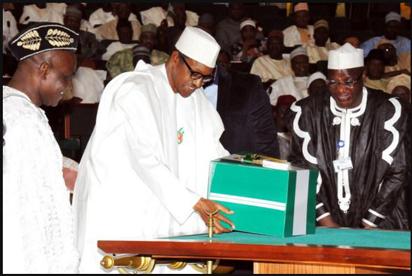
File: Buhari during the 2016 budget presentation to the National Assembly.
By Dele Sobowale
The Medium Term Expenditure Framework, MTEF, was conceived by the international community, through the World Bank, WB, and the International Monetary Fund, IMF, as a planning tool designed to enable governments to consider several programmes which cannot fit easily into an annual budget.
It would then make it possible for governments and other stakeholders, especially lenders, to see the big picture and have a feel for the direction of the national economy. It is generally assumed by the global financial institutions that nations will be as painstaking in the preparation of the MTEF as they are when addressing the annual budget. Nigeria’s experience since the 1980s would demonstrate that no single government had presented an MTEF that could not be described as a “salad bowl of illusions” (apologies to George Santayana, 1863-1952).

File: Buhari during the 2016 budget presentation to the National Assembly.(file)
While that dismal record might be disconcerting to the global economic community, it should not surprise Nigerians. Annual budgets are supposed to be easier to propose and manage than medium term goals. But, no single budget had been faithfully implemented since 1999 by elected governments – not to talk of the military governments before the return to democracy; if it lasts longer. The 2016 budget, the first full year budget presented by the Buhari administration is already racing to a dismal conclusion and could turn out to be the worst ever in our history. The budget had turned to be totally wrong on all the major elements constituting it. Consider the facts now at our disposal.
The budget was based on the following major assumptions – all of which have turned out to be widely incorrect. Furthermore, with three quarters of the year gone, there is no way the positive estimates will be achieved. Unfortunately the 2016 budget was also the basis for projecting MTEF for 2016-2018. With the results for 2016 so far at variance with the budget, it should be clear to anyone why the projections for 2017 and possibly 2018 cannot be considered reliable.
The major assumptions underlying the 2016 budgets are tabled below and the actual results side by side. They tell a story of incompetent and self-deceptive budgeting leading to the devastating consequences Nigerians are now experiencing.
* out of the actual expenditure, over N400bn was spent on external debt servicing which was higher than expected and did not in any way benefit the domestic economy.
Of all the factors contributing to the increasing gap between Nigeria’s budgets and actual performance every year is the seeming obsession with projection of 2.2 million barrels of crude oil per day exported. Yet, in no single year, since 1999, had this country succeeded in reaching that figure. Nevertheless, mentally lazy Ministers and their bosses continue to adopt it as the foundation for budgeting. The reason is easy to understand. Without starting with that seemingly unattainable target for crude exports, no government would have been able to announce the padded, to use the new language, budgets they present annually.
Buhari’s second annual budget and the MTEF for 2017-2019 had been based on this fundamental error which had been responsible for the nation’s increasing debt stock. Last month, the Debt Management Office, DMO, revealed that the country’s debt profile had risen by N4.17tn from July 2015 to June 2016 or 34.41 percent. And debt servicing had gone up in tandem to about 40 per cent of recurrent expenditure. Monthly revenue allocations to the Federal Government and states are well below budgets resulting in the Federal and state governments accounting for 8.65 per cent of all loans granted by banks. With few exceptions, all Nigerian governments now borrow to pay salaries and in the process crowd out private sector investors needing loans to operate and at the same time drive up the high interest rates the Minister of Finance deplores.
Allied to that is the penchant by governments, Federal and states, to exaggerate expected growth and exchange rates without regard to the current situation and the fact that Nigeria is part of the global economic community. The 2017 budget projects exchange rate at N290/$1 when right now, October 2016, it is close to N500/$1. The quantum of dollar inflow into the Nigerian economy to make that happen is so massive as to be considered a mission impossible. At any rate, nobody had disclosed where the dollars will come from to drive down the exchange rate. Similarly, the Federal government projects Gross Domestic Productivity, GDP, growth of 3.2 per cent. Meanwhile, the World Bank, the IMF and other global economic monitoring organizations predict, at best one per cent growth. Just in case some wooly headed individuals think that the World Bank and IMF are targeting Nigeria, it is important to know that they have all reduced their global growth forecasts for 2017 from over 3.5 per cent to under 2.0 per cent. South Africa, Brazil, Russia, Saudi, Britain and USA and China are among countries expected to record lower GDP growth rates.
With such a wide variance between our own self-deceptive estimates and the more detached and professional estimates of the global organizations, investors would tend to disregard our own estimates as being unrealistic and base their decisions on whether to invest or not on theirs. To demonstrate that they actually recognize a tougher year ahead of us than Nigerian economic managers do, the IMF is offering zero-interest loans to Nigeria and other countries known to be caught in the deadly trap of low crude oil prices. The International Finance Corporation, IFC, a member of the World Bank group, is shopping for $5 billion infrastructural investments for emerging nations, at low interest rates – including Nigeria. Obviously, the global group of low-interest lenders are not taking Nigeria’s economic managers seriously. They are working hard to avert a greater calamity than would ordinarily occur without their preventive measures.
And, there is a reason for this. Early this month, the IMF revealed its concerns that Nigeria’s economic crisis may spill to other countries in West Africa and beyond – based on the fact that about 45 per cent of the Federal Government’s revenue was going into debt servicing. Mr Victor Gaspar of the IMF pointed out the main reason why global organizations are alarmed, while Nigerian leaders pretend that things will soon improve. According to him: “Message number one is that if you look at the global debt and deficit landscape in the world, you’ll see that the countries that have the highest public sector deficits are oil exporters; Nigeria is in debt and it is a country much hit by very low oil prices.” Fortunately, global oil producers, recognizing Nigeria as the most vulnerable member of OPEC had excluded the country from the agreed reduction in production.
Obviously, the international community is more concerned about our predicament than even our own leaders who present political budgets and MTEF which, from a close look, can be seen to be illusory and counter-productive. The only people who can possibly believe the MTEF just published must be Federal Government officials and their political associates. It will certainly not get us anywhere. It might even make matters worse by allowing us to leave the substance while pursuing shadows.
This time next year, after we would have failed to export 2.2 million barrels per day, another MTEF will be released; it will again project 2.2 million barrels for 2018. Since when has doing the same thing over again produced a different result? Why can’t we start with a reasonable estimate of crude oil exports and face the reality that the present structure of government is unsustainable for much longer? For how long will governments continue to borrow to pay salaries? For how long will the banking sector support governments with loans?
TABLE
ITEM BUDGET ACTUAL VARIANCE
Crude Price* $38/barrel $42/barrel $4+
Volume 2.2mpday 1.4mpday -0.8m
Budget (half-year) N3.03tn N2.95tn* N0.08tn
Capital Expenditure N0.9 tn N0.33tn -N0.57tn
Recurrent N2.13tn N1.49tn -N0.64tn
GDP Growth 4.2% -2.0% -6.2%
Exchange rate N197/$1 N300/$1 -N103/$1
Deficit (half year) N1.10tn N1.74tn -N0.64tn
Disclaimer
Comments expressed here do not reflect the opinions of Vanguard newspapers or any employee thereof.