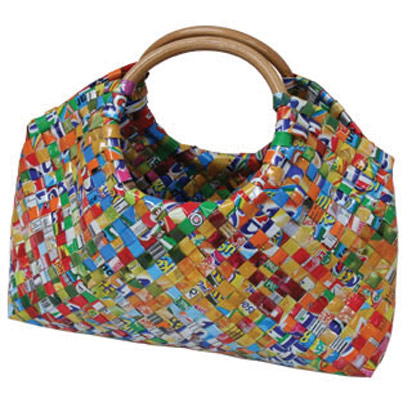
Eco-friendly bag
BY JOSEPHINE AGBONKHESE & ANINO AGANBI
MORE than ever before, the world is becoming green conscious; even though this seems to be happening more in theory than in practice. World leaders, with the Vatican Pope in the forefront, spread, at every given opportunity, the gospel of global warming and how mankind can mitigate the phenomenon to which it is becoming a major contributor through its activities and delights.

Eco-friendly bag
Designers too have joined in the campaign, with some of them describing and labeling their pieces as “eco-friendly,” “organic” and “sustainable”, claiming to be doing their part to help the planet. In the lead in Nigeria was ace designer Lexy Mojo Eyes, the helmsman of Legendary Gold International.
Lexy, at the Nigerian Fashion Week 2011, whose theme was ‘Going Green’, presented a ‘Going Green Collection’ of designs made from recycled materials. That made headlines in both local and international media. He did a repeat in 2012. We however have a problem with the wearability of those designs, as most of them appeared like leaves. That’s not supposed to be the whole essence of green fashion, which unknown to some of us, generally refers to something broader than global warming.
Style with responsibility
Green or eco-friendly fashion is about reintroducing eco-conscious methods right from the source through the use of environmentally friendly materials such as natural fibers, organic cotton, etc. and socially responsible methods of production that create social change and empower communities. Meanwhile, going green can be summarized by the mantra “reduce, reuse, recycle”-which means reduce waste, reuse what you can, and recycle what you can’t.
The business of it
But is Nigeria ready or equipped enough for eco-friendly fashion? How much of fabric production takes place within our shores? Shamefully, not even the Bank of Industry N1.0 billion fashion fund meant to support the fashion value chain- including but not limited to garments, women’s shoes, handbags and jewelry/accessories- is talking about placing premium on sustainable fashion and social responsibility.

Eco-friendly design by Loyal Wear
The criteria published on its website for eligibility for this loan says so- not Woman’s Own, because it puts into consideration nothing of such. A call to a Bank of Industry official confirms this. Almost every item used for production by our designers, down to the needle and thread, are imported.
Far from eco-friendly
For Evelyn Okere, CEO, Rose Di Omimi fashion label, eco-friendly fashion remains a distant dream to Nigerian fashion because only industrialized nations with manufacturing plants (garment factories) can practice such. “You can only talk about eco-friendly materials if we had a cloth factory where clothes are produced with hundreds of workers in the factory. Such revolution can start from manufacturing hubs such as that, not ours, where every designer operates on their own and depends only on their finances.
“The truth of the matter is that Nigeria has not gotten to the point where we use eco-friendly materials. We’ve not even gotten to the apex of our fashion and designing business. Right now, we are trying to find our feet in the industry with every available material; not screening for eco-friendliness. Everybody is thinking business,” she said.
“The first question is: what are the recyclable materials available to us when making our designs? When you talk about the thread, machine and fabrics, you think about how they are made. You talk about energy being used- whether gas, fuel, solar, etc.” the Rose di Omimi boss said. Internationally acclaimed bag designer, Morin Obaweya, CEO Morin.O, however says she is on her part imbibing some elements of sustainable fashion in her designs, the challenges notwithstanding.

Eco design by Tatania Inglis
“As a brand, we take pride in being authentically Nigerian and our goal is to produce in Nigeria with 75% Nigerian content to the world. So, we are strongly committed to imbibing qualitative Nigerian content in our delivery. We are also constantly researching ways we can use products and services with the environment in perspective. As a matter of fact, the awareness for environmental sustainability must cut across every segment because it is a situation that affects all,” Morin said.
Eco-friendly fashion and employment
Another aspect of sustainable fashion is the ability to empower society and create employment. “These factories will definitely employ human labour and raw materials will be sourced by from individuals. When such is practiced, automatically, fashion will become the major job and revenue spinner which it actually is in developed countries,” Evelyn said.
For a start towards green fashion, a recycling expert, Matilda Olatundun Taiwo, Managing Director, Goodware Stitches Ltd., however suggested the use of pet bottles for fabrics production. This, she said, can help in the production of half cotton and half polystyrene. “Unfortunately, we export all these pet bottles outside Nigeria and there, they are put into better use. Nigerians do not value available resources. Instead, we specialize in exporting raw materials and indirectly importing unemployment.
“A major challenge though is the unavailability of the required technology, and that’s where government has to come in. “All used clothes, for example, instead of being burnt, can be recycled if we had the technology. They can be changed into blankets, bedspreads and other fabrics,” Taiwo said.
Eco-friendly fashion in practice
Designers in developed countries appear to understand and practice the concept better. St James, for example, uses organic cotton, linen, hand dyed fabrics and recycled materials. Strives for no-waste pattern making and production, and makes everything locally in New York, United States. It is also involved in several mentorship programs for eco-minded emerging designers. For charity purpose, its helmsman is Fashion Director for The Uniform Project, a fundraising platform using sustainable design to raise money for underprivileged children.
Tatania Inglis is another designer. This brand ensures every of its garment is sewn in a small factory in New York from sustainably sourced fabrics including Japanese organic cotton, French vegetable-tanned leather, and dead stock wool from New York’s garment industry. Inglis’ innovative designs mean that many garments can be worn a multitude of ways, reducing the consumer’s need to purchase more (and therefore reducing production).
Disclaimer
Comments expressed here do not reflect the opinions of Vanguard newspapers or any employee thereof.