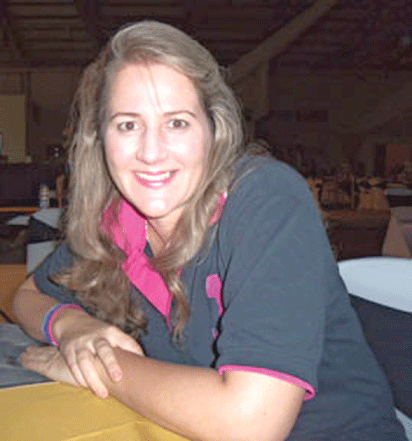
Jelena Zivkovic
“Give a man a fish, he’ll eat for a day; teach him how to fish, and he’ll eat for a lifetime” – Anne Isabella Ritchie.
The best legacy parents can leave for their children is not money or houses or land but sound education. With education, they can acquire all these things but without education, they may not be able to handle whatever the parents will leave for them. As a result, many parents go out of their way to provide their wards qualitative education no matter the cost.
So it can be devastating to see such wards failing to do well in school. Students fail exams for various reasons not just because they are not intelligent. Some grapple with depression, financial and family issues and these invariably distract them from their studies.
Recognising this fact, the American University of Nigeria, Yola, set up the Academic Advising & Retention Office to help students in their academics to ensure they graduate at the end of the day. In this chat with Vanguard Learning, Ms. Jelena Zivkovic, Director of Learning Resource Center, and Mr. Ebenezer Otijele, Director, Academic Advising & Retention Office, speak on the activities of the office. Excerpts:
By Ebele Orakpo

Ebenezer Otijele
WHAT we do here:“The Academic and Retention Office is a place where students can come and seek advice in choosing their courses, if they are having issues with communicating with their teachers, if they are struggling academically, if they want to know what courses to take during the summer classes and which teachers to pick etc,” said Zivkovic.
Is it like Counselling department?
(Otijele cuts in): “Not exactly. If you say counselling, you might be looking at other issues beyond academics but we are very particular when it comes to academics. If we have other issues, for example, health or psychological issues, depression or if they have had any misfortune that is impacting on their academics, we refer them to the appropriate place. So if we say counselling generally, that may not be appropriate.
Poorperformance
We are very particular about what happens to their academics. Of course, sometimes we have to get down to the nitty-gritty of what really led to the poor performance and all that.”
Our main goal:
“Our main goal is to get them to graduate so we try to act as their best friend. What do we do to get them to graduate? However, we have identified a number of students struggling academically and they are failing and unable to graduate. Some cannot seem to get over their math course, they keep failing. This is where we come in and try to offer deeper/broader assistance from a more holistic approach. We identify the students that are at academic risk and then work to get them over the hurdle so that they can progress,” said Zivkovic.
Our programme:
“One of the things that make AUN particularly unique is the fact that we do not just lump the students together, we are interested in the individual student. Here, we do students profiling. This means that at the beginning of every semester, we try to categorise our students on the basis of their academic performance.
Some are in good standing, some are on restriction and some are on probation. For those on restriction, what we do is this: You know this is liberal art education; it is not the Nigerian system that is tailored towards the British system where there is a straitjacket that you must wear as it were.
In the liberal art education, you are free to pick courses as much as you can carry per semester. So when a student’s performance is actually falling below expectation, we work with that individual student. We do not lump our students together, we do profiling to identify each of them and try to meet each of their specific needs. Sometimes we invite them over for one-on-one counselling with respect to their academics and in so doing, sometimes we get to know the reason they are failing.
It may be because they are having health issues in which case we refer them to the appropriate place and if we discover that they have had some bad experiences, may be death of parents or money issue is beginning to impact on them negatively, we refer them to the appropriate places.
If we discover that those are not really the issues but probably the student is finding it very difficult to cope with the standard here (the truth is that the standard here is high, you just have to be good in your business to be able to graduate), and the student is struggling, then we try to say ‘ok, here is what we can identify as your strength, here is where we think your weakness is, and in order to help you to be able to graduate, let us restrict you a little.
Don’t take this number of courses, take this number of courses.’ “If you are having issues probably with math, we advise you to stay off math for a while and we help you pick writing courses, economic courses or whatever, so you can boost your Cumulative Grade Point, CGP. That is what makes AUN very unique. I am sure no other university in Nigeria is offering this.
Minimum requirement:
The minimum requirement here for one to be able to graduate is a CGP of 2.0 on a scale of four. We start monitoring students from their very first semester until the day they graduate. So when we notice that a student is doing below 2.0 or he is at risk of doing below 2.0 or is actually doing below 2.0, we identify them and meet with them one-on-one. Sometimes we bring them together, we organise workshops for them.

Jelena Zivkovic
We have been running workshops such as Understanding your grading system to help them understand what constitutes the score they get at the end of the semester. We have introduced them to time management skills; test-taking skills, we have done so many workshops all in a bid to help them. We bring in our psychologist and motivational speakers to talk to them.”
The Office launched a new computer-based tool— C/GPA Calculator—that enables students to calculate their CGPA. The calculator has features that will enable a student to determine what GPA s/he needs to achieve a certain CGPA. Otijele noted that academic risk students can use the tool to calculate the GPA they need to steer clear of peril. “With this, they can be more focused and goal-oriented,” said Zivkovic.
Rising Potential students:
“For those students doing below 2.0, we call them Rising Potential students. Why rising potential? We don’t use derogatory words here; we don’t call them failing students. Why we got that name for them is because we believe they can do much more than what they are doing but probably, there are certain situations that are hindering their excellence so we try to see how we can work with them to bring the best out of them,” said Otijele
“We are monitoring and observing them closely because we want to measure the impact, how many will end up graduating, how many will end up may be even slipping back and how many will just stay the same,” said Zivkovic.
Disclaimer
Comments expressed here do not reflect the opinions of Vanguard newspapers or any employee thereof.