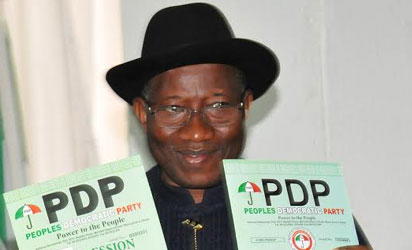
President Goodluck Jonathan displaying Expression of Interest and Nomination Forms at the People’s Democratic Party’s Secretariat in Abuja on Thursday (30/10/14).
By Obi Nwankanma
Of all those who emerged to lead the government in Nigeria, Dr. Goodluck Ebele Jonathan, Nigeria’s current president is the darkest of its dark horses. Nigeria’s governments have always been led by dark horses – those least expected to emerge: Balewa was sprung from the political loins of the British colonial office; Yakubu Gowon from a concert of neo-colonial and regionalist military interests that dismantled the firm hierarchies of the Nigerian Armed Forces; Obasanjo from the need to enact balance and reassure Nigeria’s “foreign partners” after the assassination of Murtala Muhammed; as a much younger politician, Shehu Shagari was the late Sarduana’s “ears and eyes” in Balewa’s cabinet, and so the Caliph’s vizier, in Nigeria’s central government. In the second republic, while those who sought power actively were busy, he was taken from his senatorial ambition and made President, and on and on.
These were dark horses given power and authority by the often invisible hands that control Nigeria’s politics. But if one were to look closely; carefully; these hands are not quite as invisible as it may seem. They are covenanted to power by deceit and intrigue because most Nigerians, without political education and without active civic, grassroots movements by which they could organize for power and control it, allow a more organized and sophisticated minority to continually determine the course of political power in Nigeria. Nigerians in other words want democracy, and fought for democracy, but were not prepared or organized for democracy.
They left everything to God, even though by his very nature, God is not much of a democrat, nor is S/he interested in the ballot. In any case, Jonathan’s ascendancy to the presidency of Nigeria, were I inclined to believe in the horseshit called “the hand of God,” I would say, was like God himself indulging in political mischief; playing Russian roulette with Nigeria.
But much as those thus inclined might like to believe, particularly since nothing happens in the primitive mind without the force called God, but President Jonathan was not elected by God to govern Nigeria. He was brought to government by a different kind of mischief: the political mischief engineered and packaged by former President Mathew Aremu Olusegun Obasanjo. Unless Nigerians think of Obasanjo as God, the intrigue that brought Jonathan to office, can be fully attributed to the very finite or limited human projection dedicated to a particular form of brinkmanship.
There was a cold, devious, human calculation behind the act that took Jonathan, from behind the lines, and placed the laurels of power in his then uncertain and trembling hands. I say this quite clearly to specifically address the usually dumb claims or declarations by certain elements in the polity who are fond of suggesting that power belongs to God, and that only God gives power to whomsoever it pleases him or her to so give. Such a person therefore owes no one but God, and is thus obligated to none but the said God in the rendering of political accounts. Such a mindset creates certain presumptions in power, and it makes the already powerful immune to reason.
Such a talk, in a presumptively modern, secular, democratic nation such as we are attempting to build, places Nigeria in the corner of monarchies and theocracies. It is only under such aberrational constructs that insist on the “divine right of kings” that God makes rulers; under democracies, a most rational and self-interested process, even God, were he to be registered to exercise suffrage has only one vote. But more remarkably in Nigeria is that God has no known address in Nigeria and is not registered to vote, and therefore, God cannot make anyone president or ruler of Nigeria.
That power has been given, under Nigeria’s secular constitution to Nigerians registered to vote, and who out of their own rational will make the choice of who must govern them. But very often, by the partisan irrationality of the two religions currently contending for the soul of Nigerians – Christianity and Islam – it is as though Nigerian presidents govern theocracies. It is such that President Jonathan will embark on pilgrimages to Jerusalem or whatever he calls the “holy land.”
For the president of Nigeria, there should be no other holy land but the land to which he has been given guardianship. Every other expression of faith must be private, and never accomplished, particularly in a nation like Nigeria riven by religious extremism at either ends of the divide, in any public expression.
As an Evangelical Christian, President Jonathan should never seek the office of the president of Nigeria because he would be forced by his obligation to Nigeria to swear an oath of allegiance. Submitting his spiritual life publicly to another force outside Nigeria amounts to an abdication of such an oath – it endangers in many ways the sovereignty of Nigeria.
It was on account of such a contradiction, for example, that Henry VIII founded the Church of England and disavowed the external authority of the Pope. The same goes to any Moslem who seeks to govern Nigeria: they must, because Nigeria is a secular state, disavow their religious obligation to Mecca and the Princes of the House of Saud, or keep their religion, but step away from seeking to govern Nigeria. Nigerians must be very insistent on this because the greatest divisive force today in Nigeria is the religious differences modeled by the extremes of these contending forces.
But let me return to President Jonathan, our incumbent: his greatest albatross is that he arrived to power without a structure of his own. There he was, a University Lecturer and Research Scientist, who was suddenly taken to become a bureaucrat in the EPA; from there to sudden political office at Deputy Governor, and by a twist of political fate, he became the Governor of Bayelsa. Always in the background, Jonathan’s greatest attribute for a long time was “loyalty and humility,” not that he had original ideas. So, when Obasanjo was looking for a “spare tire” for his own dark horse, he found the humble Jonathan. Years later, Aremu discovered that Jonathan is not quite as humble, and apparently did not stick to the original plan, which was to let Obasanjo govern Nigeria through him by proxy. Jonathan had no program of his own coming into power: all his economic and social programs have come straight out of Obasanjo’s template.
This is Jonathan’s political albatross: he arrived government as a political butterfly – without grounding; without his own structure, or men: he did not know anyone whom he could personally call to do strategic policy; he was basically a marionette – in the hands of the puppeteers who quickly converged around him, took charge of him, and issued policies in his name.
He let them put their snouts in the national trough because he has very little control – at least so say his greatest critics. Last week, the president went to pick nomination forms to contest for the office of the president on the PDP platform. There are threats of mass desertions from his party. There are rebellious rumblings. But one point needs to be made: the last six years in office ought to have given Jonathan a more solid backbone and firmer grips on the steering; now he ought to have learnt the mysteries of power, and if he gets elected come 2015, it will be on his own terms. Perhaps, then, we might have a different, more experienced president capable of taking decisions and stepping more firmly on the ground to resolve economic questions; national security challenges, and the rather singular question, that this president must resolve, of what to do with the various challenges to the sovereignty and future of this republic.
Disclaimer
Comments expressed here do not reflect the opinions of Vanguard newspapers or any employee thereof.