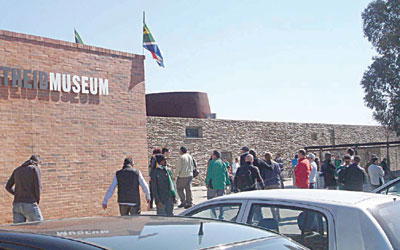
Tourists in front of the Apartheid museum. Pix by Jimoh Babatunde
By Japhet Alakam
After showing the exhibition extensively in South Africa and Mozambique, internationally renowned South African artist Cedric Nunn finally brought his one-man show to Nigeria. The documentary photography exhibition tagged Call and Response, an exhibition of black-and-white photographs by, Cedric Nunn is organised by The Ben Enwonwu Foundation (BEF) in conjunction with South African-based Galerie Seippel. The exhibition which is the artist’s first time in Nigeria was declared open on September 14 at Omenka Gallery, Lagos and will run till October 3, 2013.
Featuring over 30 real images all in black and white that captures some of the defining moments in South Africa, the travelling exhibition which has already recorded successes at other prestigious exhibition centres all over the world which is now on view finally offering Nigerians stunning images that tell the story of the apartheid system better than what many knew about it.

File: Tourists in front of the Apartheid museum. Pix by Jimoh Babatunde
For the excited Cedric, who confessed that he came into photography as a means of finding a medium to express and articulate several issues, the exhibition was put together to celebrate his 30 years engagement as a photographer. And as the title suggests, Nunn who felt he has a vocation and that he can answer its call through his photography, here, captures powerful imagery dating back to the 1970s of economic, cultural, and socio-political events in South Africa’s recent history including the civil war in Mozambique, the forced exodus of people in KwaZulu- Natal and the living conditions of the black population in Johannesburg. He has always kept human beings – and their cultural, economic, and social situation – at the centre of his creative work.
“I was particularly struck by the racism in my own mixed-race community and sought to understand this and why it was that mixed-race people were so prone to alcoholism, unemployment, broken marriages, teenage pregnancy, and other social ills” reveals the artist.
Though the pictures are elemental in a way art rarely is anymore. They seem to emerge from a place that is at once archetypal and very much of this world. Although the images are black-and-white photographs, mostly shot among the crumbling buildings, sweltering cane fields and burned-out savannas of KwaZulu-Natal, South Africa, they sometimes evoke Renaissance masterworks with their balance and quiet power.
In one stunning print, Nunn manages to capture people in his photographs in an incredibly sensitive and truthful way. For example the incredible image Deborah Eksteen and Noel Norris Visiting the Grave of Deborah´s Recently Deceased Father. In this shot he captures the whole tragedy and beauty of live. The couple, just married, is embracing each other beside the graveyard of her father. Relatives beside the scene are deeply involved emotionally. Once one has seen this image one will remember it forever.
A Tenant Farmer Family Evicted from White-owned Land from 1988 was photographed in Weenen, KwaZulu-Natal. The complete tragedy of the apartheid system is given a face in this photograph. The poor family was forced to leave their land and instead live in tents. It is a quiet but strong image for the system of oppression, similar to the photograph “Migrant Worker from the Eastern Cape on a Sugar Farm from 1987. A young black man stands with his guitar in front of endless fields of sugar cane. Cedric Nunn, or rather his photographs have given a voice to all these people.
According to Dr Ralf- P. Seippel, curator at Bailey Sieppel Gallery in South Africa, “However difficult their circumstances, Nunn manages to capture people in an incredibly humane way in his photographs. His images preserve the dignity of both his subjects and his audience:’
For Mr Oliver Enwonwu, the director of The Ben Enwonwu Foundation and curator, Omenka Gallery, “one of the reasons for bringing the show to Nigeria is the close history that South Africa shares with Nigeria. The political upheaval and events of the apartheid regime in South Africa resonate strongly with the Biafra – Nigeria Civil War from 1967 – 1970, that claimed an estimated 3 million lives.”
Continuing, he said, “through compelling but yet subtle photographs, Call and Response tells the story of a people who existed on the fringes of reckoning, and conserves a memory that is timeless as it sparks significant contemporary discourse.”
Disclaimer
Comments expressed here do not reflect the opinions of Vanguard newspapers or any employee thereof.