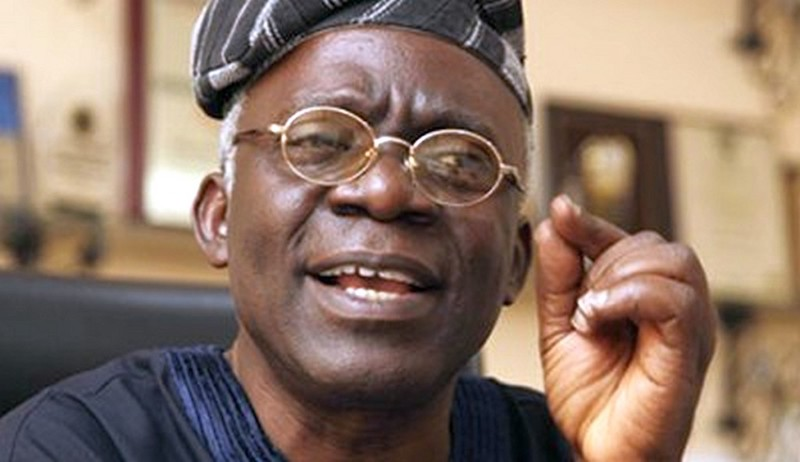
Falana
….How Buhari Administration Framed Former CJN in 2019 – Prof. Odinkalu
…Many Justices Today Are Subservient to Politicians – Akinola
….Judicial terrorism is due to specific regimes, not entire military establishment
….Christians should embrace forgiveness, nothing happens outside God’s will – Bishop Kukah
By Kingsley Omonobi
Human rights lawyer and Senior Advocate of Nigeria (SAN), Chief Femi Falana, has stated that despite the release of minors detained over a protest against poor governance, he will proceed to sue the federal government for neglecting the children’s right to education, as mandated by the Child Rights Act.
Falana made this statement at the launch of Judicial Terrorism: A Macabre Trial and Death Sentences on Major General Zamani Lekwot and 5 Others on the Zangon Kataf Crisis, a book by Mr. Richard Akinola, held at the Nigerian Army Resource Centre, Abuja.
During the event, former Chairman of the National Human Rights Commission, Professor Chidi Odinkalu, who served as Chairman, remarked that “32 years into Civil Rule, the country’s judicial system still has military parasites embedded within it.”
He explained, “When the Buhari administration in 2019 doubted its ability to control the Chief Justice of Nigeria, Walter Onnoghen, it used the Code of Conduct Tribunal to allege false asset declaration. This effectively removed the CJN, and it wasn’t until November 2024 that he was discharged and acquitted.”
Falana recounted his recent court appearance, saying, “This morning, in an Abuja court, 119 Nigerians, including 29 minors, were presented. However, the government was too ashamed to proceed in open court. The frivolous charges were withdrawn, and the minors have been released.”
“But terminating the trial isn’t enough. These young people, who should have been in school, must be rehabilitated. If the government fails, we’ll take them to court because it’s their responsibility under the Child Rights Law. Section 15 mandates free, compulsory education up to junior secondary school, and we will ensure this education is extended to senior secondary school.”
Professor Odinkalu, in his address titled “Military Terrorism in Judicial Robes,” read by Comrade Owei Lakemfa, emphasized the importance of historical memory, stating, “Richard has ensured we do not forget our history. If we forget yesterday, we cannot remember today, and our tomorrow suffers.”
Odinkalu detailed the judicial-military entanglements that have plagued Nigeria, recalling that “after the 1983 coup, military tribunals were used to settle scores, such as when three young men—Lawal Akanni Ojuolape, Bernard Ogedengbe, and Bartholomew Owoh—were executed for crimes that were not capital offenses at the time.”
Reflecting on the Zangon Kataf case, Odinkalu described it as “another example of judicial decisions being pre-determined by the regime.” He criticized the continued impact of military rule on the judicial system, where “military logic overrides justice.”
Mr. Richard Akinola echoed this sentiment, describing Justice Benedict Okadigbo’s role in the Zangon Kataf crisis tribunal as “one of the lowest moments in judicial history.” Akinola lamented that many judges today are beholden to political interests, a condition that erodes public trust in the judiciary.
Quoting Lord Denning, Akinola stated, “When a judge sits on a case, he himself is on trial,” emphasizing the need for accountability in the judiciary.
General Lucky Irabor, former Chief of Defence Staff, clarified that judicial terrorism cannot be attributed to the entire military establishment. “Misuse of power does not reflect the ethos of the military as an institution,” he said, asserting that military training does not endorse or teach abuses of power.
Finally, Bishop Hassan Kukah, who wrote the book’s foreword, urged Nigerians to unite, warning against internal divisions. “We are lucky to have a country, unlike those who suffer displacement or war. Christians must adopt a spirit of forgiveness, recognizing that nothing happens beyond God’s will,” he said.
The 114-page book, organized into seven chapters, honors General Zamani Lekwot, who attended the launch in person.
Disclaimer
Comments expressed here do not reflect the opinions of Vanguard newspapers or any employee thereof.