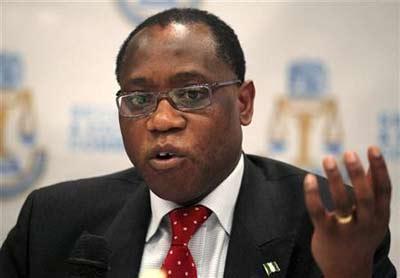
Minister of Trade & Investment, Olusegun Aganga
By Akoma Chinweoke
Nigerian economy shows the characteristic problems of underdevelopment economies, which we can attribute to failure of economic planning, ill adapted model and economic development strategies. According to some analysts, Nigeria has a disarticulated economy; it produces what it does not consume and consumes what it does not produce.
We produce crude oil and import refined petroleum products, we are blessed with large space of land and majority of our population are farmers but we import food for the teeming population. These over -reaching problems arise from the structure of the Nigerian economy, of production, consumption and industrial structure.
“Some analysts believe the Nigerian economic development process tends towards industrial strategy that was essentially based on import substitution with three policy objectives mainly (1) was to acquire technology to develop our industrial sector, (2) develop internal market through private sector to stimulate local demand,(3) to block economic leakages.
“It is important to note that during this period, the structure of the manufacturing sector in Nigeria was dominated by low technology industries – establishment of breweries, beverages, food and tobacco etc. while South Korea decided to forge its industrialization strategy policy on the development of tools and machinery equipment’s manufacturing industries”, one of the analysts said.

Minister of Trade & Investment, Olusegun Aganga
Not too long ago, the Minister of Trade and Investment, Olusegun Aganga, referred to import substitution as one of the approaches to revive our manufacturing and to achieve sustainable economic development.
Our internal systems and structure must address mode of production and our consumption pattern. The capacity of the manufacturing sector is determined by the structure and capacity of the local market. In order words, made in Nigeria products quality versus market acceptance will play an important role in import substitution strategy. The strategy must be accompanied with strong internal market structure.
If the circle is breached, it may result to internal market highly dependent importation to survive. No wonder the Nigerian economy is locked up in vicious circle of import oriented economy; any form of policy inconsistency has an adverse effect on economic transformation.
The Facts
One major fundamental fact that is affecting Nigeria’s socio-economic process which is considered as a profound social problem and economic disorderliness is the widespread pursuit of individual interests (personal accumulation and self infringe happiness). Now is the time to move to action and not empty platitudes statement of good intentions.
It is time to move from blame games, from lamentation to doing. In the final analysis, what matters most is diligence and discipline, implementation of a sound policy measures in order to deliver enhanced economic performance and improved standard of living for Nigerians.
The process of economic transformation must be built on “the common good”, it must consist primarily of a good social system, institutions, and environments on which we all depend, work in a manner that benefits all people.
It is a statement of fact that Nigeria is facing a structural economic problem that requires urgent intervention and transformation. An “economic problem” is defined as the undesirable gap between the desired economic condition and the economic actual condition.
As such, a problem is an effect resulting from the interaction of either known or unknown causes. In this particular case, Nigeria’s economic problems are known to Nigerians which is the problem of import orientation that took its origin at the formative stage of the Nigerian economy.
An analyst noted: “If Nigeria cannot manufacture range of advanced goods that we need and goods that the rest of the world needs; products like aircraft, spacecraft, electrical machinery, precision & surgical instruments, and high-quality pharmaceutical products,etc., in that case, our policy makers have to be thankful to the abundance resources and plan our economy properly.
“To transform the economy, government must address the fundamentals by deciding which sectors should grow in which places, and then aligning infrastructure, innovation, human capital, and other investments to make it happen”.
Transformation agenda should remain focused on fiscal and budgetary policies to support agric innovation, achieve greater output in food production, and improve power supply with functioning refineries. The agenda should also be committed to reviewing the educational system and adapting to national developmental stage.
When these foundations are laid, then the process of economic transformation had begun. The next stage of the Nigerian economy must be opportunity-rich as well as export-oriented, agriculture development, and innovation-fueled.
Disclaimer
Comments expressed here do not reflect the opinions of Vanguard newspapers or any employee thereof.