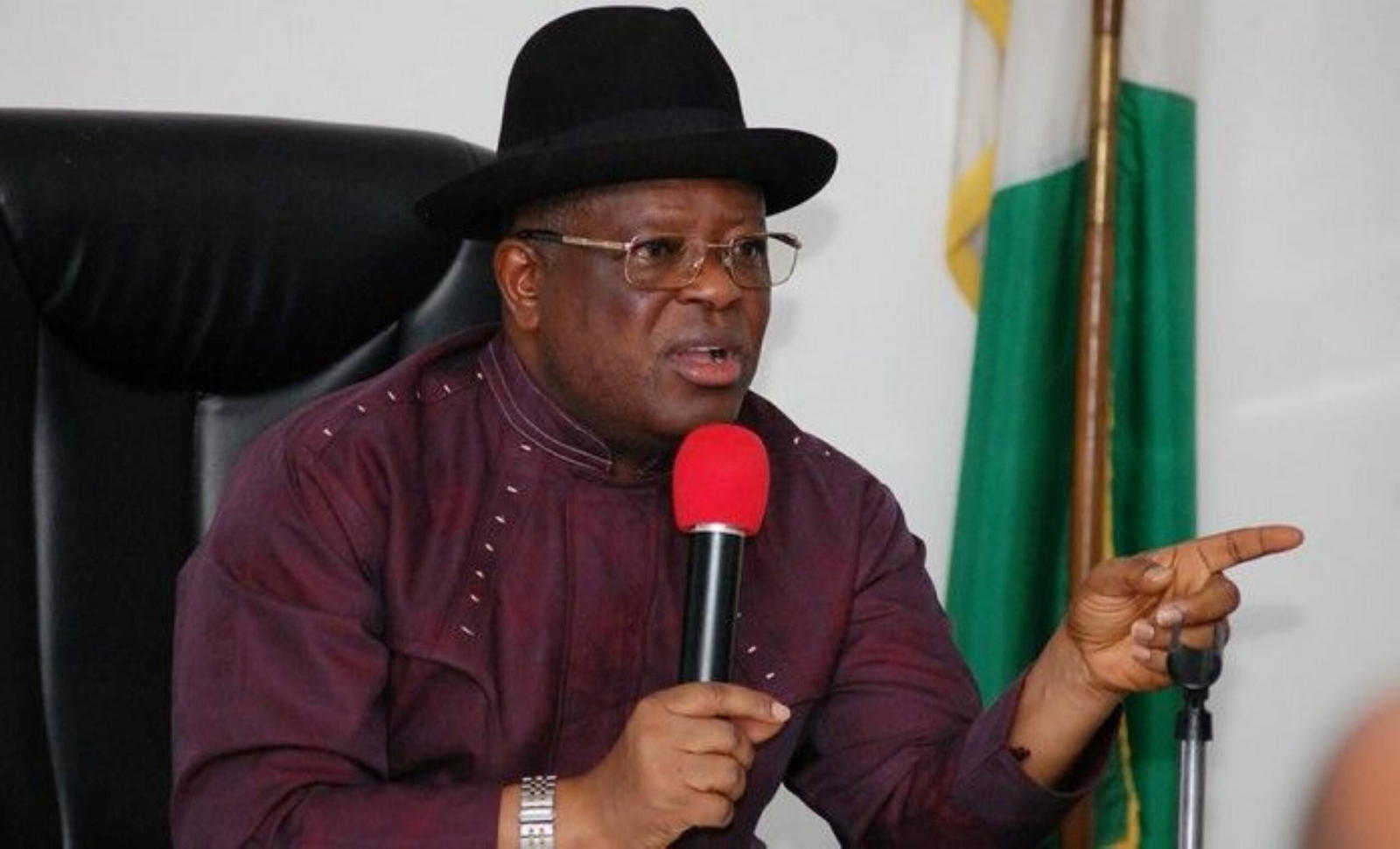
Umahi
By Chinonso Obasi
The very recent decision by the Federal High Court sitting at the Federal Capital Territory, Abuja delivered on March 8, 2022 by Justice Inyang Ekwo, has indeed troubled the political waters of Ebonyi State.
It has raised many concerns as it expressly sacked the governor, his deputy and the speaker of the State House of Assembly, Dr. David Umahi, Eric Igwe and Francis Nwifuru respectively from their offices.
Justice Ekwo in resolving the issue whether a person who was duly elected in office under the platform and candidateship of a political party can after being sworn into office defect to another political party and yet retain his position in office, held summarily that the number of votes secured during election by a candidate, belonged to the political party that sponsored that candidate and not the candidate himself, and same cannot be legally transferred to another party at defection.
READ ALSO: Gov Umahi’s undignifying outbursts
Hence, the implication of defecting to another party while in office amounts to a jettisoning of both the political party and the votes secured by the political party.
Accordingly, this decision has nettled the defendants, and as well caused several reactions in the public space. In a media conference featuring Dr. David Umahi, a defendant in the suit, declared indubitably his election to ignore the subsisting judgement of the Federal High Court on various grounds.
Alleging the unconstitutionality and nullity of the judgement delivered; electing to follow a subsisting order of court declaring him governor of the Ebonyi State; the bias of the Judge on Ebonyi State and a threat of petition to the National Judicial Council, NJC, against the Judge.
In criticising the constitutionality of the judgement of the court, Dr. Umahi posited that there are only three recognised ways through which a governor can be removed from office: by death, resignation, and impeachment by the State House of Assembly.
He stressed that the court does not possess the vires to remove a sitting governor from office. Therefore, the declaration of the court sacking him from office is unconstitutional and therefore null and void.
Declaring his intentions to ignore the judgement of the Federal High Court, he in the same breath, chose to follow another judgement of court, delivered by the High Court sitting at Abakiliki declaring him the governor of Ebonyi State.
Such piqued reaction of Dr. Umahi raises and reveals lots of concerns on the judicial process of the country and the way in which the executive arm meanly esteem the rule of law.
First, it is not in the manner of our laws or in the model of our justice system that a litigant would deliberately choose to flaunt and disobey a subsisting order of court. Albeit, openly in a media conference.
Such actions have best been characterised as “executive lawlessness” in Attorney General, Ekiti State v. Daramola (2003) 10 NWLR (part 827) 104 page 161 para H. Where a party or government is enjoined by an order of court to do a particular act, such party or government has a duty to carry out that order, and failure to do so may amount to contempt of court and is tantamount to interference with due administration of justice.
This position was upheld in Tewogbade Sons Limited v. Governor of Oyo State (1991) 2 NWLR (PART 171) 52 Page 59 Paras. G – H.
Secondly, pursuant to section 287 subsection 3 of the Constitution of the Federal Republic of Nigeria 1999 (as amended), which provides inter alia, decisions of the Federal High Court ‘shall’ be enforced in any part of the Federation by all authorities and persons. The word ‘shall’ in the above provision leaves no room for discretion in obedience of a subsisting order of court.
It is mandatory that such decision given by the Federal High Court is enforced. There exist no conditions given to a litigant or anyone permitting disregard or non-enforcement of an order of court. The word ‘shall’ denotes compulsion to action and not questions on the ‘nullity or voidance’ of the decision of court by the litigant.
Such questions on the validity of the judgement of court lies within the ambit of the appellate court to resolve and decide upon and not on the litigant.
On the issue of the constitutionality of the court’s decision in sacking the defendants from office, especially the governor, the position of the Constitution is clear on the instances that can lead to the vacancy of the seat of the governor, as prefaced particularly,under sections 180(1) and191(1) of the Constitution of the Federal Republic of Nigeria 1999 (as amended).
This includes death, resignation, impeachment, permanent incapacity or removal of the governor from office for any other reason in accordance with section 188 or 189 of the constitution, and for any other reason he otherwise ceases to hold office in accordance with the provisions of this constitution.
In the circumstance where an order of court, as in this instance, is sacking a governor from office, can it appropriately fit the scenario envisaged by section 180(1)(d) of the 1999 Constitution? The question, therefore, arises whether removal of a governor from seat by an order of court is in accordance with the spirit of the provisions of the Constitution?
Pursuant to section 6(5)(c), (6)(a)(b) of the Constitution of the Federal Republic of Nigeria 1999 (as amended), the Federal High Court possess the vires notwithstanding anything to the contrary in the Constitution, to exercise its judicial power on all matters between persons, or between government or authority and to any persons in Nigeria, and to all actions and proceedings relating thereto, for the determination of any question as to the civil right and obligations of the party.
To this end, the Constitution accords unlimited power to be vested in the Federal High for all matters, albeit within their jurisdictional limit as further prescribed in section 251 of the 1999 Constitution, to determine ‘any’ question as to the civil right and obligation of the party.
It is right to begin with the fact that the Federal High Court possesses the jurisdictional competence to entertain matters relating to the operations and interpretation of the Constitution in so far as it affects the Federal Government or any of its agencies, pursuant to section 251(1)(q) of the 1999 Constitution. The Independent National Electoral Commission being an agency of the government accords the Federal High Court jurisdiction on matters affecting its operations, which is somewhat captured in one of the prayers of the Plaintiff, the Peoples Democratic Party, PDP, being the withdrawal of the certificate of return from governor of Ebonyi State to the person nominated by PDP. Hence, the determination of
any question arising therefrom accords with the spirit of the Constitution.
Also, by a combined reading of sections 180(1)(d), 6(6)(a)(b), 251 (1)(q), and 221 of the Constitution of the Federal Republic of Nigeria 1999 (as amended), it is glaring that the decision of the Federal High Court on the question of cessation/vacation of office of the governor aligns on all fours with the spirit of the constitution. There exist no provision in the Constitution or any other law, restricting the court from determining any question on the vacation or cessation of office of the Governor.
It is against this backdrop and as minister in the temple of justice that I insist the order of the Federal High Court must be obeyed. The brazen disregard of the rule of law must stop. The Court must rise to this occasion of jealously guarding the judicial process from being ridiculed and scandalized, especially by the folks in the executive arm of government, as held by the Supreme Court in a very recent decision, Ezenwo v. Festus (no. 1) (2020) 16 NWLR (part 1750) 324 page 341 para c.
Obasi, a legal practitioner, wrote from Abuja
Disclaimer
Comments expressed here do not reflect the opinions of Vanguard newspapers or any employee thereof.