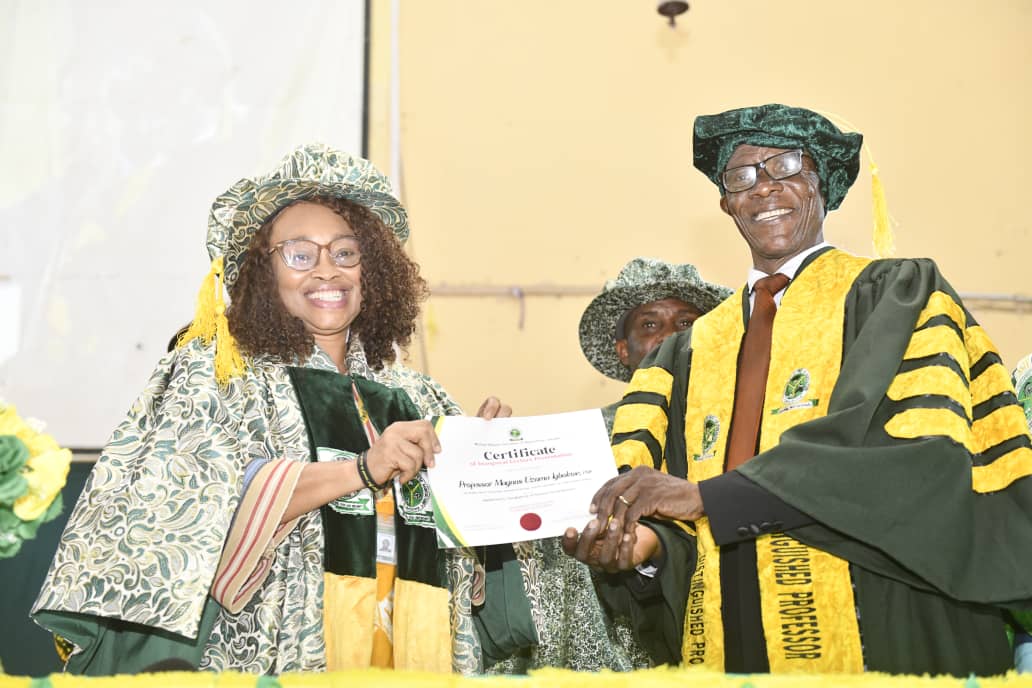
By Steve Oko
UMUAHIA — A Professor of Geophysics at the Michael Okpara University of Agriculture, Umudike (MOUAU), Prof. Magnus Igbokwe, has called for mandatory geophysical studies before borehole drilling, road construction, erosion-control projects and the construction of multi-storey buildings.
Igbokwe made the call while delivering the university’s 74th inaugural lecture, titled “Geophysics: The Bedrock of National Development.”
He warned that failure to investigate subsurface conditions before undertaking construction and water projects could result in structural failures, groundwater contamination and wastage of public resources.
The don also urged governments to adopt modern landfill systems and locate dumpsites away from residential areas to prevent leachate from contaminating underground water.
He advocated carbon capture and storage in the Niger Delta, as well as the use of carbon dioxide for Enhanced Oil Recovery to increase crude oil production from existing reservoirs.
Igbokwe said his research had identified thick aquiferous zones in Umuohu-Ahiaeke and the Old Timber area in Abia State, as well as Uhuala Aku in Okigwe, Imo State, using electrical resistivity methods.
According to him, Electrical Resistivity Tomography (ERT) had also helped identify erosion-prone areas, groundwater contamination and saltwater intrusion.
He said magnetic and aeromagnetic surveys had revealed areas with high geothermal gradients suitable for power generation, while studies showed that MOUAU’s geological setting was suitable for multi-storey structures.
The don advocated regional groundwater schemes covering Olokoro, Umudike and Umuohu in Abia State and Uhuala Aku in Imo State to curb indiscriminate borehole drilling and provide affordable potable water.
Igbokwe further recommended the establishment of a geothermal power plant at Okorroba in Akamkpa Local Government Area of Cross River State, citing its high geothermal gradient and potential to support the national grid.
He urged investors to explore kaolin deposits in Ohiya and other mineral resources in Abia State while complying with relevant regulatory requirements.
The don also called for greater deployment of Artificial Intelligence and emerging technologies, including Surface Nuclear Magnetic Resonance, Audio-Magnetotellurics, Transient Electromagnetics, ERT, magnetic surveys, remote sensing and Geographic Information Systems (GIS).
He said the technologies would improve groundwater exploration, mineral mapping, disaster-risk assessment and subsurface imaging.
Igbokwe stressed that investment in modern geophysical technology, research and skilled manpower would help save lives, protect the environment and prevent costly infrastructure failures.
Geophysics can curb road failures, water contamination — VC
The Vice Chancellor of MOUAU, Prof. Ngozi Akanwa, said geophysics could help Nigeria address road failures, groundwater contamination, erosion, energy and mineral-development challenges.
Akanwa said Nigeria had barely scratched the surface of its vast underground resources, stressing that geophysical studies before road construction could help prevent premature failures and identify safe groundwater zones.
She also highlighted the application of geophysics in oil and gas exploration, electricity generation, erosion control and mineral development.
The Vice Chancellor welcomed Igbokwe’s advocacy of carbon sequestration to reduce carbon emissions and combat global warming, describing the lecture as a roadmap for national development.
She said Nigeria must deploy science and technology to unlock its underground resources, while reaffirming the university management’s commitment to sustaining the inaugural lecture series as a platform for developing practical solutions to societal challenges.
Disclaimer
Comments expressed here do not reflect the opinions of Vanguard newspapers or any employee thereof.