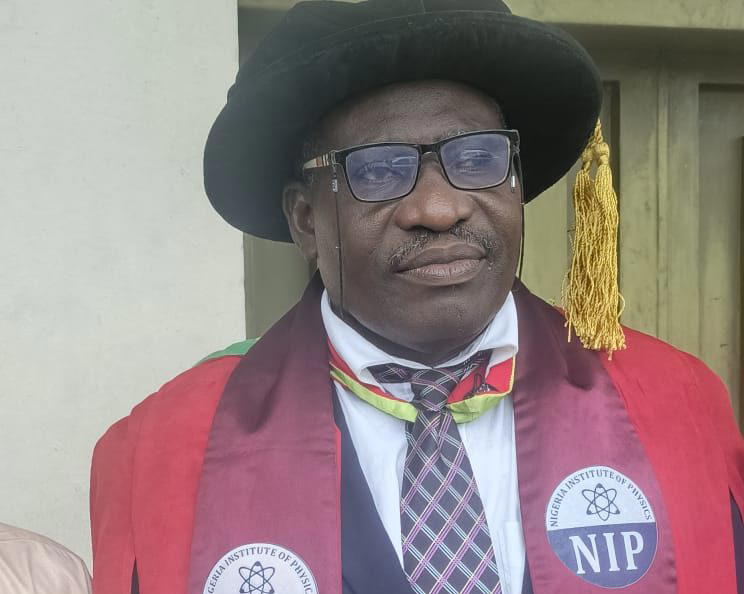
By James Ogunnaike, Abeokuta
A Professor of Applied Geophysics at Olabisi Onabanjo University (OOU), Ago-Iwoye, Professor Joseph Olakunle Coker, has warned that Nigeria is losing billions of naira annually to failed boreholes, unsafe construction practices and poor environmental planning due to the failure to conduct geophysical investigations before executing major projects.
Coker, who is also the National President of the Nigerian Institute of Physics, spoke with journalists on Tuesday after delivering the 129th Inaugural Lecture of Olabisi Onabanjo University, titled, “Unraveling the Earth’s Subsurface Incidentals and Treasures: The Wonder of Geophysical Tools.”
He said the lecture was aimed at creating awareness about the importance of geophysics and its critical role in driving sustainable national development.
According to him, one of the greatest contributions of geophysics is in groundwater exploration, noting that many Nigerians drill boreholes without first carrying out geophysical surveys, resulting in widespread failures.
“The thrust of the inaugural lecture is to make a positive impact on society by creating awareness of what geophysics is and how it can contribute to national development.
“Over the years, many people have simply chosen locations to drill boreholes without conducting a geophysical survey. As a result, many boreholes fail. During the rainy season, there may be water, but by the dry season, around January or early February, the boreholes dry up because the proper survey was not carried out.
“If a geophysical survey is conducted beforehand, we can identify the presence of aquifers and determine the appropriate depth for drilling, thereby reducing the risk of failed boreholes,” he said.
The professor disclosed that findings from one of his assessments revealed that more than half of the boreholes in a community had failed because geophysical investigations were not conducted before drilling.
“Based on one area where I carried out an assessment, there were over 30 houses, and more than 15 of the boreholes had failed. We discovered that many of these failures resulted from the absence of a geophysical survey before drilling.
“Depending on the terrain and location, drilling a borehole may cost between ₦1 million and ₦2.5 million. If 15 boreholes fail at an average cost of ₦2 million each, that represents a loss of about ₦30 million in just one community.
“When you consider the situation across Nigeria, the losses amount to billions of naira. Ironically, a geophysical survey often costs less than ₦100,000, making it a worthwhile investment that can prevent these costly failures,” he added.
Coker also linked the increasing cases of structural failures in parts of the country to the neglect of geophysical investigations before construction.
According to him, erecting multi-storey buildings on unsuitable soil without first examining subsurface conditions exposes such structures to eventual collapse regardless of the quality of construction materials used.
“Some people build two- or three-storey buildings without first conducting a geophysical survey of the land. If an engineering structure is built on unsuitable soil, such as clay, the building is at risk of structural failure regardless of the quality of the building materials.
“Even with strong blocks and quality cement, a weak foundation will eventually lead to problems,” he warned.
On the nation’s economy, the geophysicist urged the Federal Government to prioritize the development of Nigeria’s solid minerals sector, describing it as a viable alternative source of revenue capable of generating billions of dollars.
“Nigeria should pay greater attention to the solid minerals sector. The country is developing rapidly, and mining can provide an important alternative source of revenue.
“We have abundant untapped solid mineral resources across the country, and developing this sector could generate billions of dollars for the nation,” he said.
The don further expressed concern over the indiscriminate siting of waste dump sites across the country, warning that many were established without proper geophysical investigations, thereby posing serious threats to public health.
He explained that rainwater filtering through refuse generates contaminated liquid known as leachate, which can seep into the ground and pollute groundwater sources used by surrounding communities.
“Most of the dump sites we have today were established without conducting geophysical investigations. Over time, rainwater passes through the waste and produces what we call leachate. This contaminated liquid contains pollutants from paper, plastics, metals and other waste materials. As the leachate infiltrates the ground, it can move through fractures and permeable layers in the subsurface until it reaches groundwater sources such as wells and boreholes”.
“When people consume contaminated groundwater, it poses serious health risks,” he stated.
Coker called on governments at all levels to make geophysical investigations compulsory before approving borehole drilling, major construction projects, mining activities and waste disposal sites.
“The government should regulate and properly manage the establishment of waste dump sites. Before any location is designated as a dumpsite, a geophysical survey should be conducted to determine its suitability.
“Where dump sites have been established without proper investigation and pose a risk to groundwater, the authorities should take appropriate action, including closing such sites where necessary,” he said.
Disclaimer
Comments expressed here do not reflect the opinions of Vanguard newspapers or any employee thereof.