By Victor Ahiuma-Young
The clamour for the reinstatement of gratuity payments to workers upon retirement has become a subject of intense agitation by organized labour in recent times.
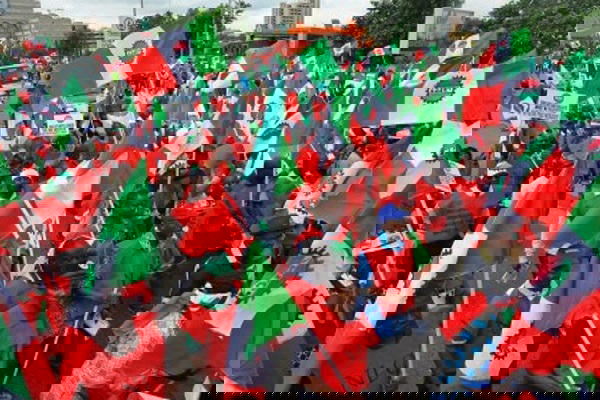
The restoration of gratuity payments was one of the key takeaways from last Thursday’s national May Day celebration at Eagle Square, Abuja.
Addressing workers and other dignitaries, including government officials and diplomats, leaders of the Nigeria Labour Congress (NLC) and the Trade Union Congress of Nigeria (TUC) demanded the immediate restoration of gratuity payments to workers.
The Presidents of the NLC and TUC, Joe Ajaero and Festus Osifo respectively, in a joint statement, also called for an upward review of the retirement age in the public service.
They urged the “immediate payment of all outstanding allowances, pensions, and gratuities across the nation; and the restoration of gratuity payments. Public servants who served diligently for decades deserve a dignified exit, just like political office holders who serve for much shorter periods.”
The NLC and TUC also demanded an “upward review of the retirement age. It is imperative to extend the revised retirement age of 65 years or 40 years of service — currently enjoyed by teachers, health professionals, and judges — to all public servants; an end to dehumanizing verification exercises in the public service; an acceptable national minimum pension to guarantee dignity in retirement; and automatic adjustment of pensions to reflect inflationary trends.”
Elaborating on the issue of gratuity, the NLC and TUC stressed the need to reactivate gratuity payments to public servants, explaining that “the concept of gratuity payment to employees can be likened to the proverbial golden handshake from their employers. Gratuity is a monetary benefit from an employer to an employee at the time of retirement.
“Public service employees were receiving gratuities until the 2004 Pension Reform Act (PRA), which was silent on gratuity payments. As a result, both the federal and state governments stopped the payments. “Meanwhile, private sector employers are still paying gratuities to their employees. We call for a reactivation because Section 173 of the 1999 Constitution, as amended, provides for the right of a person in the public service of the federation to receive pension and gratuity. After all, political office holders continue to receive terminal benefits.”
A misnomer
At the 2024 May Day celebration, the Chairman of the State Council of the TUC, Gbenga Ekundayo, among others, said: “We want to bring to your (Governor) attention the issue of gratuity payments. The Pension Reform Act (PRA) of 2014, as amended, did not abrogate the payment of gratuity. Prior to the PRA 2014, when a public servant retired, he was entitled to gratuity and pension under the Defined Benefit Scheme (DBS). Now, with the introduction of the Contributory Pension Scheme (CPS), the government no longer pays gratuities to retired public servants. If you go through the PRA, it does not prohibit gratuity payments.
“Unfortunately, when you look at the Political and Judicial Officers Act 2008, these officers are entitled to gratuity. Someone who serves in the House of Assembly, National Assembly, as a Minister, Commissioner, Governor, President, or even as a Permanent Secretary is entitled to receive gratuity. Imagine that someone who served for four years is entitled to gratuity, while someone who served for 35 years is not. This is clearly a misnomer.
“If you refer to Section 173, Subsection 2, of the 1999 Constitution, public servants are entitled to gratuity. Not adhering to this can be described as a constitutional violation. What joy could possibly be derived from depriving committed workers of such entitlements?
“It is disheartening that the government does not pay gratuities. We are therefore calling on the state government to commence the payment of gratuity to its retirees.”
Disclaimer
Comments expressed here do not reflect the opinions of Vanguard newspapers or any employee thereof.