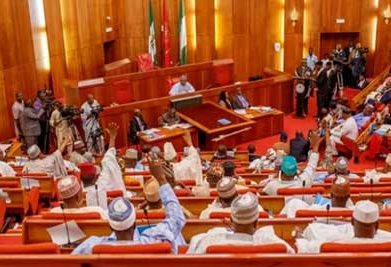
File image of the Nigerian Senate.
By Henry Umoru
Abuja — A bill seeking to regulate and formalize the employment of domestic workers, apprentices, interns, and other informal sector employees in Nigeria has scaled second reading in the Senate.
The bill also aims to empower the National Directorate of Employment (NDE) to license and monitor privately owned employment agencies. These agencies will be tasked with enrolling workers in a central database, ensuring their social security, and supervising their recruitment under legally agreed terms and conditions.
Titled “A Bill for an Act to Regulate and Formalize the Employment of Domestic Workers, Apprenticeships, Interns and Other Informal Sector Employees and to Empower the National Directorate of Employment to Issue Licenses and Monitor Privately Owned Employment Agencies in Nigeria, and for Other Related Matters, 2025 (SB. 629),” the proposed legislation is sponsored by Senator Sani Musa (APC, Niger East).
Following the debate, Senate President Godswill Akpabio referred the bill to the Senate Committee on Employment, Labour and Productivity for further legislative input, with a directive to report back within six weeks.
Leading the debate on the general principles of the bill, Senator Musa said the legislation seeks to address long-standing issues in Nigeria’s informal labour sector, which includes a wide range of unregulated jobs typically characterized by low wages, unsafe working conditions, and a lack of social protections.
“The informal sector is often a residual labour market where income is not largely wage-dependent, working time is discretionary, and some jobs go unpaid,” Senator Musa said.
“This bill is designed to correct the decent work deficit by promoting fair treatment, decent remuneration, and protection of workers’ rights in line with International Labour Organization (ILO) conventions to which Nigeria is a signatory.”
The bill mandates the NDE to issue licenses to employment agencies that meet specific criteria, including proper registration, financial accountability, and a clean legal record.
Agencies must maintain proper documentation and records of both staff and operations.
Licensing officers will be appointed by the NDE to oversee and enforce compliance within designated jurisdictions.
The law seeks to standardize employment terms in the informal sector and protect workers from abuse and exploitation.
Senator Musa emphasized that although the informal sector serves as a safety net for millions of skilled and unskilled Nigerians, current labour practices in the sector fall short of international best standards.
“This bill is a significant step toward formalizing the informal labour market and ensuring decent work conditions for millions of Nigerians. It also aims to improve data collection, workforce planning, and social security coverage for informal workers,” he added.
If enacted, the bill is expected to promote employment rights, enhance job quality, and foster inclusive labour market practices across Nigeria.
Disclaimer
Comments expressed here do not reflect the opinions of Vanguard newspapers or any employee thereof.