By Marie-Therese Nanlong, JOS
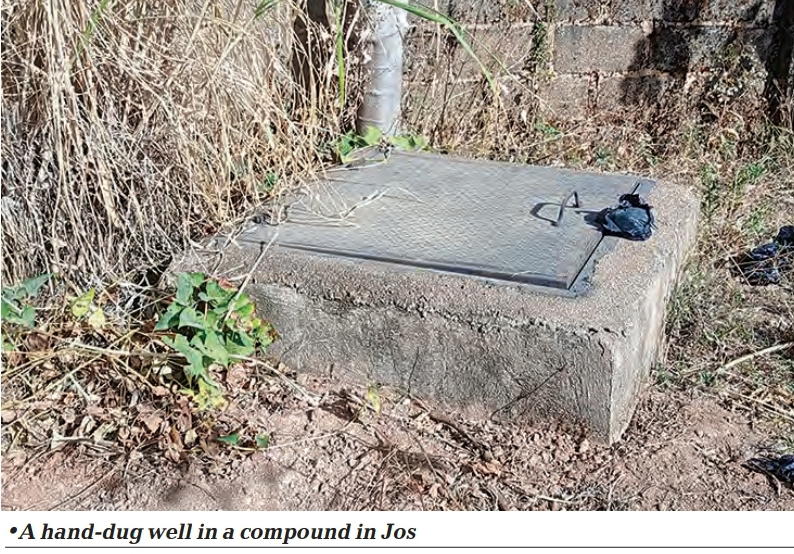
Kim Davou, a 42 years old man from the Shen community in the Jos South Local Government Area of Plateau State, digs water wells for homes around his community.
Read Also: 2024 review: N2.7trn GenCos debt, endless grid collapses ruin FG’s 6,000MW plan
In the last decade, new residential areas have emerged in the community and other neighbouring ones and he has had more contracts to dig water wells for the new homeowners, sometimes getting more than three such requests monthly.
Before now, Davou explained that the time to get one’s well dug was between March and April, and the depth of the well, depending on the area, would be between 30 to 33 feet deep, but he added that the pattern has changed for some reasons he could not understand.
“A few years ago, we used to dig water wells between March and April, and to get water that will sustain a family all year, we dug between 30 to 33 feet deep,” he said. But in the last three to five years, he added, “the ground has become very dry and hard so we now start digging anytime from January, February and go as deep as 35 to 37 feet before we can get enough water for household use.”
Also, a geologist, Kassam Gaktuwe, the Managing Director of Benian General Services Limited, a borehole drilling company shares experiences of the challenges of getting underground water in Jos.
Kassam, a Plateau State contact person for Daibau Nigeria, a group of borehole drilling experts with about 14 years of experience, said: “Before now, drilling boreholes in most parts of Jos was within 25, 30, and 35 meters. If you go beyond 30 meters, it is assumed that there’s no water.
“With the advent of the Indian machines, which could go deeper, we started drilling deeper to about 80 to 100 meters and you would get water. But these days, at 100 meters, you will not get water even in places that you used to get around 100.
“There’s a particular incident: we drilled a 100 meters borehole along the Rukuba Road and they’ve been using the water for about five years, but last year, the water just went dry.
“Although a lot of places have been affected, we have a few places where water is still very much accessible, and you don’t have to go very deep. But generally, things have changed. Where you used to get water at, say, 10 meters, now it has gotten to maybe 15 or 20 meters.”
What caused it?
Kassam opined that: “Climate Change is affecting the aquifers. We discovered in the last two, or three years, that when you are drilling, the aquifers are there where they are supposed to harbour water, but they are empty. This year, we have to go sometimes beyond 150 meters before you begin to get water, and the deeper you go, the costlier it also becomes to get water.”
The high cost of getting water affects homeowners
Manual water well drillers measure in feet, while machine borehole drillers measure in meters, and three feet is a meter.
Davou said he used to charge between N14,000 and N30,000 to dig depending on the measurement, adding: “Now we charge between N150,000 to N200,000 because you can’t say at what feet you will get enough water.”
To Kassam: “The cost of drilling now has gone almost four or five times what it used to be. Before now, you would drill a borehole at N2,500 per meter, but currently, it is at N14,000 or N15,000 per meter. Now, imagine drilling 150 meters at, say, N15,000 on average; that is much. You’ll be talking about two point something million.”
We need a collective responsibility to reverse the effects of climate change — Expert
Meanwhile, a Water Resources and Environmental Engineering Consultant, Dr. Meshach Alfa, is optimistic that the effects of climate change could be reversed through collective responsibility.
Alfa, the Head of the Department of Civil Engineering at the University of Jos and the Jos Branch Chairman of the Nigerian Society of Engineers, NSE, noted that the advancements in technology and developments have significantly shaped humanity’s interaction with the earth and the productive capacity of the earth is not unlimited.
His words: “Many of the resources we draw from the environment are not renewable. The rate at which we harvest some of the resources is way faster than the ability to regenerate. Sustainable development, therefore, requires an integrated approach that considers environmental concerns along with economic development.
“With the increasing threat of climate change, concrete efforts must be made to ensure development today does not negatively affect future generations. Climate change does not just present environmental risks but also a risk to global political stability, infrastructure, water resources, and food security.
“Given that climate change is one of humanity’s biggest challenges of the 21st century, and its effects are already being felt around the world, we must commit to playing a part in reducing its impacts.”
He advocated the use of clean and renewable energy, walking, biking, using low-carbon or zero-emission vehicles, reducing meat consumption, less flying, changing agricultural practices, limiting deforestation, and planting trees.
Why should we care?
Davou, the ordinary water well digger, has seen the impact but does not understand the cause, and Alfa explained: “Climate change is a tragedy of common occurence; you cannot exempt yourself no matter your status in society. If we don’t come together as stakeholders to do something, we will all be done for it in no distant time from now.
“It is now critical for us to strongly advocate for integrating the global warming and climate change problem in the plan for infrastructure and systems development. It should serve as an important factor in the construction of future highways, bridges, water or wastewater plants, buildings, ports, harbours, energy production systems,” Alfa said.
Disclaimer
Comments expressed here do not reflect the opinions of Vanguard newspapers or any employee thereof.