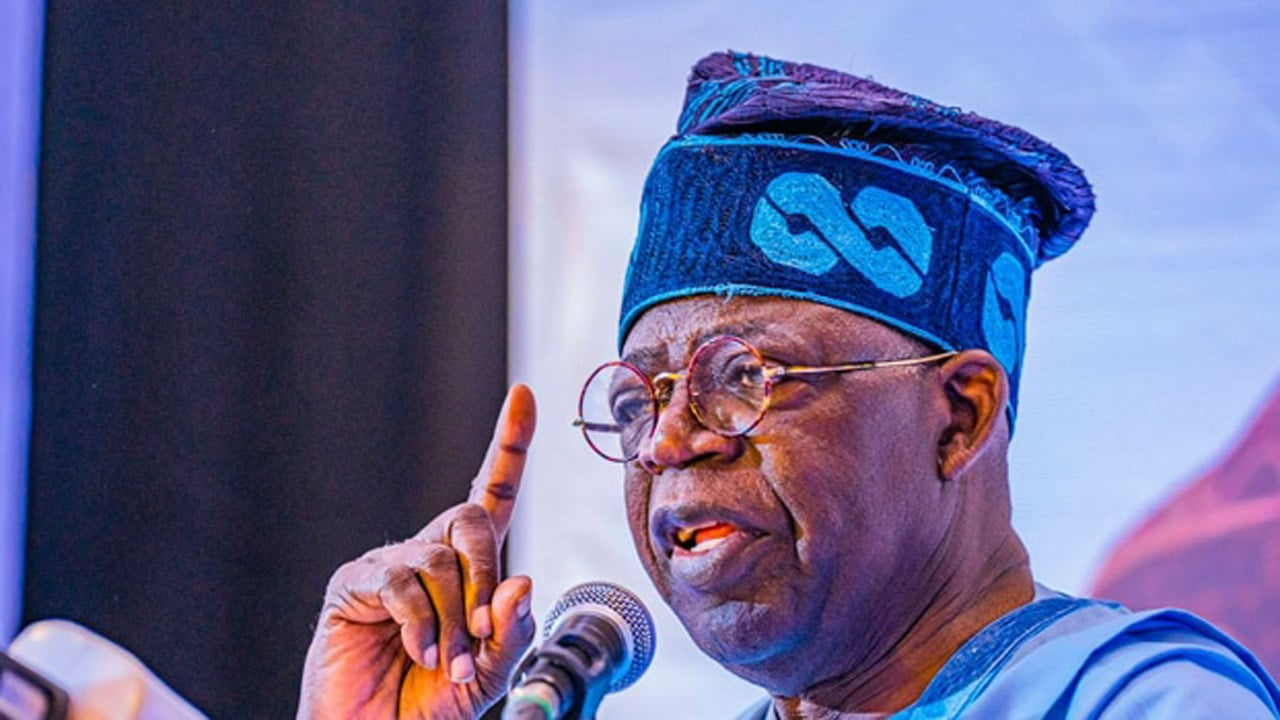
President Bola Tinubu
President Bola Tinubu has said that Nigeria is committed to efforts against climate change through a cooperative approach.
He made this known in an opinion article published on CNN on Tuesday where he enumerated how Nigeria has upped her game in tackling adverse effects of climate change.
Tinubu said security threats, the dislocation of people, the environmental atrophy and other collateral impacts of climate change were at the forefront of his mind during his participation at the COP28 World Climate Action Summit in Dubai, United Arab Emirates.
He wrote: “COP28 marked a critical milestone with the first Global Stocktake on implementing the Paris Agreements, a comprehensive review and inventory that allows each country to assess its progress in reducing emissions and achieving climate goals.
“Nigeria, Africa’s largest economy, has battled back against major obstacles, including the impact of the COVID-19 pandemic, short-term challenges from economic reforms, and the ongoing unification of foreign exchange rates. However, we remain steadfast in our resolve to reconstruct a better, cleaner nation despite these challenges.
“To uphold our legally binding commitment to a cleaner world, Nigeria launched the Nigerian Carbon Market Initiative at COP28 by joining the African Carbon Market Initiative.
“The Intergovernmental Panel’s Sixth Assessment Report released earlier this year underscores the inadequacy and slowness of global efforts against climate change. It remains clear that developing nations, despite contributing minimally to the problem, endure most of its impacts. We all want to solve the problem, but too few of us are currently willing to do our fair share.
“The rapid loss of water resources and the escalating rate of desertification are closely tied to the Sahel crisis, which is characterized by the emergence of extremist and authoritarian elements.
“The startling loss of 90% of Lake Chad over the past three decades is a perfect example of this. We seek urgent international collaboration in both financing and technology toward the total recharge and recovery of this critical body of water.
“Together, with one voice and coordinated action, we can stop the desert from consuming Nigeria’s vast arable land, displacing communities, and causing food insecurity and social dislocation that often erupts into violence.
“In southern Nigeria, rising ocean levels threaten coastal areas. Throughout the nation, flooding kills hundreds of innocent civilians and decimates farmlands, towns, and villages, all while rendering tens of thousands of our people homeless.
“Nigeria has taken significant steps and acted decisively in enacting the Climate Change Act and committing to net-zero emissions between 2050 and 2070.
“However, challenges persist as energy and food crises caused by conflicts in Europe and the Middle East have weakened the willingness of wealthy nations to fully cooperate with less developed economies. This affects the ability of less developed countries to pursue national plans for achieving net zero emissions, even when those plans are detailed and achievable.
“Africa’s most populous nation has successfully mobilized tens of thousands of youths nationwide to plant 250,000 trees annually to honor a pledge to plant 25 million trees by 2030 as we build our great green wall to fight back against encroaching desert across the northern region of our nation.”
He said in recent weeks, Nigeria has signed agreements that are critical to reducing one of the major ways the country contributes to global greenhouse gases.
He further called for partnerships for a new green economy in Africa saying, “African countries simply cannot travel on this road alone. There must be a fair and cooperative approach. For too long, too many developed nations have hesitated to do what they should.
“But the time for watching and waiting is over. Developed nations must honor commitments in the form of significant contributions to the Loss and Damage Fund and the $100 billion annual climate financing pledge.
“In September, African countries embraced the Climate Positive Growth paradigm at the Africa Climate Summit in Kenya. We envision Africa becoming the leading green manufacturing hub globally, with targeted financial support and access to global markets.
“Nigeria and much of Africa possess a unique advantage — we do not need to decommission coal-fired power plants. We have an unparalleled opportunity to leapfrog decades of conventional, high-emission industry by building our industrial future on a new green foundation.
“The world faces a stark choice: prioritize the economic status quo or genuinely reduce dangerous emissions. This is a crucial moment.
“Choosing equity and justice in the global economy offers a chance to right past wrongs, save the planet, and create a better future for all. It is time to seize the moment.”
Disclaimer
Comments expressed here do not reflect the opinions of Vanguard newspapers or any employee thereof.