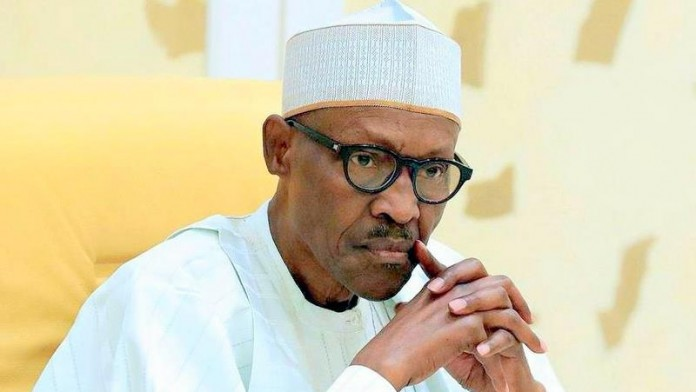
Ex-President Muhammadu Buhari
By Adekunle Adekoya
LAST Tuesday, President Muhammadu Buhari told a stupefied nation that he had delivered on his change agenda. He spoke at the inauguration of a new housing estate in Zuba, Abuja. While presenting keys to new home-owners, the president said the new housing estate was addressing multidimensional poverty as the beneficiaries had “taken a step up on the ladder of prosperity and away from poverty”.
“I convey my hearty congratulations to the new homeowners in this estate. Our promise of change has been fulfilled for you,” Buhari added.
It is incredulous for the president to claim that one single housing estate is an indication that the promise of change made in the electioneering season of 2014-2015 has been fulfilled. The estate in question is a N9.5bn affair, developed on 18.5 hectares of land, consisting of 16 blocks of three-bedroom flats in a block of eight flats, 32 blocks of two-bedroom flats in a block of eight flats; 14 blocks of one-bedroom flats in a block of 16 flats and five blocks of terrace duplexes in four rows. What impact could this have made on the housing crisis in the country?
It is imperative to remind the president that the change agenda of his party, on which he rode to power did not go beyond mere sloganeering. I am of the opinion that the concept of change, with which the former opposition party hoodwinked the electorate and snatched power from the ruling party was neither articulated nor developed into a working idea that could have changed Nigeria. In 2014-2015, Nigerians craved change.
They wanted it. They had grown weary of the quicksand template of governance on which the country had been running since 1999, and when the opposition party shouted “change!”, it was all Nigerians needed to boot out the ruling party, in the expectation that perhaps, Nigeria would be made to work again in their interest, and not just the interest of the oligarchs and their compradores that had fed fat on her endowments for decades. If we need change, what did we need to change from, and into what?
This needed to be articulated properly and working documents developed to deliver the desired change in virtually all aspects of national life and sectors of the economy, be it in the way we do things, how we relate with each other, how we conduct ourselves in the public space, and so on. It should also have spelt out how our educational system should run, how the oil and gas sectors should function, how the maritime sector should operate, how the road transport sector should run, and so on and so forth. But all we got were mere slogans. At every rally, broom-wielding politicians, the president inclusive, merely shouted “APC!!!”, and the crowd of attendees bellowed “Change!!” in reply.
Nobody had any idea what we were to change from, and into what. Meanwhile, the president’s predecessor had been described as “clueless”, but this actually was the take-off of the present administration’s cluelessness. As such, a golden opportunity to radically redeem the Nigerian nation was frittered away. The cluelessness was so deep that that it took President Muhammadu Buhari nearly five months to constitute a cabinet after swearing-in.
Nigerians wanted a change from a situation in which as an oil-producing country, we would stop importing refined petroleum products. But what did we get? Not only was it impossible to make any of our four refineries work in eight years, the subsidy regime inherited from the previous administration grew more opaque and ballooned under Buhari.
We also thought that as a retired general who had “given the Chadians a bloody nose” while in service, the nation would have a firmer grip on the insecurity situation. But we were set for a massive disappointment. Not only did insecurity worsen under Buhari, criminal activities actually became billion-naira businesses under his watch as the armed services seemed impotent at curtailing criminality.
In the education sector, the nation witnessed one of the longest university system shut-downs in our history as the Academic Staff Union of Universities, ASUU, went on strike for a grand 10 months, leading to the loss of one full academic session by students in public universities. Smuggling worsened, while the border agency whose mandate it is to check smuggling opted to operate within the country, away from our borders. The agency’s head was even temerarious enough to, at one time, suggest an increase in the pump price of petroleum products as a way of discouraging smuggling! All these, and more, under Buhari. If indeed he has delivered on the change agenda, I must say it is not the change for which he was elected. It is also not the change that the ordinary Nigerian craved. In fact, from the president’s recent utterances regarding his performance in the last eight years, we’re not on the same page. He must be seeing and feeling things we don’t see or feel. Or else, how can somebody that assumed office when a bag of rice sold for N7,000 and is leaving office when the same bag of rice now sells for N41,000 say he is leaving Nigeria better than he met it? We don’t live in the same country, do we?
Disclaimer
Comments expressed here do not reflect the opinions of Vanguard newspapers or any employee thereof.