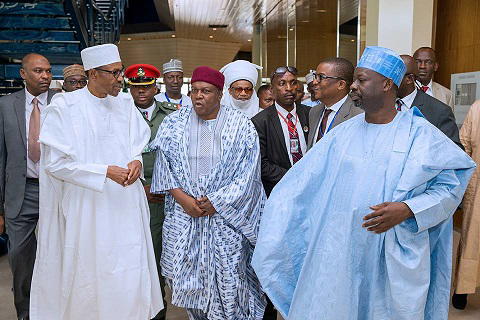
President Buhari receives Leadership 2015 Man of the Year Award from Former President Abdulsalam Abubakar flanked by L-R: Governor of Akwa-Ibom State H.E. Udom Emmanuel, Representative of Goodluck Ebele Jonathan Mr Tanimu Turaki, Chairman Leadership Group Sam Nda-Isaiah at Transcorp Hilton Hotel Abuja on 6th October, 2016.
By Muyiwa Adetiba
The President advised all of us at the recently concluded Economic Summit to start patronising made in Nigeria products. I am sure many Nigerians in this harsh economic climate will not need too much prompting if the products are available and affordable. It is both patriotic and prudent to so do.
Government’s role in this endeavour is two folds as I see it. The first is to create an enabling environment for Nigerian products to be viable and competitive. The second is for them to patronise Nigerian products whenever and from wherever. I am talking about hardware like cars, roads, bridges, curtains, furniture down to software like training, consultancy and IT.
There should be a conscious and deliberate effort to increase local content in government endeavours and purchases. Fifty-six years after independence, many of us still think the white man is inherently superior to us. Not only do we buy their products at the expense of ours, we accord them respect and positions that are largely unearned. I have friends who put whites and even Asians in prominent positions because ‘they get results.’
Unfortunately, in the week that the President asked us to look inwards, he personally brought in a ‘foreign product’ and launched it with fanfare. The who is who in Nigeria jostled for seats as they came to witness the launch of a book titled: ‘Buhari— The Challenge of Leadership in Nigeria.’ It was written by Professor John Paden, a white man.
I came across a copy within three days of its launch and was able to flip through—it is a small book written in simple prose. There was no part of that book from my point of view that could not have been written and produced in Nigeria, by Nigerians.
If the eminent personalities who attended the event understood the absurdity in importing a foreign writer to write a simple, straightforward book, they were silent. When will our leaders realise that it is not what you say but what you do that gives you credibility.
It is not to the credit of the writer— or the book—that allegations of inaccuracies dogged the book even before it had been fully read and digested. Two issues are simmering at the moment and more will still simmer as the book goes round—if it goes round. I was with a group of veteran journalists when I glimpsed the book and the phones were buzzing.
The account of how Prof Osinbajo became the Vice President had unsettled some people and different meanings are being read on the intent of the foreign writer. Was he misinformed and was too sloppy to fact check or was he simply told what to write? Whatever.
The inescapable fact is that Senator Ahmed Tinubu played a far more prominent role in the formation of APC and the emergence of General Buhari as President than all those who emerged from the woodwork to grab the structures of power.
Any account that does not acknowledge that singular fact loses credibility. If the reason as being adduced by some, is to cut Tinubu to size, then those doing it might actually be doing him a favour because you can no longer associate him with a failed administration if his input has been so openly ignored and disdained.
Already, some groups are hinting that this administration would have been more dynamic and cohesive if Tinubu had been given a greater say. It would also they say, have been more socially relevant alluding that those who have captured power are too cocooned in the past to lead all sections of the country into the future. The second simmering issue is the account of the coup.
Some of the dramatis personae are still alive and one or two of them apparently believe that the book’s account of the events surrounding the coup is not the accurate one. A book of this stature should be painstakingly fact checked if it is not to be seen as self-serving.
It is easy to lose credibility and stature when you are self-serving as our judges have just found out. Who would have thought 30, 40 years ago, that Supreme Court judges could be arrested in the dead of the night and thrown into detention.
(The only thing left to complete the embarrassing picture was to put them in handcuffs.) But the judges of that era carried themselves with the dignity that their jobs entailed. They prided themselves in being erudite and brilliant and gave judgements with posterity in mind.
Those judges didn’t give judgement that they knew could not stand the test of time. They didn’t throw ‘owanbe’ parties not to talk of compromising themselves by receiving money for the burial of a dead relative from a senior lawyer that had one or two cases before them.
I once heard of a top, top Judge—now retired—who had what can only be described as an unholy relationship with a multi-national company. Once a year, the company gave him a first class ticket, gave him FX to spend, paid for his hotel accommodation and arranged for a chauffeur-driven car at the airport in the UK. What do you think would happen if anybody took that company to court?
For years, the nation has been talking about corrupt judges. Instead of being taken out of the system, they get promoted. Many of the corrupt judges become chief judges, and many of the corrupt lawyers become SANs. They become filthy rich with houses at home and abroad.
The judiciary is supposed to be the bastion of democracy, the last hope of the common man. Yet it had become so warped; so obviously dysfunctional. The worst cases are the political judgements. It never occurred to these judges that by favouring the highest bidder, they are subverting democracy and the will of the people, subverting the constitution and breaching national security.
I am not really surprised that SANs have come out in protest. After all, they are the greatest beneficiaries of the status quo. It doesn’t matter that young lawyers no longer win cases on the strength of their arguments and the position of the law. It doesn’t matter that straight judges don’t go far on the bench.
It doesn’t matter that the legal system is tedious and frustrating and often gives justice to the undeserving. It doesn’t matter that our judiciary has become a laughing stock in many countries. What matters to them is business, their unholy business, as usual.
I really don’t know whether the method used by the DSS last weekend was legal or not. There are different arguments about that. What I do know is that our judiciary is rotten and needs to be cleansed and that nobody is above the law. I would have preferred internal cleansing but that is not likely to happen soon is it?
It is a trite saying—to use the lawyers’ language—that a child who is not disciplined at home will be disciplined outside. Besides, you cease to be honourable when you do dishonourable things. I rest my case.
Disclaimer
Comments expressed here do not reflect the opinions of Vanguard newspapers or any employee thereof.