BY PETER DURU, MAKURDI
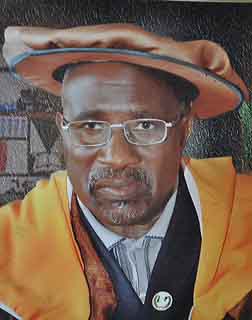
Prof. Emmanuel Kucha is the Vice Chancellor of Federal University of Agriculture, Makurdi, FUAM. In this interview, he speaks on why Nigeria is lagging behind in agric production and has also remained a major importer of food. Excerpts:
 Nigerian has remained a major food importing country despite the initiatives of successive governments. Do you attribute this to the failure of agriculture-based institutions in the country to meet the objectives for which they were established?
I’ll say yes and no. No in the sense that we have not been able to make successful impact. Institutions like the Federal University of Agriculture, Makurdi and related institutions were established to bring in scientific agricultural techniques to the door steps of our farmers, but we have not been able to do that.
The extension component of our mandate is the one that is currently helping. We are producing graduates but we have not impacted these techniques on farmers. That is the aspect that is missing.
When I came on board I decided to improve on that, but for lack of resources to open up demonstration farmers which is the only way you can get farmers exposed to the new techniques. We have also not been able to attract students into core agriculture. Our students don’t want to go into agriculture. They want to do engineering. They want to read single honors, like biochemistry, physics. You’ll discover that our children prefer to read such courses other than crop production, animal science, animal production, simply because they don’t want to hear the word agriculture.
But those that did these courses are doing well. That is why we have achieved our mandate to some extent because some of the students that graduated from this institution are on their own practising. But you cannot read physics and go to practice. You can only go and teach, or go to a research institution. But those who have read fisheries, forestry, animal production, crop production go to practice. So the mandate has not been met.
What would then be your advice to government?
Funds should be provided for institutions like ours to establish demonstration farms where we can teach our farmers the techniques of modern farming, it is important. Agriculture is not all about going to the farm alone but the issue of value chain must come to play. The processes of getting the finished products out to the market makes agricultural production complete. Through the Tertiary Education Trust Fund, TETFund, we are putting up confectionary and fruit juice plants here, and in no distant time our students would be taught in these plants. What I’m saying in effect is that until we properly fund demonstration farms across the country, and also accord priority to well laid out value chain development and sustenance programme, we might for a long time remain a food importing country, because majority of our farmers are still at the level of peasantry.
You have been in the saddle as Vice Chancellor for almost three years. What are your achievements so far?
The focus of my administration is clearly defined in our mission statement of re-engineering. On this premise, we have laid out a five-point agenda in the areas of creating an enabling academic environment for teaching and learning. We have entrenched improved staff and students welfare and manpower development and also ensured rapid infrastructural development through public private partnership/ budget and internally generated revenue, IGR, research, innovation and technology development and the strengthening of extension activities to ensure unimpeded access to scientific agriculture.
The agenda revolves on the nexus of re-engineering with a single objective of value addition and transformation of all facets of university life. The participatory and all inclusive approach to governance anchored on due consultation in decision making process has enthroned unprecedented peace, harmony, cooperation, unity and togetherness on campus among all stakeholders.
How far have you gone with the accreditation of courses in the institution?
Our previous rating by programme accreditation of the National Universities Commission, NUC, indicates that out of 28 programmes offered by the university, 26 have received full accreditation, and two interim accreditation status.
By the institutional accreditation of 2011, the university scored 76.5% (full accreditation) valid for seven years which rated the university as Class A, thereby placing the UAM as among the best universities in Nigeria.
How do you describe the TETFund interventions and the Needs Assessment Report in universities in the country and how has your institution benefited from them?
I believe that the TETFund interventions and the Needs Assessment Report in our universities is the best thing to happen to tertiary education. On our part at the FUAM, our commitment to re-engineer campus infrastructure is borne out of our belief that academic excellence cannot happen in an atmosphere of poor infrastructure.
We appreciate recent interventions of the Federal Government on infrastructural development on the campuses to create a conducive atmosphere for teaching, learning and research under the Needs Assessment Report.
We are utilizing the funds for renovation and construction of new structures.
We have completed a 500-seater capacity College of Management Sciences and Entrepreneurship Centre. Some other projects at various levels of completion include a Centralized Equipment Centre, pilot plant for a juice production, College of Engineering Complex; College of Agriculture and Science Education Complex, College of Forestry and Fisheries Complex, 500 capacity lecture theatre for the College of Food Technology, Indoor Sports Hall for NUGA Games, Integrated Food Technology Pilot Plant in the College of Food Technology, Informatics Centre, Entrepreneurship for Confectionery; Specialised Equipment Centre, ICT Centre and students hostels.
I must also mention that we have ensured harmonious and cordial working relationship with the host community which has accounted for peace and stability we enjoy on campus. We are doing everything possible to jealously preserve that relationship.
We have been granted the hosting rights of the 25th National Universities Games (NUGA). This has confronted us with urgent challenge to develop word class sporting facilities estimated at over N10.5billion. Despite the paucity of funds we have commenced work on the construction of new football, handball, volley ball and basket ball arenas. We are also putting up a cricket oval, squash court, a proposed indoor sports hall for indoor games and a swimming pool. The hosting right has also availed us the opportunity of constructing four gigantic hostels of 407-bed space each.
On research and extension activities?
Collaborative research efforts of the university have culminated to partnerships and funding from the World Bank/African Centres of Excellence; World Bank’s West African Agricultural Productivity Programme, WAAP; Bill and Melinda Foundation/IITA these partnerships and findings are valued at N307million.
The university also has ongoing sustainable partnership with McGill University, Montreal Canada; the National Centre for Agricultural Mechanization, Ilorin; First Bank of Nigeria Plc. Professional chair in Agronomy and National Centre for Space Research, Abuja; Nigeria Army Institute of Technology and Environmental Dtudies, NAITES, Makurdi and the Federal Ministry of Agriculture and Rural Development. These relationships have given filling to collaborations and internationalization of the institution. Research grants are also awarded to staff that have developed meaningful research proposals through TETFunds interventions. It is also important to note that research efforts of staff have earned UAM the National Universities Doctoral Thesis Award Scheme, NUDTAS, by NUC for 2011 and 2012 in Chemistry and Education.
Intense research efforts of staff have also resulted to the promotion of 58 academic staff to Professorial rank ( 18 Professors and 40 Associate Professors) in the first two years of this administration.
More so that we consider the issue of staff well fair, training and motivation upmost in our strategy of engineering the university to greater heights. I’m delighted to tell you that our staff have benefited from one form of training to the order across different categories of jobs. Many have received full scholarships for post graduate studies within and outside the country through the TETFund training window. Other staff have also been sponsored for local and international conferences. The training policy of the university is premised on the understanding that a properly trained workforce is a veritable tool to actualise our re-engineering. The FUAM staff are being motivated adequately through timely promotions and other incentives. There is also a cordial relationship between the university administration and the unions on campus including the students whose welfare has remained a major priority of this administration.
I must hasten to add that our five point agenda is summarized in a single maxim of Re-engineering with a single objective of value addition and transformation of all aspects of the university life. In the process of Re-engineering the university we has adopted a participatory and all inclusive approach to governance. Due to consultations with stake holders in decision making process is aimed at minimizing bickering, acrimony, suspicious and I’ll feelings that are associated with disenfranchisement. The all inclusive approach has yielded peace, harmony cooperation, unity and togetherness on campus among all stake holders. More importantly we have become a bridge between the past and the future.
Disclaimer
Comments expressed here do not reflect the opinions of Vanguard newspapers or any employee thereof.