By Obi Nwakanma
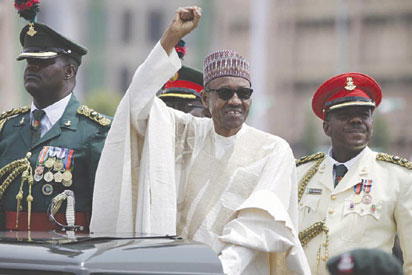
With the inauguration of President Muhamadu Buhari as the president of Nigeria on Friday, Nigerians expect the promise of the transformative initiative on which his party, the APC, ran to be fully put to force. That time is now. At the Eagle square, the president said all the right things, and gave a heartwarming speech. He also set the tone of this government in the simple unostentatious ceremony that dispensed with many flowery rigmaroles, and went straight to the heart of the matter.
Two things right now are on President Buhari’s side: he has vast experience behind him, and because he is no newbie, he can dispense with all the clutters of bureaucratichide-and-speak. Secondly he has a massive groundswell of local and international goodwillwhich he himself acknowledged, because quite frankly, the world is looking for a bit of good news from Nigeria. The pictures of Nigerians among the horde of migrants to Europe, the new “boat people” fleeing from poverty, insecurity, and unemployment does need to stop.
Europe itself is overwhelmed, and these migrants, Nigerians among them, are now a scourge on the threshold of Europe, a continent that is increasingly facing its own powerful economic and social challenges. Because Africa is the world’s new frontier, and Nigeria is its greatest country, a stable, prosperous, and secure Nigeria would relieve Europe of the pressure of the African migration in large part; Nigeria would provide some stability in the continent, and assume its place in the emerging global order.
 Certainly, the problems of poverty and human movement will require a more radical reformation of the global system, and challenge the ethos of cannibal capitalism, but it would also require the emergence of Africa as a more serious player in the world, of which Nigeria provides an important possibility, to redefine the international system and its predatory globalization. President Buhari must take Nigeria seriously; far more seriously than he has ever done.
He must have a vision of Nigeria drawn from, not merely its place as aformer colony of Great Britain, but as a new, vital, and powerful force among the top nations of the world. As Africa’s powerhouse, Nigeria should play second fiddle to none, and should re-vision itself, in terms of its engagement with other powers, as “the giant of Africa” – an awakened Africa intent on taking its place once again in the world.
This is Nigeria’s chance to fulfil the dream of the fathers of Nigeria’s anti-colonial nationalist movement, who fought based on their vison of an African century and an African renaissance in the 20th century; a renaissance that was truncated in Nigeria by powerful forces, of which Buhari today, from his experience as a former head of Nigeria’s government with access to all government’s security information, ought to know. An important part of Buhari’s mission of regeneration must be the overhaul and constitution of a powerful Foreign Policy, with a new, highly trained, Foreign Service. I say this because Nigeria’s Foreign Service is in tatters.
Foreign Service Staff are poorly trained, and Nigeria’s diplomatic engagement is quite often sophomoric. This president must as a matter of urgency retool Nigeria’s Foreign Service infrastructure. A program of strategic recruitment and retraining of a new generation of Foreign Service officers must commence based on the 1957 model that saw the emergence of superb diplomats like Leslie Harriman, Edwin Ogbu, George Dove-Edwin, Ignatius Olisemeka, and so on. A nation’s foreign commission, of course, is only as powerful as the nation itself, but any visitor to any of Nigeria’s foreign missions abroad will note a particular kind of dreariness, which equally essays the kind of reception Nigeria gets abroad. Adynamic foreign policy is also backed with solid domestic policy.
Nigeria must, as a matter of urgency, under President Buhari reassert its sovereign capacity. The decline of Nigeria’s domestic space is obvious in the quality of its citizenry: a poor, ill-educated, insecure people, model and reproduce poverty – particularly the most dangerous of all poverty – the poverty of the imagination. In many instances, poverty is not the absence of excess, it is the condition of powerful and unmatchable desire arising from a psychological lack. If the social environment is empty and without purpose, poverty arises. Poverty is the product of arbitrariness, and poverty breeds corruption.
Corruption is the product of systemic failure. If the institutions are well established, there will be minimal corruption of the system. There will be a reduction in waste. There will be effective check and there will be active institutional sanction. It is therefore imperative for this president to embark on the following to recalibrate Nigeria: he must, as the first order of his business with the National Assembly send a Public Service Reform bill to reshape the structure of public governance and of the executive branch.
The constitutional requirement that ministerial appointment must draw from the 36 states is a constitutional trap. Nigeria does not need 36 ministers to run its affairs. Nigeria does not need ministers of state in a presidential system, and in a civil service with Permanent Secretaries. It is duplication of the sort that makes it a laughing stock internationally. It is a waste of government resources to carter to that number of the ministerial retinue.
The president must reduce his ministerial staff to 13. If he wishes, he can make it an appointment of two people from each of what is now the six zones or regions of the federation. There should be a ministry of Education and Culture, because national culture is the product of a national education program: who are our poets, playwrights, novelists, painters, sculptors, musicians, photographers – Nigeria’s National library, Museums, Galleries, its publishing infrastructure – etc are part of a cultural matrix that is or ought to be linked bypublic education.
There should be a Ministry of Information and Research; Ministry of Home Affairs & Natural Resources; Ministry of Mines & Energy (under which should come the Petroleum Ministry), Ministry of the Economy & the Treasury, the Foreign Ministry; Ministry of Labor and Establishment; Ministry of Works & Transport; Ministry of Agriculture; Ministry of Health & Human Services (under which should come Youth and Sports), Ministry of Trade,Ministry of Defence, the Ministry of Technology & Industry, and the Attorney-General’s office.
There should be no minister for Abuja, which at this stage must be governed by an elected Mayor. There must be a very urgent program to retrain and re-orient public service personnel on new skills and new ways of doing things in the 21st century. It is time to strategically recruit and position a new generation of Civil servants from among our best and brightest, and buffer them from the kind of want that leads to corruption. This president must commence the process of the total overhaul of the Nigerian police system to accord to a new, civil, skilled, and well-motivated national police service. Nigeria’s ministry of Defence must be linked to a national Research and Production arm.
The president must dust up some of what the Biafrans did, and model RAP after the Biafran agencies under four coordinating inter-ministerial groups: Education, Defence, Home Affairs, and Industry/Technology. This president needs to engage bold thinkers; he must create a pathway for Nigeria’s dormant intellectual class who currently are busy doing nothing in the universities, and fuse them to the task of nation-building. He must rebuild the universities. It is time, for nation-building, and it is long past time to be on your marks, Mr. President.i
Disclaimer
Comments expressed here do not reflect the opinions of Vanguard newspapers or any employee thereof.