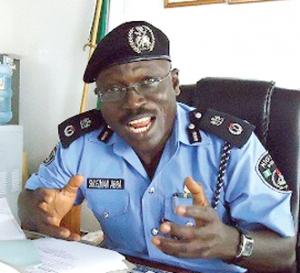
Suleiman Abba
By Evelyn Usman
Nigerians woke up on August 1, 2014 , with the news of the appointment of Suleiman Abba , as the 17th indigenous Inspector-General of Police, by President Goodluck Jonathan. He took over from Mr. Mohammed Abubakar , with the pledge to do whatever was necessary to halt violent crimes in the country.
 On whether he lived up to expectation, that is a question for Nigerians to judge. His sack has been interpreted by many people as a move to disgrace him out of the exalted position in the Nigeria Police, at the twilight of President Goodluck Jonathan’s administration.
News of his sack was disclosed in a statement issued by Jonathan’s spokesperson, Reuben Abati, on Tuesday. The statement read: “”President Goodluck Ebele Jonathan has relieved the Inspector-General of Police, Mr. Suleiman Abba, of his appointment and duties with immediate effect. President Jonathan has also appointed Deputy Inspector-General of Police, Mr. Solomon Arase, as Acting Inspector-General of Police, also with immediate effect.
“Until his appointment as Mr. Abba’s replacement, Mr. Arase was the Head of the Force Criminal Intelligence and Investigation Department.
“Mr. Arase holds Bachelors and Masters Degrees in Law, as well as Bachelors and Masters Degrees in Political Science and Strategic Studies. He is also a Fellow of the Nigerian Defence College.”
A report said that hours after the statement was released, Abba was still carrying on with his duties at the Force Headquarters, FHG without correspondence from the authorities, informing him of his removal. He was even quoted as stating that he was unaware of his sack or removal as at about 11pm that Tuesday.
Even though Abba later swallowed the humiliation like a bitter pill and, without ruffing feathers, those close to him revealed that he kept wondering what offence he committed to warrant such ill treatment.
While a some school of thought asserted that his removal would not have been unconnected with his non-partisan stand during the just concluded general elections which turned the table upside down for the ruling Peoples Democratic Party (PDP), others categorically stated that he incurred the wrath of The Presidency for allegedly arguing with government officials over the directive to recall an Assistant Inspector -General of Police from one of the states, thus becoming the first casualty of an administration which curtains were to be drawn soon.
Many had expected that the commendation from the American Ambassador to Nigeria, James Entwistle, to Abba, over the police conduct during the general elections, just 24 hours before the action, would earn him further accolades rather than a sack.
With his unprecedented ousting, Abba’s tenure is the shortest among other 16 Inspectors General of Police in the history of Nigeria since independence, having spent just eight months in office.
Next to Ringim
Also, Abba is the second IGP to be ousted unceremoniously by Jonathan. The first person to get the president’s butt was former Inspector-General of Police Hafiz Ringim.
Sunday Vanguard learnt that Ringim was equally the second police officer to be promoted from the rank of Assistant Inspector-General of Police to IGP. But his 16 months in office as the IGP was described as the stormiest of his 35-year career as a police officer, owing to the controversy bordering on the activities of terrorists in the country.
On November 4, 2010, Ringim was confirmed by the National Council of State as the 15th substantive Inspector-General of Police, having served in acting capacity for two months. Same day, he announced the disbanding of multiple crime squads nationwide, arguing that the squads had become inefficient, with his focus majorly on conducting crime free elections (2011)
Ringim, in his five-point agenda, highlighted the curbing of violent crimes as a major assignment and announced putting necessary machinery in place, including the collaboration of other security agencies as measures aimed at meeting with the challenges of the moment.
Challenges
But his appointment came with some major security challenges in the nation. First, he was confronted with the Boko Haram insurgency in the North which had policemen and innocent citizens as its targets. Regrettably, many policemen were killed by members of the sect agitating for the establishment of Sharia in the country.
The situation, within his 16 months in office, reached the peak, with the serial bombing of the FHQ in Abuja he barely escaped as well as the attacks on the United Nations House, St. Theresa’s Catholic Church, Madala, Niger State and the coordinated attacks on the police and other security formations in Kano State in which over 200 persons were massacred.
His end in office, however, started following the public outcry that trailed the alleged escape of Kabiru Sokoto, a suspected leader of Boko Haram, from police custody in Abuja, an incident that reportedly earned him query from The Presidency and a 24 –hour ultimatum to produce the suspect.
An investigative panel was set up by the National Security Adviser, NSA, to investigate Ringim’s culpability in Sokoto’s escape.
Another major challenge for Ringim was the police/army clash in Badagry, Lagos, where the Badagry Divisional Police Officer, the Divisional Crime Officer, the Operation Officer and other policemen were murdered in cold blood by suspected soldiers from the Ibereko Army Barracks.
A twist in the murder was introduced following the silence by the police and the army in fishing out the perpetrators of the dastardly act. Ringim’s utterance that there was no clue that his men were murdered by soldiers heightened the already tensed mood of policemen who accused their boss of being insensitive to their plight and also failed to watch their back. Although both security agencies claimed to have begun investigation into the cause of the trouble, till date, nothing has been heard.
Civil rights organistations called for Ringim’s resignation over what they described as his inability to come out with a definite response to the murder of his men.
While still smarting from the negative public opinion on the police officers murder, a bomb blast occurred right at the car park of the FHQ, killing two persons and destroying hundreds of vehicles.
The explosion sent fears down the spines of many Nigerians who wondered how safe the country was, considering the seeming inability of the police to check bomb explosions in the country.
IGP Ogbonna Okechukwu Onovo ( July 28, 2009 to September 8, 2010)
While Ringim spent 16 months in office, his predecessor, Ogbonnaya Okechukwu Onovo, the first Ibo man to assume the exalted position in the police, spent 13 months. His emergence as the 14th IGP, during the tenure of the late President Umaru Yar’Adu’a, received accolades from his Ibo brothers. But he was ushered into office while the Boko Haram sect was ravaging the North. One of the unforgettable incidents that dogged his tenure was the attack by Boko Haram fighters on prisons where 721 inmates, among them 190 of their members, were freed.
Onovo was reportedly sacked as a result of rising insecurity in the country occasioned by a sharp increase in militant activities by the Niger Delta fighters and these of Boko Haram in the North. There was also the kidnapping for ransom in the South-East.
As if relieving him of his job was not enough, his successor, Hafiz Ringim, set up a machinery to unmask those behind an alleged fraudulent disbursement of the N2billion loan meant for 100,000 police housing units scheme. The action reportedly followed the petitions from a lawyer on behalf of 31 sub-contractors handling the construction of the housing units against a developer. The petition claimed that the developer had been paid N304 million “through Aso Savings and Loans by an arm of the Nigeria Police Force Housing Scheme and yet the sub-contractors were not paid.”
However, during investigation by detectives of the Special Investigation Unit, SIU, an arm of the office of the IG, some former IGPs ,estate developers and a serving Commissioner of Police then, who involved his company, were allegedly fingered in the scam.
For instance, investigation showed that the loan was obtained during the administration of the Chairman, Police Service Commission, Mr Mike Okiro, while he was the IGP, in order to provide shelter for thousands of police men nationwide, with the Police Service Commission giving approval for the loan, owing to its favourable terms.
The beneficiaries were expected to make 10 per cent down payment for a unit of 2 – 3 bedroom flat which cost between N3million and N5million, while the National Housing Fund, NHS, was expected to pay 90 per cent from contributions from beneficiaries salaries.
In a move to ensure that there was no default in payment of the loan, Okiro reportedly opened an Escrow Account with a bank and appointed three senior police officers as signatories, where money deducted from salaries of beneficiaries would be paid into, directly from the pay office.
Aside that, Okiro reportedly instructed the former officer in charge of the housing scheme to furnish the bank with the list of officers of the rank of Assistant Superintendent of Police (ASP) and above. This, he explained then, was to forestall any form of fraud, as the loan was to be paid within 24 months. The list was also to enable the bank screen officers whose tenure was within or below two years , as their exit from the force could pose difficulty in repaying the loan.
About N130 million was reportedly disbursed to about 272 officers by the bank to cover their 10 per cent while NHF was said to have paid the 90 per cent through the Federal Mortgage Bank of Nigeria.
However when Onovo took over from Okiro in July 2009, he was reported to have ordered the bank to stop the disbursement on the suspicion that the N2billion may have been embezzled by some ‘officers’. He reportedly ordered an enquiry headed by a DIG which, however, found that the money was intact.
However, along the line, a list of additional 4,000 policemen was reportedly sent to the bank which was refused by one of its managers, on the suspicion that they were ghost workers.
A then serving House of Representatives member, appointed as a consultant on the police housing scheme by Onovo, was arrested, interrogated and later released on bail by SIU. Directors of the property development company were reportedly also arrested and their statements obtained and then released on bail. In the course of investigation, directors of other companies involved in the alleged scam were arrested, interrogated and their statements obtained.
Mustapha Balogun (2000-2005)
While Onovo’s exit from the police was not on the account of his alleged involvement in the N2billion housing scheme that of Mustapha Balogun could not be said to be same. In fact, Balogun’s tenure heralded the ousting out of IGPs in a disgraceful manner.
Nigerians will never forget in a hurry that the top police officer was humiliated on the instruction of the powers- that-be at that time.
Balogun, popularly known by his abridged name of Tafa Balogun, was the 11th Inspector General of Police. On assumption of office, he reeled out an eight-point crime control strategy among which was an anti-corruption crusade both within and outside the force.
Ironically, he became a victim of his much clamored campaign, a situation that saw Balogun being shown the way out of office in handcuffs for allegedly misappropriating N17 billion belonging to the police.
This, however, did not deny the fact that he was one of the most cherished IGPs by policemen following their prompt promotion. During his tenure, policemen, who had been denied promotion for over 12 years, were said to have been adequately compensated with their desired ranks and their welfare boosted.
Sadly for him, it came to an end in January 2005 when he was forced to retire due to allegations of corruption. This followed his arraignment by the Economic and Financial Crimes Commission, EFCC, under the administration of Nuhu Ribadu , before a Federal High Court sitting in Abuja on April 5, 2005 over allegations of stealing of N12,861,570,098.00.
In his submission, Balogun was quoted as saying: “Life is full of challenges, it has its ups and downs. I was up yesterday, I am down today but I will bounce back.”
Sunday Ehindero (2005-2007)
Any discerning IGP was expected to take a cue from Balogun’s horrible experience . But that was not the case of his predecessor, Sunday Ehindero, who had a calm disposition suggestive of a saint , as he was also ridiculed. Ehindero allegedly got entangled in an N23 million scandal. The amount, said to have been found in the trunk of a car, was allegedly smuggled out of the FHQ and allegedly being taken to Ehindero.
After his retirement in 2007, Ehindero faced a probe over the N2.5 billion Police Cooperative money, N300 million police funds and for allegedly building about eight magnificent houses. His passport was seized.
In April 2008, the Independent Corrupt Practices and Other Related Offences Commission, ICPC, interrogated him on how money meant to buy arms and ammunition for the police was spent.
Ehindero, alongside the then Commissioner of Police in charge of Budget, was arraigned before an Abuja High Court for alleged complicity in the misappropriation of N557 million belonging to the Nigeria Police for the procurement of arms and riot control equipment.
They pleaded not guilty to the six-count charge preferred against them by the ICPC and were admitted to bail.
The suspects were reported to have filed notices of preliminary objection, challenging the jurisdiction of the court as well as the leave granted the ICPC to file charges against them. They also prayed the court to quash the charge.
The trial judge, Justice Mudashiru Oniyangi, dismissed the application and asked the accused to face trial.
Not satisfied, they approached the Court of Appeal to challenge the decision of the lower court on three grounds: (a) whether the Abuja High Court had jurisdiction to entertain the charge against them wherein the allegation is bordering on the revenue of the Federation vis-a-vis the provision of Section 251 (1) (a) – (f) of the 1999 Constitution; (2) whether there is a prima facie case linking them to the charge preferred against them by the prosecution and (3) whether in view of the constitutional powers of the Attorney General of the Federation (AGF enshrined under Section 174 (1) and (2) of the 1999 Constitution (as amended) , Mr. Paul Bassi, or any other officers of the ICPC, could validly prosecute him without a fiat of the AGF.
Musliu Smith (1999-2002)
But among IGPs who served without any charge of corruption against them is Alhaji Musliu Smith. He was elevated above some of his seniors in May 1999, which necessitated the retirement of those affected . But for the shake up, he would have remained in office as Inspector-General of Police till April 1, 2006 , when he would have completed his 35 years in service.
Although no official reason was given for his sack during former President Olusegun Obasanjo’s tenure, it might not have been unconnected with the purported planned strike action by men and officers of the force, as well as the perceived growing insecurity across the nation . But the sack was simply attributed to the decision to make the Nigeria Police better and to give it a new direction.
IGP Mohammed Abubakar (January 25, 2012 to July 31, 2014)
The IGP that could best be described as one who escaped the humiliated sack of any government and without indictment even after leaving office was Mohammed Abubakar. He took over from Hafiz Ringim on January 25, 2012.
The Zamfara State-born officer, who served in different capacities in the police before assuming the number position, honourably bowed out of office, having put in 35 years of service. The emergence of M.D, as he was fondly called, as the IGP, became the downfall of several Deputy Inspectors General of Police among whom were Mrs. Ivy Uche Okoronkwo, DIG POL 2i/c Force Headquarters, Abuja; Mr. Azubuko J. Udah, DIG Administration (“A” Dept); Mr. Sardauna Abubukar, DIG Training (“E” Dept.); Mr. Audu Abubakar, DIG Operations (“B” Dept); Mr. Saleh Abubakar, DIG Works (“C” Dept.) and Mr. Mohammed A. Yesufu, DIG Planning and Info-Tech (“F” Dept.)
This was because Abubakar was elevated from the rank of an Assistant Inspector General of Police, a rank lower than that of DIG, hence the need for the forceful retirement of the DIGs.
IGP Mike Mbama Okiro (2007 to 2009)
Another IGP, who retired without being humiliated, was Mike Mbama Okiro. He retired from police on July 24, 2009, when he clocked 60 years.
Disclaimer
Comments expressed here do not reflect the opinions of Vanguard newspapers or any employee thereof.