By BILESANMI OLALEKAN
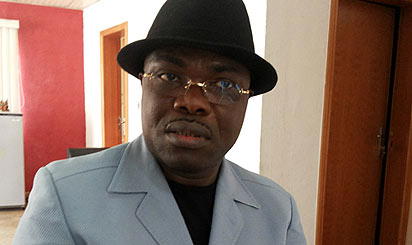
Nigeria of today is a place where buildings collapse. Chief Omo Aisagbonhi, a real estate developer, in this interview, explains why buildings go down and proffers solution. He adds that he would rather give loan to women than men, because ”even if the man becomes irresponsible in paying back the loan, the woman will not”.
The cost of doing business in Nigeria is said to be high. Is it also like that in the real estate sector?
Doing business in Nigeria has not changed from how it was five, six years ago. The only thing is that the environment has become tougher because, after the banking sector crisis of 2009, it became obvious that you had to be tough in a tough environment like Nigeria. A couple of people, not only in the real sector died after that economic meltdown.
In an environment like ours, 80% of those running medium scale enterprises are borrowing money from banks and most people had their loans recalled by these banks without notice. And those who lost money then have still not recovered. But for some of us, not necessarily because we were clever, I will say God was on our side and because we didn’t bite more than we could chew; at the point the meltdown worldwide happened, we had a loan of N300m.

*Chief Omo Aisagbonhi…..We have acute shortage of housing for young people
I never traded in shares as such. The few I bought were those I bought from people who came to me to say, ‘’Help, because we have target to sell these shares’. So I didn’t invest the money I was using for business on shares. Because the value of property was high, I bought some property here and there. I bought one in Osborne worth N260m, got N160m from Fidelity Bank and, by the time the meltdown started , what we bought for N260m went down to N120m and nobody was even ready to buy.
I had another one in GRA for N130m that now went down to N60m. The loans were there that I had to repay. So we had to sit down to review our business plans. The first thing that came to mind was that we needed to do serious rethinking. The middle class, which we were catering for, had been wiped out by the retrenchment in the banking and related sectors.
We had lot of young stockbrokers who had subscribed to some of our new developments but could not pay and were even asking us to refund what they had put in. So we found ourselves where we had to do a u-turn. The first thing we did was to recognise that housing is a need, no matter the situation, you must have a roof over your head.
‘I was not going to quit’
We have acute shortage of housing for young people in this country. And if you go by the number of hours these young people spend in traffic everyday from where they can afford to live, to where they work, you will agree with me that our country is losing so much. So I said to myself I was not going to quit. The first thing I did was to convert the things I had planned to do in those various sites to something else because, at the point of the meltdown, even though it was bad for people, it was not bad for everybody, some rich people were still coping. And luckily for us, some of our bankers were friendly.
The ones that were friendly helped us to survive the ones that were hostile. And today I can say we are no longer owing that debt; we have paid back. The business picked up not necessarily because young Nigerians are earning more but because the average Nigerian wants to give his family a comfortable lifestyle by reducing his extravagance lifestyle and trying to concentrate on those things that are important.
So people are beginning to buy houses. The GRA property in Ikeja that was supposed to be a single unit was converted to multiple units and we got big organisations to let it out to their expatriates. Before the crisis, by divine intervention, I started doing branches for the defunct Oceanic Bank. We did about 20 branches for the bank across the country. When the crisis came, the bank was owing us some money and the people who took over refused to pay. We are in court on that. But I won’t be sitting here today if those who managed that bank at that point did not help ordinary Nigerians like us. In developed countries, they give housing loans for as little as 3%.
Banks not borrowing
But in this country, if you approach any bank for mortgage, they ask you to pay between 17% and 22% and you pay in five years. So how are you going to own a house if you are not a criminal, except that you want to go and live in Ota or Mowe and then you will now have to spend 4,5hours in traffic everyday? So when we discovered that banks were no longer borrowing and people were not really buying property anymore because they did not have the wherewithal, we deviced a method where we were able to have 2,3,4 people together and say ‘each of you, bring N5m each, making N20m, we buy the land and we build and you will only be paying us the cost of owning the house’.
You can have a home in say Gbagada for as little as N20m over a period of five years to pay back. Of the people we gave this opportunity to, only two did not make it, the rest paid up. That brings me to this. If you want to give loans in this country, give it to a woman. Women are credible in terms of loan repayment. From my experience, it is better to deal with women than men.
If you make a woman to co-sign an agreement that concerns their home, even if the man becomes irresponsible, the woman won’t. Most of our property, we allowed the clients to move in while payment went on. When the cheques the man gave failed and he was no longer picking our calls, all we needed to do was to call the wife; she would come here to apologise and say,’ Give me sometime, I will work on him.’
Trouble and first loan
When I returned to this country from the UK, I came in with N40mwhich came in through a Nigerian bank. When I ran into trouble with my first development, the bank was not there for me. Oceanic came to my rescue, not because I went there to beg. I wanted to sell where I was living when I didn’t have money to complete the project I was doing.
I offered where I was living and somebody had come to look at it. Of course before making payment, he said if he bought the house now, where would I move to? and I told him within three weeks I would have moved out to rent an apartment. He was shocked that I could sell my house only to rent another. I told him that I needed the money because I was developing some property and my banks were not willing to help me.
He said it was not true. So I ended up driving him to Omole where the property was. He saw it and asked how much was needed to complete it. I said between N20m and N25m. He said he could loan me and I told him I would pay back in less than three months. That was how I met the then general manager of Oceanic Savings and Loans. He was the one that gave me my first loan.
At what point did you decide to go into real estate?
I started as a patent medicine dealer in Jos, in 1984. I was the first person to open shop in National Institute of Policy and Strategic Studies. My step mother was a midwife. We had a chemist in front of our house owned by my step mother. So, as soon as I returned from school, that used to be my pre-occupation. So, after a while, I took a decision that that was what I wanted to do. My mother was not with my father.
She left shortly after I was born. Unfortunately, the man she married never wanted any baggage to accompany the marriage. That was how I ended up with my father. So I found myself starting life earlier than I thought. I started living on my own from age 14. I rented my first apartment at 14. The decision to go to school on my part was deliberate.
I did all sorts of odd jobs but I made sure that whatever I was doing, education was part of the plan. I later sold the shop in 1988 to travel to the UK. But I, first of all, went to Spain; unfortunately, language became a barrier there. It was in 1992 that I moved to the UK. I did all sorts of odd jobs to survive. I got a Nigerian, a Yoruba to be precise, to let out his Council Flat, because he didn’t have to stay in the flat as he had accommodation somewhere else.
So I and a friend staying there were paying him rent and he in turn remitted to the Council and when Council officials came calling, we just answered his name. Eventually we were given the right to buy the flat because when you live in a Council Flat for a while, you are given the opportunity to buy it. That was how I bought it and that was how I started real estate business. I refurbished the flat and sold it and made enough money than I could ever imagined.
The bulk of your investment is here in Lagos. Is it because Lagos is more lucrative?
The question is, what does it take to be an estate developer? Every business has its own intrigues. In Nigeria today, if you start real estate business in an environment you don’t really know, you are in for a serious trouble. I started in Lagos 2003. I had thought that by now I would be doing neighbouring states like Ogun, Ondo and my state, Edo, places I can go in a jiffy. I am someone who bites as much as he can chew.
I don’t even have money to do Mainland Lagos, not to talk of Lekki. Every project, for me , has a lifespan. Any project that I cannot complete within 24 months I don’t venture into it. Any project that I wont be able to go twice a week to supervise, I won’t venture into it. You must know your environment very well before doing anything. For example, you buy a land in Lagos, but before you buy, your lawyer studies it, vets it and then you buy, but the day you hit the site, you meet some people claiming ownership of the land. You have a lot of people to contend with.
The Omo-onile are there.
The state agents, local government agents, you must deal with all of them except you don’t want to build. If you are a JJC, all these people will take undue advantage of you. I am a chief in Ikeja. Where ever I operate now, I am like bad business for Omo-onile, (land speculators) because they know that this man knows us left and right. I have studied my environment and I can tell you that I am a master of where I am. You see, if Lagos is successful, I can tell you every part of the country will be successful. For example, if you provide Lagos electricity, 80% of our economic problems will be solved. If all that is supposed to be in place is there, 80% of our unemployment would be solved.
Can you imagine the number of hours people spend everyday on traffic, going from this part of town to the Island? Have you ever imagined why successive governments have not been able to proffer solutions to the electricity problem? Yet our leaders go on holidays abroad every now and then. Between Gbagada and end of Third Mainland Bridge, if you put a ferry there and carry people and cars, do you know how much money one saves and the productive hours that would saved?
Why do you think buildings collapse in Nigeria?
Poor quality of materials. The second thing is that the system itself encourages all sorts of things. Let me give you an example. You buy iron rods that are supposed to be 12mm or 16mm from the market; if you are not smart enough to do test after you bought them, you will find out that the 16mm is less than 13mm. That is not the fault of the property developer. Of course there are greedy thieves in every industry, so it is in our industry.
Unfortunately, none of the associations has been able to coordinate itself to do what they called self-check so that if you don’t have a particular licence you cannot operate. We are hoping that one day we shall get there. In our properties, we give the clients two years warranty such that whatever that is bad there, apart from, maybe changing of your bulb, we repair it. It is only a call.
Beyond that, in our houses, you don’t need anything to come with apart from your clothing. Everything is set, washing machine, air conditioners, everything you can think of that can make life comfortable has been provided. Besides, the houses are insured. These are some of the unique things that what we do and which have helped us to remain in business.
Disclaimer
Comments expressed here do not reflect the opinions of Vanguard newspapers or any employee thereof.