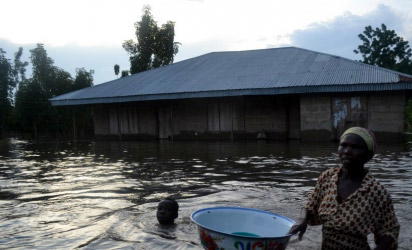
Etsako in Edo State…submerged by flood
By Dele Sobowale
“History does not repeat itself; man does”. Barbara Tuchmann. Authority on 13th and 14th Century Europe.
The floods, which devastated many parts of Nigeria in 2012, should not have caught us by surprise – but they did. For more than a generation, scientists have been warning a deaf world and its leaders about the imminent catastrophe which would follow relentless global warming as mankind heats up his own “home” – the earth. Furthermore, we knew for centuries that the year starts in January and moves inexorably to December.
The rainy season starts in different parts of the world at different times. Some areas of the world lead off in January and the level of rainfall in those areas had for long become the barometer for measuring what should be expected in other parts of the world where rains start later.
Fortunately for us, our own real rainy season, which had shifted somewhat, still, does not start until April or May. That gives us at least four months to prepare and to have an idea of what to expect. This year we can expect trouble. In fact, we should expect more trouble this year than in 2012.
That being the case, the first question, naturally, should be: “what has been the pattern so far this year?” The answer is not hard to discover. In all the countries which had experienced rainfall, so far, this year, the level of rainfall had reached record levels.
The most recent and most dramatic had been Argentina, whose capital, Buenos Aires, received in one day, more rain than it had been getting in a month before this year. According to the international news network the capital of Argentina got 313 mm of rain in eight hours.
The Latin American country was not the only country where soldiers and civil defence units have had to be called out to save people from floods or to pluck citizens from roof tops. In China and elsewhere the reports have been the same; properties which had been accumulated over generations had been wiped away in the twinkle of an eye.
Even nations which have experienced no rain have reported record snow falls. Snow, as everyone knows is ice or frozen water. New York City and parts of the Eastern part of the United States had been snowed under more heavily this year than at any time in remembered history. For the better part of three days, the New York subway system, the backbone of the transport system in the Big Apple was totally paralysed.
As the hurricane season, which will soon start to the west of Nigerian gets underway, the predictions for this year point to grave dangers ahead for every country in the world – Nigeria included. If the floods last year caught us by surprise, the deluge this year should not.
And, just as if a benevolent God had decided to warn us of the perils ahead, the flash rainfall which occurred in Lagos two weeks ago, should leave none of our national, state and local government leaders in any doubt that we are heading for another catastrophic year – unless urgent steps are taken to mitigate the destruction that will certainly occur.
Newspapers photnews reports of the next day, after that day’s downpours have demonstrated for all of us how seriously endangered we are – despite the valiant efforts of various governments to reduce the calamity. So far, the flash downpours have made clear that the best is still not good enough.
This warning has become necessary on account of the hangover from last year. In many parts of Nigeria, the promised reliefs were either late in coming or were never delivered at all. Pictures of the President paying a belated visit to flooded communities or governors wading through muddy waters in order to make promises of relief, or to “donate” relief materials, were generally followed by benign neglect of the people affected. Homes that were demolished last year have not all been re-built and there is serious question whether those on flood plains should be allowed to be re-constructed at all.
Farmers, along river beds, whose crops were washed away last year, are now caught in a dilemma. They could take their chances and plant this year, or they could abstain from planting. If they plant, they risk watching helplessly, for the second year in a row, while their crops float down the river. If that occurs, it is almost certain that they will not plant next year. That will have a devastating impact on our quest for sustainable food security.
However, crops are not the only resources that get washed away when the torrent comes. Houses, shops, storage facilities, bridges, roads, schools, hospitals, etc, along the water front are also prone to destruction. For some communities, last year, the disaster was total.
Disclaimer
Comments expressed here do not reflect the opinions of Vanguard newspapers or any employee thereof.