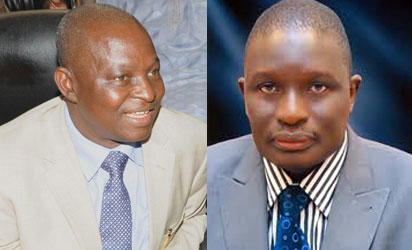
Gyang Fulani,and Senator Gyang Dantong
By Ochereome Nnanna
BEFORE the latest round of killings on the Plateau which claimed the lives of Senator Dantong Gyang and the majority Leader of the Plateau State House of Assembly, Gyang Fulani, the killing fields of the Jos area had been conveniently swept under the carpet.
This was because most of those killed in their villages while asleep were common folks. The church suicide attacks had never managed to nick any big fish.
The slaying of a senator, the highest ranking casualty since the upsurge of the terrorist insurgency all over the North and the continuing ethnic war on the Plateau, brought Jos back to the front burner, causing government to engage in its predictable, well-choreographed reaction: President Goodluck Jonathan summoned a meeting of top security chiefs; the Police deployed over 4,000 “crack” troops complete with armoured personnel carriers and combat hardware. It was classic case of deja vu.
At the end of it all, few days down the line, the killings simply continue. The so-called Fulani herdsmen, armed with sophisticated weapons, sneak in at night, hitting well-selected targets in typical ethnic cleansing style and melt away into the bush, leaving trails of blood, sorrow and tears.
When President Umaru Yar’ Adua was still alive, Brigadier General Mohammed Maina, who was in command of the military operations to restore peace was blamed for colluding with his fellow Muslim Fulani groups against the local Christian Berom people. Long after Maina was removed, it has become clear that collusion, if indeed it was true, was not enough to explain the uncanny capacity of the “Fulani herdsmen” to reap their grim harvest of death at the expense of their enemies.
The killing, last Sunday, of Senator Gyang and about 22 others while attending the mass burial of about 50 victims left one doubting the seriousness attached to security consciousness even by top officials. Anyone with common sense will know that such a grim gathering will be considered a juicy opportunity by the terror groups who have made Plateau a major cell of operation.
I am not convinced that enough security precautions were taken to forestall the tragedy that took place. It was not even a suicide bombing. It was reported as an invasion by heavily armed gunmen. To the best of my knowledge, there were no reports of exchange of fighting which a statement credited to Boko Haram gleefully claimed it was their handiwork.
After about four years of the war of attrition now with Boko Haram weighing in, the targeted communities, the Plateau State government and the military expedition on the Plateau ought to have figured out where these “herdsmen” stage their attacks from. They should have started getting idea how they move about and they coordinate their attacks, who provides them with funding and ammunition and where they are likely to strike next.
I am totally baffled that the people of the Plateau, who are supposed to be highly savvy in the military profession (having participated heavily in the anti-Igbo pogroms in the North in 1966/67 and the war to keep Nigeria one) should have produced a fitting communal response to the Janjaweed-like raids by the supposed Fulani herdsmen.
Even the governor, David Jonah Jang, is a retired military officer! Why all this cluelessness in apprehending the security threat in his domain? In April 1992, I attended the turbaning of retired General Dom Kat Bali in Langtang, his home town, by the Ponzhi Tarok, Edward Cirdap Jatau. One of the traditional dance groups that entertained were dressed up in army uniform and marched like soldiers to underscore the military culture of the Plateau people.
They should know a thing or two about intelligence, vigilance and military tactics, at least for self-preservation. Why can’t they tap into this to at least defend themselves since the state and Federal governments have proved themselves unable or unwilling to do so? During the civil war Biafrans were able to apply militia tactics to defend their communities until they were outgunned by the invading federal forces. In matters like these there are many things you can do for yourself to survive.
At first I was sceptical about the invitation of President Goodluck Jonathan to tell the House of Representatives to explain exactly why the Federal Government appears unable to cope with the security threats facing the many flashpoints of Northern Nigeria.
But now, I am more inclined to encouraging him to respond positively to it. We need to know how long we have to wait and how many more of our defenseless citizens we must lose before the people sponsoring the killers are unmasked and squelched. What exactly have we achieved since we appointed Lt Gen Sarkin Yakin Bello the President’s Adviser on Anti-terrorism?
Why was a military officer who was so effective as the Joint Task Force, JTF, commander in the Niger Delta and the South East suddenly part of an ineffective Presidency when it comes to security threats in the North? There are too many questions waiting for answers.
One thing is clear though. Unless the President comes on top of the security situation in the North there will be no basis for him to ask Nigerians to renew his mandate in 2015. Even if he succeeds in manipulating his way to become the candidate of the Peoples Democratic Party, PDP, he may become the first president to be voted out of power in Nigeria’s history, especially if the opposition parties create a credible alliance and present an acceptable candidate other than the “dog and baboon” democrats.
Disclaimer
Comments expressed here do not reflect the opinions of Vanguard newspapers or any employee thereof.