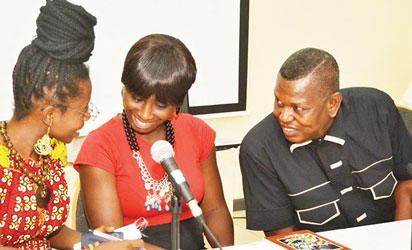
Kate Ekanem, Celina Kile and Joe Dudun at the event in Lagos.
By Prisca Sam-Duru
THE standard of living of most writers in Nigeria has long been nothing to write home about. A whole lot of issues ranging from discouragement from publishers, poor reading culture of the people which makes sales of published works, almost impossible, and most recently, advent of the social media, etc, have been viewed as bane of the literary industry

Kate Ekanem, Celina Kile and Joe Dudun at the event in Lagos.
It was with the aim of contributing to finding a lasting solution to these undermining factors, that Kate Tales Foundation in collaboration with Goethe Institut Nigeria, last week, held the April edition of Authors Talk where writers brainstormed on how best to make a good living out of their profession.
Themed, “Writing, Through the Perspective of an Unpublished Writer.”, the programme apart from eliciting debates and arguments as to what should and shouldn’t be done to improve upon lives of writers, also turned out to be a platform for young writers to present and discuss their works to an audience of publishers, journalists, art enthusiasts and other interested guests.
Standard of living
Some of the writers who were on ground to address issues raised during the programme included; Abubakar Adam Ibrahim, Adebola Rayo, Celina Kile, Dami Ajayi and Kingsley Iweka. Others were Nollywood screen writer and poet, Joe Dudun; Kate Ekanem, Miracle Adebayo, Sophia Jerome, Omoya Yinka Simult and Toni Kan.
During discussions on the standard of living of Nigerian writers which many agreed was nothing to write home about, one of the writers, Abubakar Ibrahim, regretted that writers are usually associated with poverty.
He however, corrected that wealth should not be measured in relation with how rich a writer should be but rather, any writer who finds fulfilment in his or her works is not poor.
“There’s a trajectory you can fall into; Instant success/hit like Chimamanda Adichie; those who write and die unsung, and sleepers which are those who write and no one publishes them. He buttressed his points with examples of the diverse categories of writers and advised writers to own their space, market themselves properly and make a living out of their writing career.
Another writer, Olajide surprisingly differed from Abubakar’s opinion. He told the house that he did not hope to make money out of writing. His position on the matter elicited very heated argument from the audience. At the end, it was agreed that writers must make money out of writing and that Olajide only spoke out of some ugly experience which actually ended with his father, a movie scriptwriter who died unrewarded for his hardwork.
The photography session which was handled by award winning photographer Nseabasi Akpan, was a documentary titled, “Quidah: People, Culture and History. The documentary borders on the issue of slave trade involving the people of Quidah, a community in Benin Republic, how they lived, while maintaining their cultures under the British and Portuguese colonial masters.
Spoken word performance by Chemistry, earned her a resounding applause from the audience. She lamented how things have gone sour in the nation as well as the need to recover the missing Chibok Girls.
Kingsley Iweka in another session, explained that the social media is not all about surfing the net. It is something that defines us and therefore, should not be limited to twitting, sharing posts or placing books for people to read, stressing that writers should learn how to maximise the platform for profit.
Platform for profit
During the discussion centred on a sub theme, “Between Poetry and Filmamaking: Synthesis of Form”, Joe Dudun, xrayed the difference between a good book and a film adaptation of the book. Reacting to why film adaptations of books do not resemble the original works, Dudun explained that “When books are adapted, it takes a different form, what we do is just lift the story from the book and let pictures tell the entire story on screen. We do not adapt page by page or scene by scene.”
Founder of the Kate Tales Foundation, Kate Ekanem, a 21 year old writer and girl child activist who started writing at the age of five, advised unpublished or young writers not to allow complex issues bring them down. She said that, “ You may not be as good as Wole Soyinka or other established writers but as long as you can put some sentences together, you are a writer. All you need to do is attend workshops, be mentored by established authors, work on your manuscripts and also have them checked by a good editor, and you never can tell how renowned you could become in future.”
Disclaimer
Comments expressed here do not reflect the opinions of Vanguard newspapers or any employee thereof.