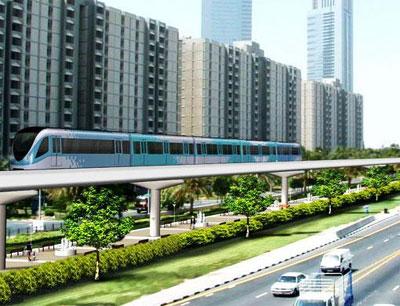
Abuja light rail
By Vera Anyangafu
It is sad to know that Nigeria, with a population of over 170 million and boasting to be Africa’s number one economy has a rail network of 3,505km besides the new lines of about 1,129 km or more under construction, while South Africa, with about 50 million people has 20,192 km of railway network.
In South Africa also, railway network connects all the major cities, and I am not misplacing facts to state herein that a nation without effective railway system is practically backward in economic development
Imagine the city of Lagos without the maddening early morning traffic gridlock. Developing countries with similar characteristics like the city of Lagos, Abuja, Enugu, Port Harcourt and the likes have remodeled their railway system to be able to accommodate up to 14 rail lines in one station connecting nearby towns and cities.
These were the words of the President and Co-coordinator, Good Governance Initiative, GGI, Mr. Festus Mbisiogu, during a recent chart with Vanguard.
According to the China-based Nigerian business mogul, who is also the CEO, Blue Diamond Logistics, China, it will be in the interest of the Nigerian government to ensure that Nigeria built itself a workable railway system to boost increasing economic activities across countries.
Africa’s number one?

Abuja light rail
He noted that a good railway system in Nigeria will reduce the risk associated with moving good from one part of the country to the other through road transportation, stressing that Nigeria, rated as Africa’s prime example of economic growth, stands the risks of losing such positions to mere paper rhetoric as Africa’s number one economic hub if such prime economic indicators as an efficient railway system continue in its snail speed and bureaucratic policies.
He said: “When we say Nigeria is a leading economy in Africa, it should reflect in its physical structures. If we say Africa looks up to Nigeria to lead in the transformations taking place across African continent, then Nigeria should take into consideration the urgent need to rehabilitate its aging infrastructures and industries.”
The Blue Diamond Logistics boss also pointed out that as head counts increases, citizens are setting up business sites and expectantly, more cars, motorcycles, and bicycles are put on the road to transport goods and services to numerous agents and consumers across the county.
He said in such situations, transportation by road becomes a major challenge, and decongestion turns out to be too chaotic for other non-commercial road users.
Citing the ugly situation as life threatening for the fact that in many occasions, drivers of tankers loaded with inflammable products and or trailers with unfastened loaded containers always jostle for space with smaller vehicles, and many a time, avoidable accidents occur.
He, therefore, urged the Federal Government to hasten construction of additional effective railway system to help decongest the number of heavy duty trucks and other commercial vehicles jostling for space on roads.
Citing China as a fast developing country, with its urban population posing a great challenge, the GGI President opined that the government of President Goodluck Jonathan should not relent in embarking on a complete overhauling of the Nigerian transportation system.
He added that introducing speed trains that connects neighbouring cities will go a long way in boosting the Nigerian economy.
On Lagos
He said: “The Lagos State government under Mr. Raji Fashola has started on a very good note with its light rail projects from Lagos to Badagry.
“But the good intention may be hampered by avoidable nonchalant bureaucratic bottlenecks disrupting progress of work, evidenced by the slow pace of work going on with the projects five years since it started.
“The situation is worrisome in the sense that Lagos serves as the economic nerve centre of Nigeria and is famed as one of the highest rural-urban migration hotspot in Africa, with a bustling population compared to its landmass.”
How it was
Recalling the Nigerian railway system as among the first generation of railway systems in the world, designed to facilitate the flow of goods, such as groundnut, cocoa and cotton from the inlands to the coast, Mbisiogu pointed out that the bringing back effective railway system in the country is one of the best thing that will happen to the country’s economy.
He said: “The Nigerian government is making commendable effort through the implementation of its promises on boosting the railway sector.
“More so with the 80 percent completion of the Abuja-Kaduna railway network.
“When you read government plans on revamping the Nigerian railway system with an investment worth over $10 billion, it could be very heartwarming, especially with the Federal Government’s August 2010 Draft on National Transport Policy.
“In view of this, I would be glad if President Goodluck Jonathanled government makes possible a complete overhauling of the railway system beyond paper rhetoric.”
Disclaimer
Comments expressed here do not reflect the opinions of Vanguard newspapers or any employee thereof.