By Joseph Erunke
How can they considerably raise the bar in terms of proportionate representation with their male counterparts in all spheres of public life, especially elective and appointive positions? This was the question thousands of Nigerian women who converged on Abuja Monday and Tuesday attempted to ask. The women who met at the instance of the Democratic Governance for Development Project, DGD, the Federal Ministry of Women Affairs and the Independent National Electoral Commission, INEC.
It was a two-day national conference tagged: “Enhancing Opportunities for Women Candidates in the 2015 Elections”. First Lady, Mrs Patience Jonathan was represented by the Minister of Water Resources, Mrs Sarah Ochekpe, while the Minister of Women Affairs, Hajia Zainab Maina and the Chairman of the Independent National Electoral Commission, Prof. Attahiru Jega, were among those in attendance.
Women in elective positions
The event, which was basically to discuss strategies that would enhance opportunities for women candidates in the forth coming general elections with the objective of achieving an increase in the percentage of women who win elective positions, saw the INEC chairman, publicly presenting the INEC Gender Policy.
The conference was also an avenue to address the need for political parties to commit to 35 percent affirmative action based on the National Gender Policy, 2006, for women aspiring for elective positions; the mitigation of the electoral violence and ensuring inclusive participation of youths and persons with disabilities.
Leading other speakers to harp on issues of concern during the two-day event, Dr. Mourtada Deme, the Project Director, DGD II, a joint donor funded project, managed by the UNDP in support of deepening democracy in Nigeria, said the conference was aimed at finding answers to the problems associated with low participation of women in politics with a view to recommending measures that will institutionalize a support system to enable women win more positions in the 2015 elections.
He said: “We know all too well that there are those who still dispute the importance of women to their country’s progress and its governance. Yet the evidence is irrefutable. There is a mountain of data today that shows investments in women correlate positively to a country’s prosperity, poverty alleviation, and economic growth; moreover, according to the World Bank, at the country level, higher rates of female participation in government are associated with lower levels of corruption. Investing in women is not just the right thing to do, but the smart thing to do,” she said.

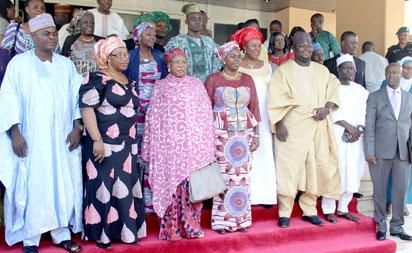
•Participants at the conference
His observation was concurred by the Mrs. Jonathan, who, while regretting the decline in women engagement in elective and appointive positions, urged Nigerian women to actively participate in the ongoing electoral processes in the country, saying it was time for them to compete favourably with their male counterparts in elective positions.
Mrs Jonathan, while applauding the roles women were playing to positively transformed the society, expressed appreciation that more Nigerian families were investing in girls’ education, saying the development would make women to be politically and economically independent.
In her speech, Women Affairs Minister, Hajia Zainab Maina, regretted that women were not being taken along in decision and law making, noting that the number of women representation in all sectors of life showed that they were more or less being excluded.
“The number in terms of female representation in Nigeria reflects the almost exclusion of women. With less than 7 percent representation in elective positions, Nigerian women are among the less represented women in any sense when critical decisions, especially law making, distribution of the country’s resources that have unprecedented impacts on their lives are made.
Chairman of INEC, Prof. Jega, on his part disclosed that the commission was “cultivating a culture of transforming our electoral experiences, in turning challenges into opportunities for improvement as we work together to midwife a stable and sustainable electoral system befitting of a country with the largest population in Africa.
“The goal is to arrive at a destination where the electoral system is structured to support equal and equitable participation and political representation of all sectors of our society, enable violence free, fair and credible elections, enthronement of good, responsive and accountable leadership at all levels and the creation of an enabling environment for the sustainable national development, closing the gender gaps in politics and offering equal political opportunities regardless of gender.
Influx of money
He said the commission has also created a unit to monitor party finances with a view to checking the influx of money in party politics, saying “serious measures were also being taken to eliminate violence during election by means of proactive steps designed to identify and avert electoral violence.”
He said the commission was undertaking dialogue with the leadership of all the political parties in the country as well as traditional and religious leaders to encourage women participation in the forth coming general election.
Disclaimer
Comments expressed here do not reflect the opinions of Vanguard newspapers or any employee thereof.