Independence address, endless promises no specifics
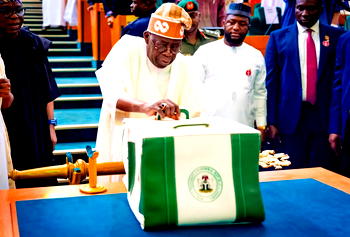
By Dele Sobowale Bayo Onanuga, the Senior Special Adviser to the President, accused critics of writing their responses without reading Tinubu’s address. That is certainly not true about me. In fact, the address was read to me by Uncle Sam, the Publisher of Vanguard, in his house – while asking for my comments on a […]



Why monthly allocations to states will never be enough -1
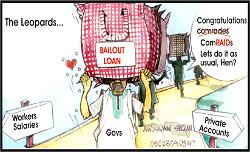
If there is one thing uniting the thirty-six state governors, irrespective of political affiliation, it is the fact that the two bail-out arrangements fashioned out by the Federal Government have not solved the problem. Doctors in the medical field know the phenomenon too well. It is called treating the symptom instead of the cause(s) of a disease. And, like cancer, which starts as a small lump and becomes bigger on life-threatening, economic tumour starts slowly; get bigger; and eventually might lead to economic calamity.
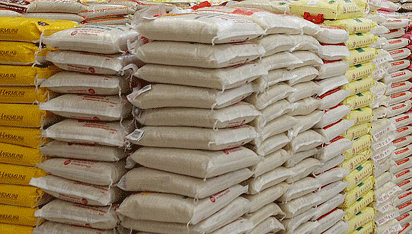
Reversal of rice import prohibition and its consequences
The report in the NATION, October 13, 2015, page 7, titled “Fed Govt suspends quota issuance to rice millers”, brought tears to my eyes. It would be the third time in my life that the Federal Government of Nigeria would drive me to tears of frustration over the national policy on rice importation. Althogu, I no longer have any investment or involvement with the sector, it is the only sector in which personal monetary investments as well as sacrifice of well-paid job was made because of government policy announcement.
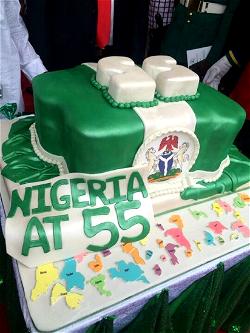
Who is baking the Nigerian cake ?
In a report written by Oyetunji Abioye, readers were told that “the bank stated that a more challenging economic environment would make growth in the region to come down to 3.7 per cent from 4.6 per cent in 2014”. Readers, familiar with this page, surely know that we have not needed to wait for the World Bank to tell us the bad news about the Nigerian economy in 2016. So far in 2015, the economy had managed to grow only about 2.4 per cent; and is heading lower!! Every economic indicator known to forecasters points to a dreadful 2016.
Toss out TSA, please (2)
Incidentally, if you ask any of its supporters what it is designed to achieve, the answer will be, “to curb corruption”. But will it? If historical experience in Nigeria is to be our guide, the correct answer will have to be “very doubtful”. Let me quickly explain the reasons. While conducting the research which resulted in the book PDP: CORRUPTION INCORPORATED, what was most striking to me was how much corruption was accounted for by transactions and activities which are not reflected in the balances in the bank accounts of Ministries, Departments and Agencies, MDAs.
Toss out Treasury Single Account, TSA, please (1)
My first articles on the Nigerian economy appeared in VANGUARD on Mondays in the 1980s, shortly before military President Ibarahim Badamasi Babangida, IBB, introduced the Structural Adjustment Programme, SAP. It was the most ambitious economic programme, ever, in our history. Even, till today, nothing has come close to the far-reaching impact of the economic policies.