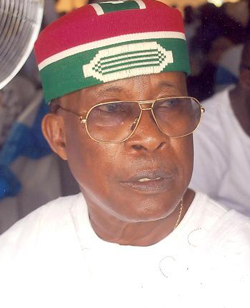
Rear Admiral Onah (retd)
Rear Admiral Mike Onah (retd) says Nigeria should face the reality by using a radical approach to resolve the current challenges facing the nation, saying it will lead to the transformation of the country.
The National President, Ndokwa Political Leaders Forum also speaks on the war against corruption, the crisis in the Niger-Delta, Nigeria at 56 and his ancestral Ndokwaland.
Excerpts:
What is your assessment of Nigeria at 56?
To God be the glory that we still remain one as a nation. Although some Nigerians would have expected the nation to have developed more than this because, at Independence, Nigeria showed a lot of promise, but, somewhere along the line, we lost focus but all hope is not lost. Nigeria is a nation with a lot of potentials. Our major problem has always been how to harness the resources to get the best for the nation.

Rear Admiral Onah (retd)
To move forward, we need attitudinal change. Nigerians should be more patriotic. We should all see ourselves as one. We should also strive to use our large population to our advantage like China, India, Indonesia and the United States. We might not be there yet, but we will get there.
On the fear that the clamouring for restructuring may lead to the breaking-up of the country, what do you have to say?
I don’t think Nigeria will break up. Restructuring will do Nigeria a lot of good. However, it is unfortunate the way some people are talking about it, giving it a wrong meaning. There are so many benefits for Nigeria remaining as one nation. It is only here in Nigeria that we are not using our size and population to our advantage.
For those agitating for break-up or thinking of forming a separate country, they should realise that they stand to gain more in a united Nigeria. If we practice true federalism, some of their concerns would have been addressed.
At independence, Nigeria adopted federalism, and this was in practice until military incursion which altered the situation. But my advice to President Buhari and other stakeholders is that we should embrace dialogue to resolve these issues. Violence by militants and other agitators and the counter use of force by government will only worsen the situation.
What do you think is responsible for our present socio-economic challenges?
One is over-dependent on oil over the years which made us to become lazy to the extent that we even neglected agriculture which used to be the mainstay of our economy. I believe a return to true practice of federalism will bring the best out of us. Adversity at times forces people to think of how to survive. When you suffer, you are forced to think about how to overcome that suffering in order to enhance your well-being and survival.
Meanwhile, the oil wealth is stolen by a privileged few while millions of Nigerians, including the people living in oil producing communities who are the primary source of this wealth live in poverty. Oil production has destroyed the oil communities eco system. It has adversely affected their livelihood. If has destroyed their farmlands, fish, etc. So where has been the blessing in the so-called oil?
Let us return to the olden days when Nigeria’s economy was diversified. I’m talking about the glorious era of cocoa and palm oil in the South-West, rubber in the Mid-West, coal in the South-East, and cotton and groundnut in the North. Some of us still remember the famous groundnut pyramids in Kano, but where are they now?
Some people have argued that our present presidential system of government is too expensive,do you agree?
That’s correct. The type of government we practice is also very expensive. Presidential system consumes a lot of money. A lot of money is spent on political appointees and other public office holders with little or no money kept for development.
Under presidential system of government, you have duplication of offices both at the federal, state and local government levels and you have thousands of political appointees, other elected public officers collecting jumbo pay. I don’t think presidential system is the best for us. We need to reduce cost of governance.
What is the way out of the crisis in the Niger-Delta?
I’m worried just as I believe that every right thinking Nigerian should be worried. Resurgence of violence not only in the Niger-Delta but in also other parts of the country has become a source of concern. To the best of my knowledge, no nation prospers in the midst of violence.
There is no doubt that in Nigeria today, we have a lot of problems. Poverty is also on the rise and things are very difficult but for all these, we have to blame ourselves for the ugly development. For us to find an amicable solution, I believe we should embrace dialogue. Violence and use of force to counter violence will only aggravate the situation. Anybody that has ever witnessed war will never pray for a repeat. Nigerians should allow the voice of reason to prevail. Rather than war-war, we should jaw-jaw.
Some people are saying that nothing has really changed in terms of transformation since the inception of the Buhari administration. What do you think?
That is wrong. A lot of things have changed, and some of those things include the way Buhari has faced corruption.
Unlike before, now there is the fear of the consequence of engaging in corrupt acts. Not only that, the culture of impunity is gradually fading away.
On the issue of Niger-Delta Avengers and the bombings, you were canvassing dialogue but …
For those bombing oil pipelines, this is wrong. Violence is not the solution, rather it worsens the situation. In the process of violence, you cause a lot of damage, and not only that, lives are often lost.
My advice to government is that steps should be taken to address the problems of unemployment especially among the youths. Government should strive to introduce people-oriented programmes that will help to cushion the effects of economic recession on Nigerians.
You are from Ndokwa and there is the claim that the area is marginalised on account of its non-representation on the NDDC Board. Where do you stand?
In Delta State, we have five oil producing ethnic nationalities namely, Isoko, Ijaw, Urhobo, Itsekiri and the Ndokwa. But strangely it is only Ndokwa that is yet to have any representative on the NDDC Board since 2000 when the Commission was set up. Delta State representatives on the NDDC Board are supposed to be produced on rotational basis among these five ethnic groups, but no representative from Ndokwaland has ever sat on the NDDC Board.
It is only representatives from Ijaw, Isoko, Urhobo and Itsekiri that are being appointed while our people have been neglected. This is unfair. We want the Federal Government to remedy the situation now.
And it is sad that there is no visible presence of NDDC in Ndokwaland. There are eight oil companies operating in our area including Agip. We also have biggest gas deposit in Nigeria. But, painfully,we have nothing to show for it.We have no electricity supply. Ndokwaland is in darkness. Our roads are very bad. No good hospital. We have made several appeals to the NDDC and the oil companies operating here but none of them has come to our aid.
Disclaimer
Comments expressed here do not reflect the opinions of Vanguard newspapers or any employee thereof.