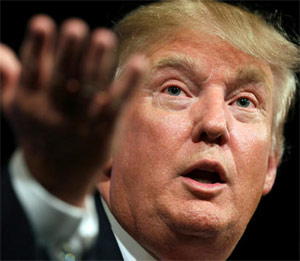
Donald Trump
Donal J Trump has declared a $916 million loss on his 1995 income tax returns, a tax deduction so substantial it could have allowed him to legally avoid paying any federal income taxes for up to 18 years, records obtained by The New York Times show.
The 1995 tax records, never before disclosed, reveal the extraordinary tax benefits that Mr. Trump, the Republican presidential nominee, derived from the financial wreckage he left behind in the early 1990s through mismanagement of three Atlantic City casinos, his ill-fated foray into the airline business and his ill-timed purchase of the Pl the Plaza Hotel in Manhattan.
Tax experts hired by The Times to analyze Mr. Trump’s 1995 records said that tax rules especially advantageous to wealthy filers would have allowed Mr. Trump to use his $916 million loss to cancel out an equivalent amount of taxable income over an 18-year period.
Although Mr. Trump’s taxable income in subsequent years is as yet unknown, a $916 million loss in 1995 would have been large enough to wipe out more than $50 million a year in taxable income over 18 years.
The $916 million loss certainly could have eliminated any federal income taxes Mr. Trump otherwise would have owed on the
$50,000 to $100,000 he was paid for each episode of “The Apprentice,”or the roughly $45 million he was paid between 1995 and 2009 when he was chairman or chief executive of the publicly traded company he created to assume ownership of his troubled Atlantic City casinos. Ordinary investors in the new company, meanwhile, saw the value of their shares plunge to 17 cents from $35.50, while scores of contractors went unpaid for work on Mr. Trump’s casinos and casino bondholders received pennies on the dollar.
“He has a vast benefit from his destruction” in the early 1990s, said one of the experts, Joel Rosenfeld, an assistant professor at New York University’s Schack Institute of Real Estate. Mr. Rosenfeld offered this description of what he would advise a client who came to him with a tax return like Mr. Trump’s: “Do you realize you can create $916 million in income without paying a nickel in taxes?”
Mr. Trump declined to comment on the documents. Instead, the campaign released a statement that neither challenged nor confirmed the $916 million loss.
“Mr. Trump is a highly-skilled businessman who has a fiduciary responsibility to his business, his family and his employees to pay no more tax than legally required,” the statement said. “That being said, Mr. Trump has paid hundreds of millions of dollars in property taxes, sales and excise taxes, real estate taxes, city taxes, state taxes, employee taxes and federal taxes.”
The statement continued, “Mr. Trump knows the tax code far better than anyone who has ever run for President and he is the only one that knows how to fix it.”
However, the tax experts consulted by The Times said nothing in the 1995 documents suggested any wrongdoing by Mr. Trump, even if the extraordinary size of the loss he declared would have probably attracted extra scrutiny from I.R.S. examiners. “The I.R.S., when they see a negative $916 million, that has to pop out,” Mr. Rosenfeld said.
The documents examined by The Times represent a small fraction of the voluminous tax returns Mr. Trump would have filed in 1995.
The documents consisted of three pages from what appeared to be Mr. Trump’s 1995 tax returns. The pages were mailed last month to Susanne Craig, a reporter at The Times who has written about Mr. Trump’s finances. The documents were the first page of a New York State resident income tax return, the first page of a New Jersey nonresident tax return and the first page of a Connecticut nonresident tax return.
Each page bore the names and Social Security numbers of Mr. Trump and Marla Maples, his wife at the time. Only the New Jersey form had what appeared to be their signatures.
The three documents arrived by mail at The Times with a postmark indicating they had been sent from New York City. The return address claimed the envelope had been sent from Trump Tower.
Disclaimer
Comments expressed here do not reflect the opinions of Vanguard newspapers or any employee thereof.