By Oghene Omonisa
Organisers and participants at the Tackling Corruption Together Conference, and the Anti-Corruption Summit: London 2016, which held in London on Wednesday and Thursday, no doubt, had expected the usual jamboree, where papers are presented and theoretical discussions held and everyone returns to his or her country: business as usual.
 However, the events turned out to be business unusual as the issue of corruption was frontally discussed beyond rhetorics, and practical steps taken to confront the issue of corruption, generally seen as a major factor responsible for the underdevelopment of third world or developing countries.
The conference, aimed to underline anti-corruption as a shared agenda for civil society, business and government, was hosted by the Commonwealth Secretariat in partnership with Transparency International, Thomson Reuters, Omidyar Network, the Commonwealth Enterprise and Investment Council, the B Team, and ONE. The conference preceded the summit held the following day and hosted by the British Prime Minister David Cameron, which aimed to agree a package of practical steps to expose and drive out corruption.
“Fantastically corrupt” comments
However, the renewed focus on corruption and practical and concerted efforts to tackle it were inadvertently triggered by the comments made on Tuesday by the British Prime Minister ahead of the conference. While briefing the Queen of England, Elizabeth II, at an event to mark her 90th birthday at Buckingham Palace, the PM had commented to Her Majesty: “We’ve got some leaders of some fantastically corrupt countries coming to Britain … Nigeria and Afghanistan, possibly the two most corrupt countries in the world.”
Afghanistan was ranked at 167, ahead of only Somalia and North Korea, in Transparency International’s 2015 corruption perception index. Nigeria was at 136. Unfortunately for him, there were multiple cameras in the room, filming the conversation, and after it was reported by the BBC, the video went viral, expectedly instigating comments around the world, with some commentators supporting the PM’s position, while others kicking against it.
In his response to Cameron’s comments at the Buckingham Palace event, Archbishop of Canterbury Justin Welby had this to say: “But this particular president (President Buhari) is not corrupt .… He’s trying very hard”, while British House Speaker John Bercow was of a carefree position: “They are coming at their own expense, one assumes?”
Back home, there were also divergent responses. The President’s critics picked on it as proof of their position that he has not been honest and effective in his anti-corruption posture, while the Presidency faulted Cameron, that he was living in the past as Nigeria was no longer that country where anything goes.
“I don’t want apology; I think Cameron was being honest about it”
Addressing the conference in London Wednesday morning, in the wake of Cameron’s comment, President Buhari said he would not demand apology but, instead, would demand action from Cameron, by returning Nigeria’s stolen money and assets stashed in the United Kingdom. He admitted that the war against corruption currently being waged by his administration was not an easy task, but expressed his readiness to prosecute the war to a successful end even if it meant stepping on toes.
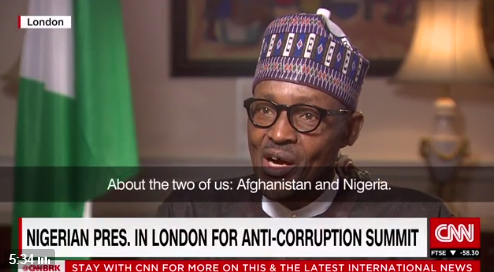
The following day, the President told CNN’s Christiane Amanpour that the British Prime Minister was right in describing Nigeria as “fantastically corrupt”. “He’s talking about what he knows about the two of us, Afghanistan and Nigeria,” said Buhari. “And by what we’re doing in Nigeria by the day, I don’t think you can fault him.” This implied that it is the same corruption that his government is presently fighting back home.
And in a separate interview with BBC’s Clive Myrie in London on the same day, Buhari repeated that the British Prime Minister was “talking about what he knew.” Earlier in the day, on his way to the summit venue, Buhari had responded “Yes” to journalists when asked if Nigeria was indeed a “fantastically corrupt” country!
Positive response
Interestingly, Buhari’s honestly has drawn positive response in words. World leaders have acknowledged the need for the Western countries, including the UK, to cooperate with the developing countries, where corruption is more prevalent, in discouraging the stashing of stolen funds in their countries, and they also hailed the London meeting as the biggest demonstration of political will to tackle graft.
Britain, France, the Netherlands, Nigeria and Afghanistan later pledged to set up public registers of true company ownership. They will also implement other measures to tackle issues ranging from property money-laundering to doping and match-fixing in sport.
David Cameron would later describe the agreement as the biggest demonstration of political will for many years to stamp out international graft. United States Secretary of State John Kerry told the summit there was no doubt corruption was intensifying the threat of terrorsm across the globe.
“And the extremism that we see in the world today comes to no small degree from the utter exasperation that people have with the sense that the system is rigged. We see this anger manifesting itself in different forms in elections around the world including ours. People are angry and the anger is going to grow, unless we shut the doors and try to prove to people there’s a fairness.”
World Bank President Jim Yong Kim highlighted the effect of what he called “radical transparency” as a deterrent to corruption. “Whether we like it or not, hackers are going to expose more and more – the Panama papers were a good example. So in that regard, since it will be forced on us anyway, we need to send a message to those who are benefiting from corruption that we’re going to get to the bottom of this.”
International Monetary Fund (IMF) Managing Director Christine Lagarde, said anyone who was pro-growth must also be anti-corruption.
And to Commonwealth Secretary-General Patricia Scotland, “It’s going to take all of us to tackle corruption in all its forms. This isn’t just about money. It’s about the corruption that sees women have to trade sexual favours for access to goods and services, it’s the corruption that sees children abused so they can stay in the classroom, it’s the corruption that blights so many lives in so many different ways.” It however remains to be seen how much of these words will be translated into action and the world finally seeing a rapid decline in corruption, especially in developing countries where corruption is commonly known to be most rampant.
Disclaimer
Comments expressed here do not reflect the opinions of Vanguard newspapers or any employee thereof.