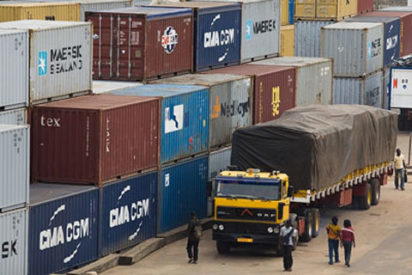
A fully loaded truck in one of the inland dry ports in the sub-region, will be delayed, harassed for bribes by the numerous security agents along the region’s transport corridor before it gets to its destination.
By Jonah Nwokpoku
The Nigeria Export Promotion Council, NEPC has said it is considering an investment policy that will give incentives to prospective foreign investors through a package in its proposed investment policy. Chief Executive Officer, NEPC, Mr. Segun Awolowo stated this while speaking at a seminar to flag off the first Iran solo exhibition in Lagos.

A fully loaded truck in one of the inland dry ports in the sub-region, will be delayed, harassed for bribes by the numerous security agents along the region’s transport corridor before it gets to its destination.
He said: “The council will advocate incentives for prospective foreign investors through a new package from the proposed investment policy that we are working on. This will encourage foreign direct investment in designated free trade zones in the country and Iran for instance might be encouraged to come and establish fully owned industries in Nigeria.”
The NEPC boss said the council was inspired by its mandate as the apex organisation in Nigeria saddled with developing and promoting non oil exports to support consolidation of trade promotion strategy through the mobilisation of Nigerian exporters and relevant stakeholders for the first ever Iranian Solo Exhibition in Nigeria.
He said: “This exhibition could not have come at a better time and from any other country being that both countries recently launched a new government and both share few economic landscapes in the areas of mining, industry, oil and gas and among other areas. To my mind, there can be no doubt that the hosting of this trade event has further internationalised the Iranian product and synchronised the social and economic relationship of both Nigeria and Iran.
“The lopsidedness of trading balance between Nigeria and Iran calls for concern. With claimed expertise, I am sure Iran can assist Nigeria to develop her maritime, air travel transport, water resources, power, agricultural and petrochemical sectors. Indeed the petrochemical sector is very key for us as we stand to diversify our economy. We request you to extend the success recorded in petrochemical industry in Iran to Nigeria.
Such industries will provide raw materials for small and medium enterprises thereby creating jobs along the value chain in Nigeria.” Also speaking, Nigerian ambassador to Iran, Mr. Tukur Mani noted that Nigeria and Iran had signed lots of trade agreements during a joint session in 2014 but implementation of those agreements have been slow.
He said Nigeria and Iran have been relating since the 70s but unfortunately many Nigerians are still unaware about what Iran is all about and how they can also take advantage of the position Iran occupies in the Middle East as the most industrialised country.
Disclaimer
Comments expressed here do not reflect the opinions of Vanguard newspapers or any employee thereof.