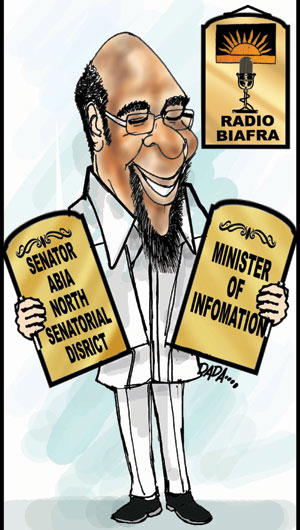
Chukwumerije
Sundays have a way of being languid. You could be recovering from a hangover induced by the previous night’s binge. Or, you went to church, if such was your convention. Or you sat in your house and watched television – if there was power supply, whether from the national grid or from your generator. As the day wore on, you decided if, perhaps, there was some wisdom in paying someone a visit; alternatively, you accepted the fait accompli of a few folks, including disagreeable ones, looking in and setting you back by a few coins, thanks to the booze you would offer them.
After the sun had withdrawn the sharper pricks of its burning fire, you could settle for watching on the silver screen as soccer stars justified their hefty paychecks and perquisites in the leagues of foreign countries. Whether the final scores gave you cheer or pain, both of which emotions should actually be pointless for the Nigerian, you watched the day gently slip away. You looked up to Monday morning, if you aren’t of the countless unemployed, that is.

Chukwumerije
On Sunday, April 19, the evening caught me with not much to do. I didn’t see the point of venturing out. I would, whether or not I liked it, leave home to following day, to keep a 10am appointment. It was necessary to print out the 40 something pages of text I had written, so we chat over their import and chart the course of further work. I kept the printed pages on a side table and took to my bed, not to go to sleep at 5.30 pm, but to sate my rediscovered joy of reading Albert Camus, whose book of essays, The Myth of Sisyphus, I had handy.
The phone call
I hadn’t done an hour of reading when my phone rang. It was the same lady who had broken the news of General Emeka Ojukwu’s death to me in 2011. “Are you watching AIT?” She asked. I wasn’t watching anything, I replied. My TV wasn’t even on. “Switch it on and tune to AIT.” I told her I wasn’t prepared to do anything of the sort, unless she mentioned whatever awaited my confrontation.
“Chukwumerije is dead.”
Thus, when I got to Comrade Uche Chukwumerije’s Maitama, Abuja home on April 20, it was not for us to look at the draft of two more chapters of his biography that I had written. Once I entered the house, Chika, the Olympic taekwondo champion, and one of Chukwumerije’s six sons, welcomed me with a handshake and this declaration: “Your friend is dead.”
Although I had known of him since Biafra, my friendship with Chukwumerije started in 2000. That year, I had presented him with a copy of Ironside, my biography of General Aguiyi-Ironsi and, although it was rather presumptuous of me (not by any stretch of the imagination would anyone pretend that I and the comrade were transmitting from the same megahertz; he was up there and I was groping for the ropes with which to climb) I asked if he would please do a review of the book for its Enugu presentation. Chukwumerije gladly accepted the task.
The biography
I believe it was Ironside that persuaded him years later to commission me to write his own biography. But the going wasn’t easy. He was busy at the Senate, and I held down the job of Chief of Staff to the Governor of Anambra State. Years later, when I had turned my back to the Awka political establishment, I returned to him with apologies on the slow pace of work on the biography. But he would not hear of it, insisting that nobody was to blame since we both had our hands full of other pressing responsibilities. Months later, I visited him one evening and watched with a certain alarm as he belaboured me for tardiness on the project. But, in a certain sense, Chukwumerije was a strange man. He didn’t dwell on infractions against his person. For instance, and as I found out in the course of my research, one of his half-brothers, an undergraduate, who was on vacation in his Lagos home, had decided that he had better use of Chukwumerije’s wristwatch. Chukwumerije found out, recovered the watch and instantly forgot the matter.
Chukwumerije was easy to misunderstand because he was an epitome of bluntness; but innately, he was a most considerate and sensitive mind. He made a choice early in life to stand on the side of the downtrodden.
He was a revolutionary
He was a revolutionary who changed his mind at the last moment against embarking on a military career, deciding instead to fight his cause with the weapon of mass communication. He was an accomplished broadcaster and journalist. That was why, shortly after the civil war, he established Afriscope, an international monthly that mediated global developments from a purely African perspective. He had been a member of the Socialist Workers and Farmers Party (SWAFP) during the First Republic, and was one of the leaders of the left-leaning People’s Redemption Party (PRP) in the Second Republic. But two of the most important roles he played were (1) in Biafra, where he was directed the secessionist republic’s propaganda machinery, and (2) in the Interim Government of Ernest Shonekan in which he was Information Secretary. A good many of the views held on this man are tied to those epochs, but they tell far less than the entire story of his reason-induced and action-packed years.
Conversation on Chukwumerije by Nigerian intellectuals
A few days ago, I got shown streams of an Internet conversation on Chukwumerije by Nigerian intellectuals mostly based in the United States. Professor Abiola Irele, the renowned literary critic, observed that, “Uche was a good friend and a great journalist. I wish him good repose.” He got stridently countered by Ebenezer Obadare, an associate professor of Sociology at the University of Kansas:
“Thanks Professor Irele. But Senator Chukwumerije was more than that, and for the sake of posterity, it is important that even as we mourn, we continue to see clearly.
“The departed senator was a malevolent force against the realization of democracy in Nigeria, and that too ought to be part of his memoriam. He trenchantly stymied the trajectory of a noble cause, and his deeds and misdeeds as the shameless factotum of the Shonekan and Abacha regimes brought grief to many families.
“Part of doing justice to the memory of the dead has to be an honest accounting of what they did while alive.
“May the senator rest in peece – and may the facts of his public service remain fresh in our memory.”
Not surprisingly, Dr. Obi Nwakanma, the poet and Vanguard columnist, who teaches at the University of Central Florida, came to Chukwumerije’s defence:
“Ebenezer. Uche Chukwumerije was a great Nigerian patriot who defended the interests of Nigeria as he saw it against imperialism by radical means. His work as a nationalist politician, from his days at the University College Ibadan, to his association with Otegbeye’s and Nzimiro’s Socialist Workers Party, and as Secretary-General of the PRP under the leadership of Mallam Aminu Kano in the Second Republic, and his service, his last hurrah as a senator of the republic who used his position in the Senate Education Committee to work for greater funding, particularly for Nigeria’s public universities, puts him beyond the pale of your characterization of him. It is often said that those who merely play drums for the Ijele on the side do not know the real toll it takes on the Ijele to carry the great mask.
“Uche Chukwumerije did not oppose the June 12 mandate, he opposed the violation of Nigeria’s sovereignty by those who find easy comfort in urging the external invasion of Nigeria. He is a greater patriot than those who will, in the end live more in infamy than to question the true patriots who have put their feet on the ground for Nigeria, and have the marks to show for it. May Chukwumerije find rest. He is in the end, to be counted among the immortals of Nigeria.”
In my view, the antipodal positions of Obadare and Nwakanma represent the tension that the biography I am working on must mediate. I may just add that Obadare’s invective is not outrageous. It is just too simply. But its simplicity is understandable, since it issues from this Age of Brevity where the social media not only allows but also actively promotes a brand of laziness that discourages the detailed exploration of antinomies. Really, it makes uncomplimentary remarks about the intellection of a people who experienced the profundity of the Nigerian civil war but have never really made any honest attempts at studying and fully appreciating its particularities and ramifications. That was why the publication of Chinua Achebe’s There Was A Country elicited from quarters thought to be academic more heat than light. That is also why, in recent weeks, all sorts of voices, including those of traditional rulers and medical doctors, have been in ascent, advocating yet another anti-Igbo pogrom.
Chukwumerije belonged to the fearless cadre
If Nigerian leaders are to be believed, the civil war was fought to keep Nigeria one. But what has continued to happen since the cessation of hostilities in January 1970, is the systematic consignment of the Igbo to a level worse than that of fourth-class citizens.
In the 1979 general elections, there were five presidential candidates, one of whom was Dr. Nnamdi Azikiwe, an Igbo. And there were five vice-presidential candidates, four of whom were Igbo. In less than four decades, the condition of Ndigbo have, in a Nigeria ostensibly kept “one”, degenerated to a lack of right to live or school or work or trade in Lagos. They can’t even aspire to produce a Minister of the Federal Capital Territory of Abuja. They must spend the rest of their lives looking behind their backs, less they are caught unawares and massacred again in a fresh wave of ethnic cleansing.
Comrade Uche Chukwumerije belonged to the fearless cadre of those loudly protesting that the current political status quo is a recipe for keeping Nigeria, not one, but two or many more. It is on this adamantine insistence on the imperative of justice and equity that his larger-than-life patriotic heroism is indexed.
Chuks Iloegbunam submitted this article from Abuja.
Disclaimer
Comments expressed here do not reflect the opinions of Vanguard newspapers or any employee thereof.