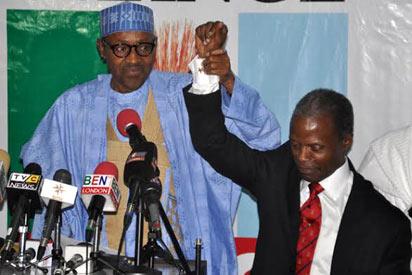
APC Presidential Candidate, Gen. Mohammed Buhari with his running mate Prof. Yemi Osinbajo SAN in Abuja. Photo: Gbemiga Olamikan
By Ochereome Nnanna
IT is strange that a section of the Nigerian political class cannot find in their ranks a suitably qualified, intelligent and competent Nigerian to give their presidential ticket to confront President Goodluck Jonathan at the polls in the next nine days. The All Progressives Congress (APC) has a galaxy of stars in all fields of endeavour in their party from all parts of the country. The APC is no longer just a gang-up of Arewa North and Bola Tinubu’s followers from the South West.
The presence of Governors Rochas Okorocha of Imo, Adams Oshiomhole of Edo, Chibuike Amaechi of Rivers, former governor of Anambra State, Dr. Chris Ngige, as well as the hordes of Peoples Democratic Party (PDP) decampees helped to give APC a national appeal. Even though the Arewa and Yoruba Muslims are still the major stakeholders in the Party, the regional, ethnic and religious coloration that disconcerted many watchers at the outset has been largely doused. The APC had an ample opportunity to present a candidate with impeccable record and quality to give Jonathan a run for his money. Even if they wanted a northern presidential candidate, they had Dr. Rabiu Kwankwaso, the ebullient, performing Governor of Kano; Alhaji Atiku Abubakar who comes with great exposure, experience and national appeal, or even the Speaker of the House of Representatives, Hon. Waziri Tambuwal a proven leader.
The Party decided, at the prompting of Bola Tinubu, to settle for General Muhammadu Buhari, a man who ruled this country thirty years ago and had nothing to show for it except sorrows, tears and blood. As soon as they settled on Buhari, they commenced a sophisticated process of dry-cleaning his image to the point where some of us who lived through his twenty-month regime could no longer recognise him. Suddenly, posters of Buhari in dinner suit (black coat, white shirt and black bow-tie) started springing up all over the skyline of Lagos and beyond. I have never seen Buhari in suit before. He has always worn two attires: his military uniform or his native Arewa babanriga. It was all an effort to make Buhari look like what he never was and never will be. It is a total hoodwink of the young people and voters born after 1985.
Today, the challenges before this nation are three-fold: the first is national unity, the second is diversification of the economy, and the third is national security.
National unity is paramount because a divided house cannot achieve anything. The politicians, in their desperate struggle for power, have thrown Nigerians at each other’s throats. We need a president who can unite the nation. I do not think General Muhammadu Buhari has what it takes to do so. He rose to political prominence through his open endorsement of militant sharia in 2000 and pledged to take it to all parts of the country. He has neither denied it nor apologised. He has no apologies for it.
Buhari is first and foremost a Fulani and Muslim before any other thing. In his brief stay in power and as Chairman of the Petroleum Trust Fund (PTF), he demonstrated these traits. As Federal Commissioner for Petroleum, he awarded 80 out of 90 oil blocks to northerners. He created the first Muslim/Muslim, Northern/Northern, Fulani/Fulani ticket. Tunde Idiagbon was a Fulani Muslim from Ilorin. Out of the nineteen members of the Supreme Military Council only two – Navy Captain Ebitu Ukiwe and Chike Ofodile, the attorney General, were Igbos! Buhari is one of those civil war fighters who see any federal presence in Igboland as “rewarding Igbos for the rebellion”. At the PTF, Buhari’s formula for sharing of contracts and amenities was: North – 65 per cent and South – 35 per cent. This was derived from the landmass proportion of North to South, forgetting that Nigeria was founded on a tripod of East, West and North, which has now been amended to six geopolitical zones.
We remember the frequent skirmishes between Fulanis and the people of Oyo state (as indeed, we see in all parts of Nigeria) as a result of Fulanis leading their livestock into people’s farms. After one of such skirmishes in Oyo in 2001 in which the Fulanis lost heavily to the locals, Buhari, a former head of state, led a delegation of Fulani Minyeti Allah (the umbrella body of cattle-rearers) to confront Governor Lam Adesina in Ibadan. He was quoted as asking the governor: “why are your people killing my people?” Anybody who has been the leader of Nigeria has no moral authority to discriminate between Nigerians, at least so openly.
The presidency in the hands of Buhari will restore Fulani/Muslim hegemony which Obasanjo strained hard to dissipate through the reformation of the Army. I am not looking forward to that. As an Igbo man, I am not looking forward to anybody who fought the civil war leading this country again. He will always remember the bullet in his leg or buttocks or his friend that was killed in the war front and deny my people their rightful due as they did from 1970 to 2007.
President Jonathan has his many faults. Some have grumbled, correctly, that he has allowed his Ijaw kinsmen to ride rough-shod over other ethnic minorities. He has kept mute while Ijaw militants and leaders like Chief EK Clark, Mujahid Asari Dokubo keep threatening and insulting those who oppose him. That is true, and it is unfortunate. People are not happy also that Jonathan has allowed Professor Ango Abdullahi, Dr. Junaid Mohammed, Lawal Kaita, Nasir el Rufai, Shehu Sani and other hot-headed northerners to abuse even the president to his face at will. Perhaps, our president is tolerant “to a fault”. This gives you the room to choose between him and a Buhari who will hunt down real and perceived enemies, using outdated laws.
At least, for all his faults, Jonathan is a democrat who allows the rule of law and permits us to enjoy our constitutional liberties. He carries all parts of the country along and spreads the dividends of governance evenly.
MORE ON MONDAY.
Disclaimer
Comments expressed here do not reflect the opinions of Vanguard newspapers or any employee thereof.