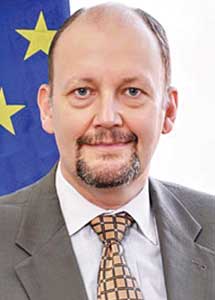
•Ambassador Michel Arrion…We need double track to tackle Boko Haram
Ambassador, Head of Delegation of the European Union (EU) to Nigeria and ECOWAS, Michel Arrion, speaks on the interest of his employers in Nigeria’s 2015 polls.
I would like to know what interest is Nigeria’s forthcoming election to EU?
You know that we in the EU are friends of Nigeria and we will like to see peaceful, transparent elections in the interest of Nigeria. We also hope for the best in those elections because Nigeria is strategic to Europe as one of the largest countries in sub-Sahara Africa and the biggest economy in Africa.
Also Nigeria is going to set a precedent; we have five or six elections in 2015 in Africa . In February, we will have the Nigerian elections; we believe Nigeria can show a good example to the other countries in Africa.
How much has EU committed financially into the Nigeria elections?

•Ambassador Michel Arrion…We need double track to tackle Boko Haram
At the financial level, we are providing 35 million euros to INEC and we are channelling the funds through United Nations Development Agency. However, we are not financing the core budget of the elections, the Federal Government is providing the budget. It is very good because, after all, it is Nigerian elections and they must be financed by the Nigerian budget.
So what we are doing is providing additional support with the financing of specific actions that will focus primarily on voter education, civic education, support to civil society, platforms of local observers or local trainers to facilitate the Nigerian civil society to really be involved in the electoral process.
So, it is not a direct support for NEC but we have agreed with INEC on this budget and division of labour in the electoral body’s actions and the partners. The EU is contributing the largest part to the basket fund.
To what extent has the EU supported the strengthening of the Nigerian political institutions to bring about free and fair elections?
Before the financial support, we were engaging not only with Nigerian institutions but the various components of the society and all political stakeholders. We believe a lot of responsibility to deliver credible elections remains with the political parties, not only INEC.
When you ask about the institutions we are supporting, I want to put a clear emphasis on the political dialogue we have not only with the authorities of the electoral commission but also with the political parties.
EU is facilitating the dialogue between the Nigerian institutions and the international community; we are engaged in permanent dialogue with INEC, we are engaged in dialogue with the civil society, with political parties and we try to have common views and common messages from the international community to all political stakeholders and those messages primarily focus on two issues that will contribute to the important question of credibility in the election: Peace and inclusiveness.
Every adult Nigerian has the right to vote; so the question of registration, voter card, access to the polling stations, etc are absolutely key. Everybody must be given the chance to vote, that is extremely important. So those two questions of non-violence and inclusiveness are the two points we have repeatedly discussed with all political stakeholders and we are quite happy about the quality of the dialogue we have been having with INEC and government.
It is important that we engage with the central government as well as the governors in the states and the media because the media is an important part of the economic development of the country and they play also an important role in disseminating information to the people. When we tell the political actors that they should refrain from instigating violence, it is not only a message for the political actors but also for the media because the media repeat and convey messages that are those of the politicians, the politicians without the media will not be vocal; so the media is very important in the process not only in the political analysis and dialogue that we have but also what the media tells its audience.
There is the suggestion that Nigeria is going to break up. Is EU worried about that?
Frankly, you know I made the point about violence and, unfortunately, there is a kind of pattern of electoral violence and political violence in Nigeria, but it has never reached the point of breaking up. So we are not pessimistic to a point that we fear any kind of break up or collapse. We believe that Nigeria has strong institutions and a very strong civil society.
We believe there is a strong feeling of nationwide nationalism in Nigeria, we are fully convinced that Nigerians want to remain united in their diversity because it is very important to recognise the diversity of Nigeria. You can be both diverse and united. This is violence that could be avoided if all political stakeholders address all serious issues and engage with INEC and other institutions to refrain from it.
We have sorts of violence that are not necessarily linked to elections but can use the opportunity of elections to develop like general crime, communal violence, terrorist attacks. So, on the occasion of the 2015 elections, one should not exclude other types of violence that could add to electoral violence but we don’t expect any kind of collapse of the state.
What is EU doing to check the escalation of violence in Iraq, Syria and Ukraine?
I don’t think we should put the three countries in the same basket. They are quite different. As a matter of principle, the EU firmly believes in peaceful resolution of conflicts. So we are trying to de-escalate any form of violence. As far as Ukraine is concerned, being at the border of Europe, the whole philosophy of the European Union is to establish sustainable peace in the continent; we are not going to start another war after 70 years of peace after the Second World War, we want to avoid any war by all means in Europe.
We believe in peaceful resolution of the conflict in Ukraine and we believe that there will be a peaceful solution to the conflict in Eastern Ukraine. Now Syria and Iraq are two different cases compared to Ukraine, but also again Syria is not Iraq. In Iraq, we see the aggression of this terrorist group called ISIS and we are supporting the Iraq government and other forces to resist the aggression and it is war against terrorism.
I want to emphasise that EU is not a state, it is not a country with European army, but a union of sovereign states and together we can work to combat terrorism and to co operate with other countries in their fight against terrorism; that is what we are doing in Iraq with allies like the US.
Syria is even more complicated because Syria is a place where you have a government, you have insurgency and you have a third party which is the Islamic State; it is much more complicated and we are also working with the neighbouring countries and democratic forces within Syria to fight the terrorists. We have a specific issue in Syria where foreign fighters, nationals and citizens from Europe member-states are in fact fighting with the terrorists, other armed groups and we have to jointly address that. You may have seen articles on foreign fighters coming back to their countries, they are indicted, they are held accountable for co operating with terrorist groups but that we don’t have in Ukraine.
How committed is EU to the fight against Boko Haram?
Regarding Boko Haram, it is important to note that the EU has no army, we have no secret service but all our member-states do co operate with the Nigerian government and in particular some forms of co operations in the field of exchange of information.
We believe that the Boko Haram threat is both local and regional, it is clearly an insurgency with roots in the North East of Nigeria and also along Lake Chad. You also find Boko Haram in southern Niger, northern Cameroon, southern Chad; that is why we call it a regional threat and we believe that the response that has been implemented so far through regional co operation is the most appropriate answer. We firmly support the co operation between Nigeria, Cameroon, Chad and Niger to put in place regional information unit, joint task force. Our member-states are quite active with Nigeria in supporting those initiatives at regional level.
We believe also that to address the root causes of Boko Haram, one has to follow a double track. Of course we need a security response to the insurgency but also have to understand that part of those fighting within Boko Haram are also people who would not have joined Boko Haram if they had access to basic social services, if they had been educated properly, if they had some kind of minimal income. So we believe addressing the root causes of Boko Haram means also fighting extreme poverty and providing basic social services to these people. The question of basic education, counter radicalisation, youth employment are where the EU can contribute to a solution.
And you know as the consequence of Boko Haram insurgency, more than a million people have been displaced and some have crossed the borders and are refugees in foreign countries; so we are providing humanitarian assistance to develop a system for refugees and Internal Displaced Persons but we certainly need a comprehensive approach, humanitarian development, military security response and all those responses are in the power of Nigeria, they have different and comparative advantages.
So, not all of us have the spectrum of assistance that is needed, some are better in military co operations, some humanitarian services and development and we try to be everywhere. But the EU is more active in humanitarian and developmental assistance than in military co operations but for instance we are also providing some technical assistance to the National Security Adviser.
What advice do you have for Nigerians as they work towards the elections?
I think people have to consolidate democracy in Nigeria. Nigeria has already gone through 15 years of civilian rule and each and every election has shown progress compared to the previous one in 2003, 2007, 2011.
Therefore, what we hope is for better elections in 2015, we think it is possible. As I said at the beginning of this interview, what will make the difference between good and bad election will be the two main points of violence and inclusiveness. To avoid violence is quite easy, it is a soft approach, it is a soft measure, we think that all politicians, all political parties, all political stakeholders have to address this basic principle of peaceful election and peaceful resolution of problems. And if you have a problem of any kind, go to court, we don’t use violence, we don’t response to violence with violence. A bad action doesn’t justify another bad action; if you read the Bible, if you are slapped on the left cheek, you must offer your right cheek.
The second thing is more technical: we need all political stakeholders engaging with INEC to deliver inclusive elections which is the possibility of every Nigerian citizen to vote. These are serious challenges and they can be overcome. We are already in mid December, one month for all political stakeholders to work hard to give the Nigerian citizens the possibility to vote and that means that registration of voters, collection and distribution of permanent voter card and the technical implementation of all the logistics of the election, the next four weeks will be crucial.
Disclaimer
Comments expressed here do not reflect the opinions of Vanguard newspapers or any employee thereof.