By Bartholomew Madukwe
As Nigeria joins other continents in celebration of the United Nations’ Human Rights Day, many observers have described 2014 as a horrific year for human rights violations in the country, saying terrorism is the major source of abuses around the NorthEast and the world.
Globally, the Syrian civil war still remains a concern as human rights are being violated. The war has entered its fourth year, leaving hundreds of thousands killed and millions forced to flee from their homes. In the past 12 months the conflict has splintered and spread to neighboring Iraq, with government forces, moderate opposition fighters, Islamist militants and Kurdish fighters all battling for territory.
 According to the senior advisor at Amnesty International, Steve Crawshaw, international community must take some responsibility “for the failures to address the Syria conflict better and earlier and to really speak out loudly and to put the kind of pressures that were needed for human rights to be better observed.”
The UN General Assembly proclaimed 10 December as Human Rights Day in 1950, to bring to the attention ‘of the peoples of the world’ the Universal Declaration of Human Rights as the common standard of achievement for all peoples and all nations.
This year’s slogan, Human Rights 365, encompasses the idea that every day is Human Rights Day. It celebrates the fundamental proposition in the Universal Declaration that each one of us, everywhere, at all times is entitled to the full range of human rights, that human rights belong equally to each of us and bind us together as a global community with the same ideals and values.
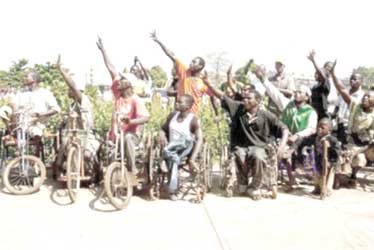
In line with this international stance on human right, Nigeria is not left behind. For instance, the Lagos State Governor, Mr. Babatunde Fashola SAN, had enacted the Lagos State Special People’s (LSSP) Law on June 25, 2011. However, Persons With Disabilities (PWDs) still suffer various challenges to the use of the courts to get justice , as compliance to the law is little or nothing at present.
Section 24, clause (2,4,5) of the law stipulates that: “No public building shall be constructed without the necessary accessibility such as lift (where necessary), ramps and others that shall make them accessible and usable to persons with disability.
“The government shall ensure that roads, side-walks, pedestrian crossings and all other facilities made for public use shall be made accessible to and usable by persons with disability including wheelchair users.
“From the date of commencement of this law, there shall be a transitory period of five years within which all public buildings, roads, pedestrian crossings and all other structures shall be modified to be accessible to and usable by persons with disability.”
According to a 25-page report by the Centre for Citizens with Disabilities in collaboration with Justice for All, Department of International Development (DfID) of the British High Commission, findings of survey conducted in three selected Local Government Areas in Lagos State showed that PWDs have major challenges to the use of the court to get justice, cost of litigation, absence of infrastructural provisions such as access ramps, braille instructions and court officials with training in the use of sign language.
The report entitled: “Enhancing Access to Justice for Persons with Disabillities” urged the Federal Government and the Chief Judge of Nigeria to strengthen the capacity of court and court personnel to make justice accessible to the PWDs in the country.
The report called for training of court officials in the use of sign language, greater awareness be created among PWDs on disability rights and the Multi-door court (Alternative Dispute Resolution, ADR mechanism in Lagos State).
“This will ensure that PWDs choose the low cost, but highly effective path to justice. Poli ce officers and court official should be re-orientated on the rights of PWDs and the ills of discrimination against PWDs. Those of them (PWDs) who seek justice through the police as an institution are often faced with the challenge of infrastructural discrimination.
“The police post visited in the course of study had no access ramps for persons using wheel chair, no instructions in braille and the officers could not use sign language” the report stated, adding that these constitutes a major challenge among other difficulties which PWDs encounter in their bid to access justice in the state.
It therefore recommend that government should sensitize the police to strengthen its capacity to make justice accessible to PWDs through provision of access ramps, the training of police officers on disability right and the use of sign language for effective communication with the deaf.
In the same vein, the Director General, Lagos State Safety Commission, LSSC, Mrs Dominga Odebunmi, has vowed to ensure the safety of lives and property of the state’s citizenry, including PWDs.
Consequently, she noted that leadership commitment must be top on everyone’s agenda and enshrined through functional management system to achieve desired business continuity and the objectives of LSSC.
In her welcome address at the 2nd Lagos State Construction and Manufacturing Safety Summit in the state, Odebunmi said: “Lagos State Government places safety at the top of its agenda in its vision to transform Lagos into Africa’s model magacity and global economic and financial hub that is safe, secure, functional and productive.
“Thus, Lagos State Safety Commission (LSSC), a trailblazing organization and first of its kind in Nigeria was signed into law on July 26, 2011 by the Lagos State government led by Governor Babatunde Fashola SAN.”
Speaking on the topic “Safe Universal Access: Getting it right”, the Chief Executive Officer of NGZ-AGSAM Limited, Ngozi Ugoji, called for empowerment of Persons With Disabilities (PWDs) through patronage of their products and services.
“A number of legislative instruments are mandatory and aim to protect the rights of individuals and advance equality of opportunity for all, including within the workforce. They aim to protect people with special and diverse needs and prevent discrimination in the areas of employment, education, access to goods, services and facilities,” she asserted.
Ugoji pointed out that the state’s special people’s law places a duty on all employers and organizations to provide equal access for all users and visitors to their buildings and facilities.
According to her: “This bill specifically provides for those living with physical and mental challenges resulting in their requiring special aids and adaptations to their environment in order to function independently or with minimal assistance.”
She said in recent years there has been a lot of emphasis on sustainable economic and social inclusion bordering on equal access and opportunity for every individual, saying that a number of initiatives have been adopted and partnership formed to drive these initiatives.
As many concerned citizens may want to ask, in line with section 13 of LSSP law, how many companies whose business entails attending to the general public have in their employment personnel who are properly trained and sufficiently competent to attend to its customers or clients who are persons living with disability?
Or, how many transport service providers have made available and mark appropriately one out of every 10 seats in their public bus for the use of persons living with disability?
Perhaps these questions may receive better answers in 2017 when the transitory period would have elapsed and the gap bridging attained by members of the public, Ministries and all Government agencies to ensure that the peculiar interests of persons living with disability are taken into consideration in every government policies, programmes and activities.
Disclaimer
Comments expressed here do not reflect the opinions of Vanguard newspapers or any employee thereof.