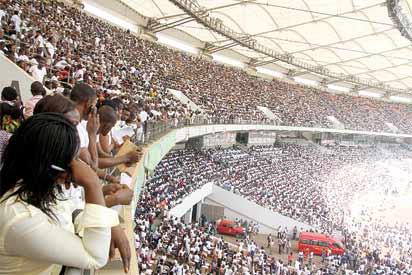
Applicants who could not find seats await further insatructions as others take seats to write the Nigeria Immigration Service examinations at the 60,000 capacity National Stadium, Abuja. Photo by Abayomi Adeshida
By Obi Nwakanma
My fourth-grade teacher – who was also my all-time favorite – Mrs. Beatrice Ohaka was a kindly and charming woman. In her most voluble moments she used to say to us kids: “you are the leaders of tomorrow. You will go to University or to England, and become important people. Do important things. Become teachers, doctors, engineers, journalists, professors; and you will make me proud.”
The point of course was that we had to be great scholars first – pass our exams; iron and keep our white shirts white, buckle up our sandals, walk straight and with purpose; not be slouches or lazybones, and be generally good examples. That was the making of great leaders of tomorrow. It was Mrs. Ohaka who first intimated me about that kind of possibility. Otherwise, I had been living my life, all of nine or ten year years in 1976 without thinking about “leaders of tomorrow.”
In fact, not long before then, one evening, as my mother was wont to do after dinner, she had thrown a question to my siblings and me? “What do you want to be when you grow up?” My sister Rosemary in those days wanted to be a doctor – a Paediatrician. I think she liked the word, “Paediatrician.” She had started spending her pocket-money by then in the bookshops in Umuahia on the Mills & Boon and the Agatha Christie novels.
So, she was quite ahead of the game. Me, I just told my mother, “I want to be a street dancer like Ok Jazz!” – you know, one of those profoundly comical and stylish dancers that followed the trade trucks around, and performed to a motley of crowds on the streets. They were regular fare in those days on Eastern streets. It was street theatre per excellence.
They usually advertised dubious medicines like the popular “Ikan Power” – which was a cure all – and sometimes appeared on the popular Ukonu’s club as guests of the variety show on the NTA Channel 6 Aba, of those years. In those days, they seemed to me like the ne plus ultra of human experience. My poor mother, and I was quite a handful, now that I think of it, was too dumbstruck by my ambition that she fell off the seat laughing, and just quietly closed the matter by simply saying, “Anuohia!” and nothing else.
I think she was more amused than shocked by my folly. I did not understand. It was Mrs. Ohaka who made me understand that we were primed for greater things; for a future of accomplishment and public service. Teachers and parents in those years had great hopes for their children, and dedicated their resources – intellectual and material – towards that possibility.
The solitude in me, of course remembers Mrs. Ohaka, and May God be with her wherever she may be. The trouble that haunts me is that the future arrived for my generation, and we are still waiting for its promise. The future was stolen from us from the generation that broke the back of this country, and now, many of us are middle-aged men, and much of our talents and promise; much of the hope invested on that promise was aborted. In 1986, Wole Soyinka took a hard and steady look at his own generation and called it a “wasted generation.”
Well, my generation was aborted. It is a great human tragedy that equally reflects the powerful tragedy of postcolonial and postwar Nigeria, that we have lived through a fifty-year curse. There are many among us who, years after graduating from the Universities since the late 1980s, have never had the opportunity of gainful employment. They live in suspended animation: no homes; no families; no regular jobs; nothing to their names after so much striving. The situation of the more contemporary generation is even more telling.
I have a younger sibling who has graduated with a University degree for the last nine years, and has expended a great deal of energy looking for a job. Last week, he was among the group of applicants who went for a job recruitment exercise by the Immigration Services. He came out of the experience lucky to be alive. The crowd of the unemployed reported in the various designated venues looking for five thousand jobs was in the millions. It led to tragedies. With deaths from stampedes; young educated men and women subjected to the most horrendous and most unparalleled forms of indignity.
Several newspaper reports have given various numbers of the fatalities: people crushed in the melee of job-seeking to about a hundred deaths with numerous injured. Let me be more specific: the event of last week, when the Ministry of Home Affairs conducted that tragic recruitment exercise that resulted in the death of those young, jobless Nigerians is the beginning of the end of the road for this country as it is currently constituted.
It is an unjust and inhuman society that can subject its citizens, particularly its young and talented citizens, to this kind of experience. Nigeria is an unjust and inhuman society. Its leaders have lacked the basic human capacity to feel, and think broadly about the welfare and the future of the people. The story of this recruitment exercise itself is a pointer to the fundamental contradictions of the Nigerian state.
First, the minister, Mr. Abba Moro, did not find it in himself to dignify that office by resigning his position, even though it is an indictment to his office, that under his charge this kind of unseemly tragedy should happen. It is jobbery at its worse. Mr. Moro has continued to give weight to the axiom that the blind cannot lead the blind.
His excuses and justifications about the conduct of the exercise are atrocious. It is critical to note that the departments under his ministry have disavowed his leadership of that ministry. It is imperative for the Federal Government to investigate this incident thoroughly – either through a Presidential Commission or a Legislative probe – and make some heads roll.
It is crucial to ascertain quite clearly what went wrong and how? Is there any truth in the allegations that the minister directly handled the recruitment using a consultancy firm in which his wife had some stakes? Should the minister of government be involved in recruitments into the public service? What is the role of the Civil Service Commission, and the Permanent Secretaries in the Administrative Services these days? It is about time that we begin to ask these questions and demand some answers.
Meanwhile, what happened last Saturday is indicative of the vast troubles ahead for Nigeria: with this army of unemployed and highly trained people, we have a ticking bomb more potent than a nuclear device, and it is just a matter of time before the explosion happens. Boko Haram will be a cakewalk in comparison to what is about to take place if we do not find a quick and urgent solution to this paradox; this legion of the jobless and increasingly antsy young men and women. Mark my word fellow Nigerians: an unemployed man trained in Physics and Chemistry is a walking nightmare. That crowd last Saturday is the outline of a horror movie unfolding.
Disclaimer
Comments expressed here do not reflect the opinions of Vanguard newspapers or any employee thereof.