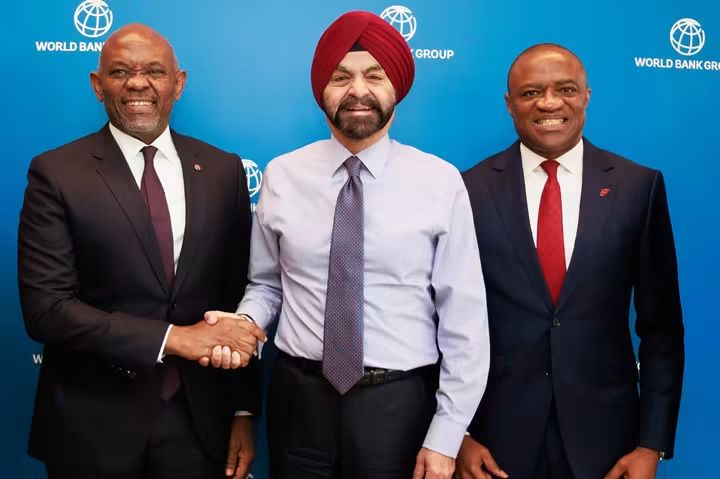
From Left – Former Group Chairman, UBA; World Bank President, Ajay Banga and Group Managing Director and Chief Executive Officer , UBA,Oliver Alawuba.
By Ogochukwu Agha
Africa does not lack opportunities. What is missing, in many cases, is how easily capital finds those opportunities.
That contradiction took centre stage in New York as world leaders converged for the 81st United Nations General Assembly, UNGA. While presidents and prime ministers debated global crises, another conversation was happening on the sidelines : how to convert Africa’s enormous economic potential into real investment, trade, jobs and growth.
For United Bank for Africa, UBA, it was a moment to make Africa’s case directly to the people who control global finance.
Driving those conversations was the bank’s Group Managing Director and Chief Executive Officer, Oliver Alawuba. His diary in New York cut across the biggest institutions and critical stakeholders : from the World Bank and the Export-Import Bank of the United States, U.S. EXIM, to international investors, Nigerian governors and traditional rulers.
The message was consistent: Africa’s time is now, but it will take partnerships that move capital to where opportunities live.
Across the meetings ,one question kept coming up: how do you pull down the barriers that stop money, goods and businesses from moving freely across Africa?
At the Forward Africa Leaders Symposium, UBA Group Managing Director, Oliver Alawuba, painted a vivid picture of the problem.
“We are in 20 African countries and in the world’s major financial centres,” he told the audience, before listing what it really means to operate across the continent”, he said
Doing business in Africa, he said, meant navigating a maze of regulations, dealing with different central banks, coping with endless election cycles and shifting government policies. At times, those policies block rather than enable capital.
Using a striking analogy, he likened Africa to a big building with 54 rooms, each protected by high walls.
“You have 54 countries. Imagine a big building with 54 rooms, each protected by high walls. With walls that high, it becomes very difficult to shake hands and get things done,” he said.
Those walls, he explained, were not made of concrete. “They are regulations, currency controls, conflicting policies and fragmented payment systems that make it hard for capital to move from one African market to another.
“If we want capital to flow, we must bring down those walls,” he stressed.
UBA, according to him, has the financial muscle to play big. The bank controls about $30 billion in total assets , what he described as a war chest to deploy across Africa. But regulations often slow things down.
“Even when you manage to deploy capital to a country, taking it back becomes another battle because of currency risks. Currency remains a major issue,” he noted.
He gave a practical example:” a tea farmer in Kenya who wants to sell to a buyer in Ghana still has to convert through the dollar. That extra step makes intra-African trade cumbersome and expensive”
The African Continental Free Trade Area, AfCFTA, he admitted, is a step in the right direction. But trade agreements alone would not move goods if money could not move.
“That is why payment systems are crucial. We are working on a platform that allows seamless payments across Africa. We are already piloting it with several countries and it is working. But we need more walls to come down for businesses to truly thrive across the continent,” Alawuba said.
The same hurdle, Alawuba noted, is holding back Africa’s small and medium-sized enterprises.
“We have an agreement with the African Continental Free Trade Area for a $6 billion fund to support SMEs. We all know SMEs are critical, but they need to grow, and they need government backing to grow,” he said.
For small businesses, however, money alone is not enough. They need markets to sell to, payment systems that work across borders, infrastructure that connects, and policies that let them scale beyond their home base.
*Turning opportunity into bankable deals*
*
That conversation found a bigger audience at the Bullish Africa Annual Summit where investors, corporate executives and policy leaders gathered to weigh Africa’s economic outlook and its place in the global economy.
Speaking as one of the leading voices for African business, Alawuba argued that Africa’s investment story cannot be told without talking about partnerships.
UBA’s position, he explained, was simple: Africa is rich in opportunities, but turning those opportunities into real investments takes more than investors with deep pockets. It requires banks and institutions that understand local realities, businesses that are clear about what they need, and partnerships that bridge the two.
That, he said, is exactly where UBA sees itself, as a financial bridge, present in 20 African countries and plugged into global capital markets, connecting Africa’s opportunities with the capital that can make them happen.
*Meeting with EXIM*
New York became more than a meeting point for UBA. It became a marketplace of ideas, money and partnerships.
At the heart of it was a strategic session with the leadership of the Export-Import Bank of the United States, U.S. EXIM. For Alawuba, it was a chance to take a relationship that already exists and stretch it further.
What was on the table? How U.S. EXIM can back UBA’s trade finance push , especially for African firms buying American equipment, goods and services. The talks also delved into project and structured financing, the kind of funding that unlocks large, complex deals.
The payoff is clear. When these doors open, African businesses do not just import. They plug directly into global supply chains and compete shoulder-to-shoulder with international players. And sitting at the centre of that conversation is UBA America in New York, anchoring the link between both ends.
*Government, royalty ,capital meet*
In a symbolic gathering, the bank hosted three prominent Nigerian figures: His Highness Muhammadu Sanusi II, Emir of Kano, Lagos State Governor Babajide Sanwo-Olu and Zamfara State Governor Dauda Lawal.
It was an evening of blunt conversations about what states really need : roads, farms that feed, hospitals that work, schools that deliver, tech that creates jobs.
For UBA, the message was simple: sub-national governments have big dreams, but they need a financial partner that can connect those dreams to global capital. That night, government power, traditional influence and private capital sat at one table .
*Banga meeting*
Perhaps the most telling engagement was Alawuba’s closed-door meeting with World Bank President, Ajay Banga.
The discussion? How to move more money ,real, long-term money into Africa’s infrastructure, energy, agriculture, SMEs and cross-border trade.
The challenge is familiar: African governments cannot fund development alone. Budgets are thin. Projects are massive. The gap must be filled by private capital that is patient and purposeful.
This is where UBA is making its case. With operations in 20 African countries, the bank says it knows where the gaps are, where the opportunities lie, and how to turn a promising project into a bankable deal that global investors can touch.
If UNGA 81 was the stage, UBA did not come just to clap.While many delegations stuck to routine meetings, it turned the week into a bridge-building exercise , linking African businesses, state governments and investors in the same room with the institutions that write the big cheques.
From SMEs eyeing regional expansion to state governments chasing infrastructure and firms pushing international trade, the conversations cut across the entire spectrum of Africa’s economy.
And that, perhaps, is the real story.
Disclaimer
Comments expressed here do not reflect the opinions of Vanguard newspapers or any employee thereof.