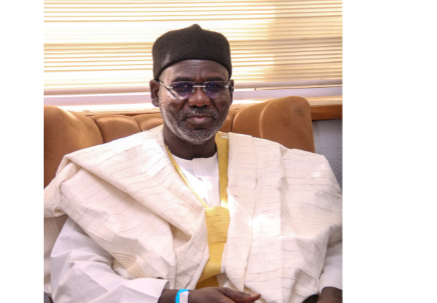
By Ibrahim Hassan-Wuyo
President Bola Tinubu has commended the leadership and service of former Chief of Army Staff, COAS, Lt. Gen. Tukur Yusufu Buratai (retd.), saying the documentation of his tenure offers valuable lessons for present and future military commanders and policymakers.
Tinubu stated this on Wednesday in Abuja in a speech delivered on his behalf by the Permanent Secretary, Political and Economic Affairs Office in the Office of the Secretary to the Government of the Federation, Mrs Bekearedebo Augusta Warrens.
Warrens represented the President at the public presentation of Military Transformational Leadership in Action: The Buratai Era, authored by M.S. Abubakar.
The event, held at the Nigerian Army Conference Centre and Suites, Asokoro, Abuja, was attended by serving and retired military officers, government officials, members of the diplomatic corps, traditional rulers, academics, business leaders and journalists.
Tinubu congratulated the author, the Buratai Legacy Presentation Committee and the publishers, stressing the importance of preserving Nigeria’s military history and institutional experience.
“Nations that preserve the experience of their institutions and leaders create valuable resources from which succeeding generations can learn,” he said.
The President said the publication documented Buratai’s tenure as Army Chief while contributing to discussions on military leadership, institutional reform and national security.
According to him, Buratai served as COAS during a period when Nigeria faced terrorism, insurgency and other asymmetric security threats, placing significant demands on the Armed Forces, particularly the Nigerian Army.
He said the period tested military leadership, discipline, courage, innovation and the ability of the Armed Forces to adapt to changing security realities.
“Lt. Gen. Tukur Yusufu Buratai, and the officers and men who served under his command were called upon to confront these challenges under extremely demanding circumstances.
“Their service forms an important part of Nigeria’s contemporary military history,” Tinubu said.
He noted that the book examined military leadership beyond battlefield operations, including doctrine, training, troop morale, logistics, welfare, institutional development and civil-military relations.
Tinubu said transformational leadership was not only about winning battles but also about building institutions capable of responding to emerging threats and preparing future generations of military leaders.
The President said Nigeria’s security environment had continued to evolve, with terrorism, banditry, kidnapping, violent criminality, oil theft and organised crime posing challenges to national peace and development.
He said the Federal Government was strengthening intelligence gathering, inter-agency coordination, surveillance, logistics and the operational capabilities of the Armed Forces and other security agencies.
Tinubu also said the government was pursuing a coordinated national security architecture, including the development of a comprehensive national threat assessment and a rolling five-year strategic defence operations plan.
He said investments were being made in modern equipment, technology and personnel development, stressing that emerging security threats could not be effectively tackled with outdated tools and methods.
The President, however, noted that equipment and technology alone could not guarantee national security.
“Behind every successful military operation are men and women who demonstrate courage, discipline, professionalism and sacrifice,” he said.
Tinubu acknowledged the sacrifices of military personnel, police officers and members of other security agencies serving across the country, often under difficult conditions and away from their families.
He called for sustained attention to the welfare, training, morale and professional development of security personnel and their families.
The President urged Nigerians to study the experiences of the Buratai era critically and objectively, saying both its successes and difficulties should provide lessons for addressing contemporary and future security challenges.
He stressed that military action, although indispensable in confronting violent threats, remained only one component of sustainable national security.
According to him, intelligence, effective policing, justice, border management, community engagement and economic opportunities were also critical components of a comprehensive national security strategy.
Tinubu described security as a collective responsibility requiring cooperation among government, security agencies, communities, traditional and religious leaders, the private sector, civil society and the media.
He reaffirmed his administration’s commitment to strengthening Nigeria’s security institutions and providing the necessary political support, resources and strategic direction for national defence.
The President also commended Buratai for his years of service to the country and congratulated the author and organisers of the publication.
He said the relevance of the book would ultimately be measured not only by what it records about the past but also by the lessons it provides for the future.
Tinubu expressed hope that the publication would inspire present and future commanders, military professionals, policymakers and Nigerians to appreciate leadership as a responsibility centred on service, sacrifice and the preservation of the national interest.
Disclaimer
Comments expressed here do not reflect the opinions of Vanguard newspapers or any employee thereof.