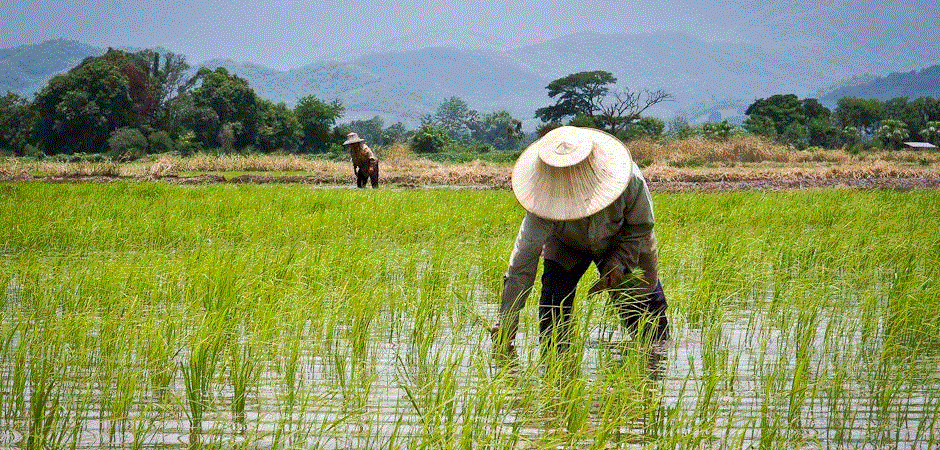
Every Nigerian meal begins with the work of smallholder farmers. They are the backbone of our food system, growing the yams, cassava, rice, maize, and vegetables that fill our kitchens and stock our markets. Today, they produce approximately 70% of the country’s food supply; yet, despite their critical role, their ability to feed the nation is under strain.
Many farmers still lack access to quality seeds, fertilizers, and effective farming knowledge, resulting in low yields. Over 200 million hectares of degraded land threaten long-term farm fertility, and climate shocks, such as erratic rainfall and pest outbreaks, disrupt growing seasons, putting livelihoods at risk. Without urgent adaptation, the World Bank reports that Nigeria’s agricultural GDP could shrink by 25% by 2050.
These challenges are not distant; they are already reshaping the lives of farmers across the country. But here’s the good news: Nigeria is not short of solutions. The challenge isn’t whether we have the right tools, but how quickly and widely they can reach the farmers who need them most.
To turn challenges into opportunities, we must focus our efforts where they matter most and invest in areas that make the greatest difference for farmers.
Access to farming knowledge and high quality farm inputs
For many farmers, access to the right tools and knowledge can mean the difference between planting high-quality seeds on time and missing the season altogether. In parts of Nigeria, the organization I work for, One Acre Fund, is working with over 94,000 farmers who have been able to access inputs on credit. Extension services amplify this impact where trusted field officers walk alongside farmers, offering hands-on guidance to ensure that tools are used optimally and translate into higher productivity. Data from our 2024 annual report shows that with the right support, such as access to knowledge and high-quality inputs through credit, the farmers we serve generated an average income of $322 in 2024.
.
Integrated Pest Management (IPM)
Pests remain one of the greatest threats to harvests. Eco-friendly techniques are reducing loss caused by pests and dependence on harmful chemicals while protecting the environment. One Acre Fund also works with young people, training them as Pest Management Champions to share IPM solutions across their communities. Equipping youth with knowledge and such leadership roles ensures today’s harvests are protected and that the next generation has the skills and resilience needed to secure Nigeria’s food future.
Digital tools
Mobile adoption is rising rapidly. By 2023, digital agriculture tools had reached 14 million farmers in Nigeria. This growth signals enormous potential for technology to transform extension services and decision-making. Recognizing this potential, the Nigerian government has been proactive in shaping the agricultural landscape. The National Agricultural Technology and Innovation Policy (2022–2027) champions the use of digital tools, youth engagement, and resilience building.
On the ground, these innovations are starting to take shape. One Acre Fund’s Digital Weather Advisory Service pilot is one example, with over 10,000 farmers now receiving timely rainfall forecasts and agronomic tips sent directly to their phones. Instead of planting too early and risking crop failure, or too late and missing the rains, farmers now have a window into the weather forecast and can apply the right practices and improve their productivity.
Climate-smart agriculture
Soil health is the foundation of every strong harvest. Across the country, farmers are adopting composting and other soil health practices to safeguard fertility for future harvests, ensuring that the land continues to sustain Nigeria’s growing population. Additionally, trees actively regenerate soil, making land more productive and sustainable for future farming. Beyond restoring degraded soils, they provide farmers with income from timber, fruit, and other products. And importantly, farmers are eager to adopt these solutions. We have seen this interest firsthand. In 2025 alone, nearly 500,000 farmers planted 13.2 million climate-smart seedlings from us, a good indication that with options available, farmers could easily invest in practices that build their resilience. This is reinforced at the policy level too: the National Climate Change Act provides the legal framework for adaptation and mitigation strategies in agriculture.
What Else Is Needed?
Scaling what works! Nigeria already has the building blocks for transformation: government policies that prioritize innovation, development programs delivering results, and farmers eager to adopt new practices.
That means expanding farmer-friendly financing so more households can access quality inputs. It means strengthening extension services and leveraging technology so that advice reaches farmers in real time. It means investing in post-harvest solutions such as storage, processing, and market linkages to stop the massive losses that erode farmer incomes year after year. And it means deepening investment in climate-smart practices, such as soil health, tree planting, and pest management, that will protect the sector against future shocks.
Partnerships are key; government, development partners, the private sector, and farmers all have a role to play in ensuring that the innovations reaching tens of thousands today can reach millions tomorrow. Supporting farmers with the right tools at the right time is how we support them to grow more, earn more, feed a growing nation, restore our land, and unlock prosperity for millions.
Disclaimer
Comments expressed here do not reflect the opinions of Vanguard newspapers or any employee thereof.