By Nnasom David
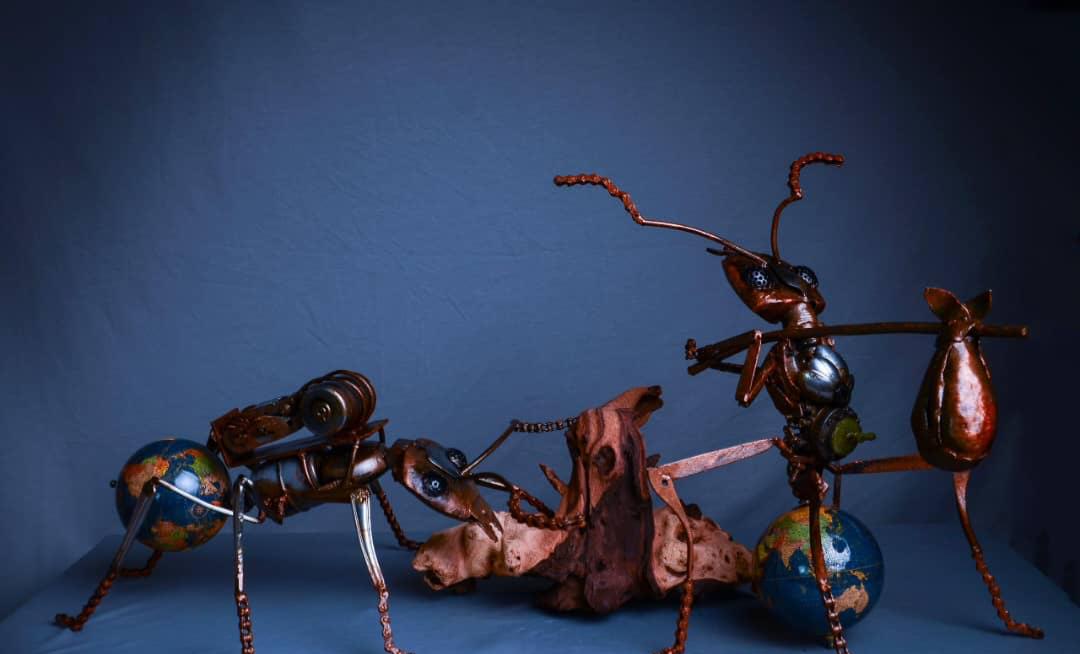
In Immigr-ants, Nigerian-born artist Ayodeji Kingsley presents a visually arresting sculptural work that transforms discarded metal and industrial debris into a profound meditation on the shared human condition of movement. At first glance, the piece appears whimsical—towering ants made of scrap metal, discarded objects, carrying globes, bags, or tools. But beneath the surface lies a deep conceptual framework. This is not a simple allegory. It is a visual essay, a socio-political reflection, and an ecological argument rendered in bronze and steel. It asks one resounding question: what does it mean to migrate, and who among us is exempt from this experience?
By choosing ants as his subject, Kingsley taps into one of nature’s most adaptable and organized species. Ant colonies are known for their capacity to migrate as a collective unit in response to environmental stress, depleted resources, or external threat. These journeys are not haphazard. They are governed by instinct, communication, and survival. In this sense, the sculpture reminds us that migration is not exclusive to humans, nor is it modern. It is embedded in the life cycles of countless species. It is natural. It is essential. It is ancestral.
The ants in this work are depicted on the move, each one prepared differently for the journey ahead. Both bear the globe under its frame, suggesting the burden of relocation across vast terrains. One carries a satchel, while yet another appears to bear little or nothing at all. This variation speaks volumes. Migration is not a single story. It is an experience defined by circumstance, urgency, privilege, or lack thereof. Some travel with foresight, resources, and documentation. Others flee under duress, forced to leave everything behind. The sculptural distinction is subtle but piercing. It reflects the reality that no migrant journey is alike, though all are valid.
The idea that some beings carry little of nothing evokes the forced displacement of people fleeing war, political collapse, or natural disaster. These are the individuals who do not have the luxury of choice. . The devastating floods in Pakistan in 2022, which forced more than thirty-three million people from their homes, stand as a reminder that displacement can come without warning, without choice, and without regard for legal status. In contrast, others are depicted as more equipped, perhaps suggesting long-term aspirations or the search for new opportunities. What unites them is not the nature of their baggage but the reality of movement itself. Whether permanent or temporary, planned or urgent, every journey requires adaptation. Every traveller is reshaped by the act of leaving and the challenge of arriving.
At the heart of Kingsley’s work lies a critique of the narratives that dominate conversations around immigration. The piece challenges the deeply ingrained notion that migration is an intrusion into stability rather than a contributor to it. In contemporary societies, the subject of immigration is often framed through fear and scarcity, where outsiders are cast as threats rather than participants in communal growth. Kingsley disrupts this perception by drawing a parallel with a scientific
experiment involving ants. In this study, two separate colonies were placed in a single container and initially coexisted peacefully. However, when the container was violently shaken, the ants misattributed the chaos to one another, leading to fatal conflict. The actual cause of the disturbance was external, yet the inability to perceive it created unnecessary destruction.
This scenario mirrors the political and cultural dynamics of many human societies today. In times of economic instability, environmental crisis, or political polarization, communities often turn on each other. Immigrants become scapegoats, and the public is encouraged to see difference as a threat rather than a resource. The true causes of societal distress such as inequity, corruption,
and exploitation go unchallenged. Like the ants, we mistake proximity for threat, and in doing so, we fracture communities that might otherwise thrive through cooperation.
Kingsley’s sculpture pushes against this reductive narrative. The ants do not fight. They carry, they climb, they persist. There is an implied unity, not just in movement but in purpose. They are builders, not intruders. Their labour is invisible but essential. In drawing this parallel, the artist suggests that migrants are not drains on systems but engines of them. They enrich culture, broaden perspectives, and propel economies forward. Just as ants contribute to the health of ecosystems by aerating soil and recycling nutrients of their newly found terrace, immigrants bring innovation, resilience, and a redefinition of what it means to belong.
The use of repurposed materials in the sculpture is itself a metaphor. What society discards, Kingsley reclaims and reconfigures into something vital and expressive. This act of transformation echoes the immigrant experience of taking what is available, however limited, and creating something new, often in the face of immense adversity. The sculpture, like the migrant, is a product of reinvention.
Most importantly, Immigr-ants does not situate migration as an external issue, one that only affects a particular group of people. Instead, it asserts that migration is a universal experience. Whether we move across borders, across towns, or across generations, we all carry the inheritance of movement. We are all part of histories shaped by departure and arrival, by loss and adaptation. The sculpture underscores this by placing globes directly into the anatomy of the ants, suggesting that the entire world is both the stage and the substance of migration. The journey is not somewhere else. It is here, in all of us.
In this deeply reflective and meticulously crafted piece, Ayodeji Kingsley has achieved more than a clever visual pun. He has offered a poetic, political, and ecological argument for migration as a fundamental condition of life. The ants are not metaphorical stand-ins for humans. They are mirrors. In them, we see our own instinct to move, our struggle to adapt, and our capacity to build anew.
We are all immigrants. The only difference is what we carry, and why we move.
Disclaimer
Comments expressed here do not reflect the opinions of Vanguard newspapers or any employee thereof.