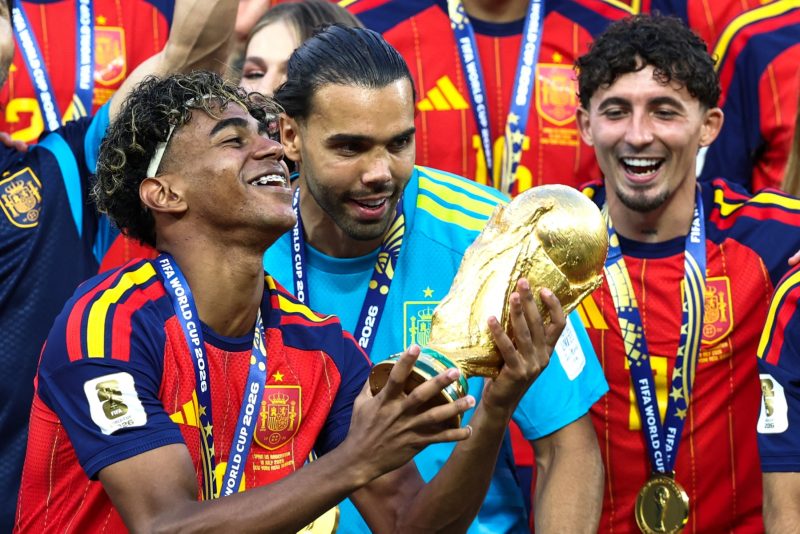
Spain’s forward #19 Lamine Yamal lifts the trophy after winning the 2026 World Cup football tournament final match between Spain and Argentina at the New York/New Jersey Stadium in East Rutherford on July 19, 2026. (Photo by FRANCK FIFE / AFP)
By Aihawu Victor
Spain, France, and a tournament shaped by the movement of people, and the contradictions surrounding migration
On Sunday night, July 19, 2026, in New Jersey, Nico Williams cut down the left wing, cushioned a header into the path of Ferran Torres, and watched Torres score the goal that secured Spain’s second World Cup title. It was the moment that defeated Argentina. It was also, in many ways, the defining story of the tournament.
After the final whistle, Williams did something that carried a deeper meaning than the assist itself. He took his winner’s medal, walked over to his mother, María Arthuer, and placed it around her neck. Years earlier, while pregnant with Nico’s older brother, Iñaki, María had crossed the Sahara Desert on foot, leaving Ghana in search of a safer and more hopeful future.
She eventually reached Spain. Both of her sons grew up to represent the national team. One of them has now become a world champion. Nearby, 18-year-old Lamine Yamal was also making history. Yamal’s father, Mounir Nasraoui, left Larache, Morocco, as a child. His mother, Sheila Ebana, left Bata, Equatorial Guinea.
They met in Catalonia, where they raised their son in a working-class neighbourhood outside Barcelona. That son is now one of the world’s most celebrated young footballers, proudly embracing the three identities connected to his heritage, Spanish, Moroccan, and Equatoguinean.
Spain’s champions were not an exception in this tournament. They reflected a broader pattern. France told a similar story from another perspective. Kylian Mbappé, who ended the tournament as the World Cup’s all-time leading scorer, grew up in Bondy, a working-class suburb outside Paris. He is the son of a father with Cameroonian roots and a mother whose family comes from Algeria’s Kabyle region.
Mbappé has always acknowledged his background while expressing his commitment to France. “My nationality is French, but my origins are Algerian and Cameroonian,” he has said. A significant number of France’s players in this tournament either have African birthplaces or family connections to Africa, a reflection of the country’s long-standing multicultural football tradition.
Nearly every major contender at this World Cup carried a version of the same story. That is worth reflecting on because it is often missing from wider conversations about migration.
What migration actually means
It is important to define the word clearly because migration is often discussed in broad and sometimes misleading ways. Migration simply refers to the movement of people from one place to another, across a city, a country, or a continent, often in search of work, safety, family reunification, or opportunity.
It includes the trader who moves from Ibadan to Ghana to expand a business. The nurse who relocates from Lagos to London for employment. The mother who undertakes a difficult journey because she believes another place offers her children a better future.
It also includes children who move because their parents made those decisions on their behalf.
Most migration around the world is not dramatic. It is ordinary people making difficult choices about where they believe their families can have better opportunities. María Arthuer’s journey was extraordinary, but many migration stories are quieter, slower, and equally deserving of understanding and dignity.
The conversation about migration
The World Cup also highlighted a wider global conversation about how migration is understood. The same movement of people that has contributed to the success stories of players like Nico Williams and Lamine Yamal is often the subject of intense political debate in many countries.
Across the world, migrants and asylum seekers face complex legal systems, border controls, and public discussions about immigration policies. Some encounter detention or lengthy procedures while authorities assess their status and claims.
During this tournament, there were also discussions about the experiences of some African teams during international travel, including concerns about delays and additional checks at borders. Such situations raise broader questions about how mobility is experienced differently depending on a person’s nationality, documentation, and circumstances.
This difference in experience is at the heart of many migration debates, whether movement should be viewed primarily through security concerns or also through the human stories behind why people move.
The contradictions surrounding migration
One of the striking themes of this World Cup was the contrast between how migration is celebrated in sport and how it is debated elsewhere.
Millions celebrated Nico Williams’ contribution to Spain’s victory without questioning the difficult journey his mother made years earlier. Millions celebrated Mbappé’s achievements without focusing on the migration history that shaped his family’s story.
In those moments, migration was recognised as part of a success story.
The contrast reveals a wider conversation: movement across borders can be celebrated when it produces extraordinary achievements, while the challenges faced by migrants seeking opportunities and safety often receive far less attention.
The same desire for a better future that motivates many people to move can be viewed differently depending on the circumstances, the individual, and the society receiving them.
The contribution of migration
It is important to acknowledge the many ways migration contributes to societies. Migrants help build communities, support industries, establish businesses, contribute skills, pay taxes, and raise families that become part of the countries where they live.
Spain’s World Cup success was not achieved because of migration alone, but the stories of players such as Nico Williams and Lamine Yamal show how migration histories can become part of a nation’s sporting identity.
Their journeys demonstrate that when people are given opportunities to belong, they can make remarkable contributions.
Migration is not only about movement. It is also about potential, resilience, and the ability of people to create value in new environments.
Why the conversation should continue beyond the trophy
Spain lifted the World Cup on July 19. The stadiums have emptied, celebrations have ended, and attention has moved towards the next football season. But the questions surrounding migration remain.
For those working on migration governance across West Africa and beyond, the lesson is not simply that football should celebrate migrants. Rather, it is that wider conversations about migration, policies, borders, and media coverage should recognise the human experiences behind every movement of people.
Football has shown the world that people who move and receive opportunities can achieve extraordinary things, not only because of where they came from, but because of the determination and sacrifices that shaped their journeys.
María Arthuer crossed a desert hoping to create a better future for her children. Her story represents the hopes and struggles of many migrants around the world.
Aihawu Victor is the Director of the Centre for Youths Integrated Development (CYID) and the Platform for Cooperation on Mixed Migration (PCMM).
Disclaimer
Comments expressed here do not reflect the opinions of Vanguard newspapers or any employee thereof.