Soni Daniel, Abuja
Running water, an essential commodity for human existence, is still not readily available in many parts of the districts that make up the Federal Capital Territory of Nigeria since its inception. It is a fact that while the Central Business District of the FCT can boast of sustained water supply with steady pressure in their offices and homes, residents in many other districts depend largely on boreholes and other sources of water to meet their daily needs.
The water supply situation is very dire in the outskirts of Abuja and the other area councils apart from the Abuja Municipal Area Council, AMAC, which mostly falls under the metropolis. Outside the CBD, many residents buy water from water vendors or adopt personal strategies to secure water for daily use, a situation that has left them spending a fortune to get the vital commodity to support their families on a daily basis.
But the absence of clean running water does not end with the high cost incurred by residents; it also causes frequent illnesses arising from uncertified sources of water consumed by the citizens.
It was in a bid to end this cycle of avoidable challenges associated with water that the Nigerian Government entered into a contract with the Chinese Government to improve water supply in the FCT and put an end to the perennial water hiccups in the city and its environs.
The water scheme, which is being handled by the Water Supply Division of CGC Nigeria Limited, a Chinese firm with extensive business expertise in the areas of engineering projects, internationally competitive water project construction capabilities, project sub-contracting management, matching design consulting, operation management and market development, has already taken off in earnest.
Since entering the Nigerian water industry in 2001, the firm has built more than 100 water plants in the 36 states of Nigeria, serving the daily life, production and water supply of 70 million people, making important contributions to the improvement of people’s livelihood and economic and social development in Nigeria.
The FCT water scheme known as the The Greater Abuja Water Supply Project, which started in May, 2021, is a significant infrastructure development in Nigeria’s capital, which is managed by the Federal Capital Development Authority (FCDA) and jointly financed by the Export-Import Bank of China.
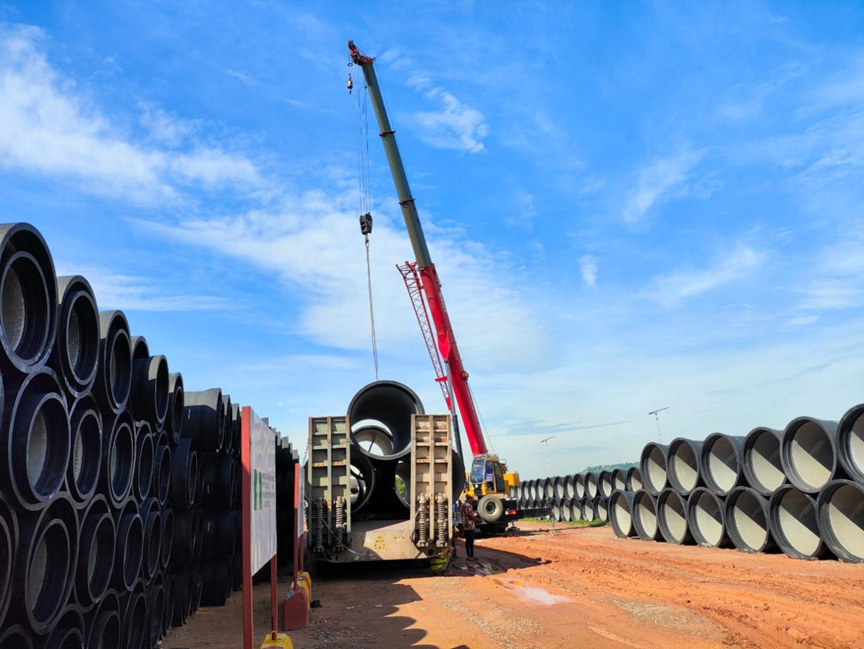
Under the scheme, the Water Supply Division of CGC Nigeria Limited, is to construct four pipeline loops, thereby enhancing the city’s water supply capacity by 480,000 m3/d. The project encompasses 415 kilometres of ductile iron water distribution pipelines of varying diameters (DN1500-200). Upon completion, it will alleviate water scarcity in 50 districts, benefiting an estimated 2.5 million residents.
But by its design, this project is more than just a water supply initiative but represents a comprehensive plan to enhance the quality of life in the FCT by providing safe, reliable, and ample water to its inhabitants. The project’s social benefits are manifold:
Without doubt, the water scheme will among other things, improve the living standards of the people. By laying and commissioning water supply pipelines, the project connects the final “mile” of the water supply system. This expansion increases the city’s water supply capacity from 240,000m3/d to 720,000m3/d. It effectively addresses the long-standing water shortage in the capital area and enhances residents’ quality and health of life.
It will also create employment opportunities for the people of Nigeria in that it directly employs over a thousand indigenous workers during construction, indirectly creating more job opportunities. It stimulates local employment and income growth while nurturing a group of Nigerian local talents and enhancing local personnel skills and quality.
It is also aimed at promoting sustainable development as it allows the existing water plant to operate at its maximum capacity, reducing resource waste. It expands the number and scope of water users, improves the expenditure of the water supply system, forms a virtuous cycle, and lays a foundation for the long-term stable development of the water supply service in the capital area.
Beyond all these, the Greater Abuja Water Project will not only boost international competitiveness but will also strengthen the capital area’s water supply system, providing a crucial foundation for its economic, social, and cultural development. It also bolsters Nigeria’s international image and soft power.
There is hope therefore that if well handled and completed on schedule, the water project would bring to an end the current water challenges that continue to afflict the residents and natives of the FCT and open a new chapter of wellness and environmental safety.
Disclaimer
Comments expressed here do not reflect the opinions of Vanguard newspapers or any employee thereof.