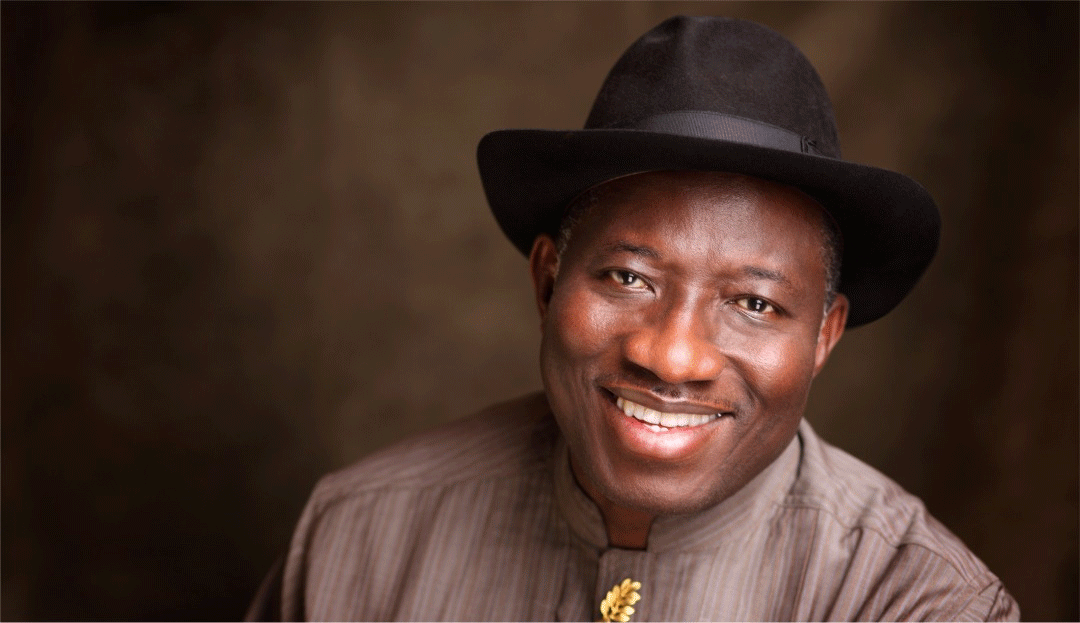
Dr. Goodluck Jonathan
By Sola Ebiseni
A FRIEND accosted me during the weekend complaining that this column is too political and controversial. I am sorry to disappoint him that this week’s edition may follow precedent.
After all, as the Yoruba say, the finger nail cannot be free of blood stains so long as the head remains infested with lice and that the hunting stone can only be cast in direct flying proportion of the bird. In a nutshell, this column is basically political in concept and character and our responses to such events are determined by the patriotic need for the continued corporate existence of Nigeria as a nation where no group or individual is oppressed. Our styles and language and no less compelled.
While optimists, particularly those privileged to hold the reins of power in their hands, condemn as alarmist the postulations that 2023 may sound the death knell of the Nigerian state contraption, it may not be truthfully imagined that the nation is not in a state of existential anxieties susceptible to several centrifugal forces.
The most compelling of these forces of denudation on the nation’s sovereign fabrics is the unending drawing of its architecture for a structure that will withstand the erosional tendencies within or without. We basically intend to look into two issues today.
The eligibility of former President Goodluck Jonathan for another term and the call for a Government of National Unity. By Section 137 (3) made pursuant to the Constitution of the Federal Republic of Nigeria, 1999 4th Alteration No.16) Act 2017: “A person who was sworn-in as President to complete the term for which another person was elected President shall not be elected to such office for more than a single term”.
It is important to note that the extant section 137 ended at Section 137 (2) (d) before the inclusion of the new section by way of amendment on June 7, 2018. Several principles of interpretation of statute have been raked up or alluded to by commentators in interpreting this section of the Constitution.
It also needs be appreciated that this section draws no inspiration from the laws or constitution of any other country from which we may seek concurrent assistance. In other words, the amendment was derived from the use and implementation of the Constitution. Flowing from the above, the first principle of interpretation of this section is to explore the minds of the legislature to decipher what was the mischief that was intended to be cured by the amendment.
This purposive rule was considered by the Supreme Court of Nigeria in the case of Abubakar v Yaradua (2008) 19 NWLR (PT1120) and held as follows: “Whatever rule of interpretation is to be applied in a case, including the purposive rule, the intention of the lawmaker is paramount and central.”
The purposive rule of interpretation would appear to have been originated by Lord Denning in the case of Seaford Cort EstatesLtd. v. Asher (1949) 2 KB 481. In developing the rule, which evolved from the mischief rule, Lord Denning said: “It would ordinarily save the Judges trouble if Acts of parliament were drafted with divine presence and perfect clarity.
“In the absence of it, when a defect appears a Judge cannot simply fold his hands and blame the draftsman. He must set to work on the constructive task of finding the intention of parliament, and he must do this not only from the language of the statute but also from a consideration of the social conditions which gave rise to it, and of the mischief which it was passed to remedy and then he must supplement the written word so as to give ‘force of life’ to the intention of the legislature”.
ALSO READ:
Without much ado, and to the best of my knowledge, this amendment had its roots in the controversy stirred up by the decision of then President Goodluck Ebele Jonathan to contest the 2015 presidential election. He was Vice-President to President Umaru Yar’Adua who died before the end of the tenure and Jonathan was sworn-in to complete the tenure ending May 28, 2011. Jonathan was elected and served as President for the four year tenure of 2011 to 2015.
His contest of the 2015-2019 tenure, if he had won, would have seen him in the office of the President beyond the eight year maximum tenure provided by the Constitution. However, by the Constitution as it then was, there were no provisions that expressly prevented or prohibited Jonathan from contesting the 2015 presidential election.
The new subsection (3) of Section 137 is intended, in clear words to prevent “a person who was sworn-in as President to complete the term for which another person was elected President” from being “elected to such office for more than a single term”. The question that arises now is whether in view of this subsection, Jonathan or any person who was sworn-in as president to complete the term for which another person was elected president, would be eligible to contest the 2023 election.
It is instructive that only citizen Goodluck Jonathan is affected by this provision among over 200 million Nigerians and, therefore, the man in the eye of the storm. We shall return to this important observation later.
Having made it clear that the unmistaken intention of the provision of the Constitution is to stop any person who has been president for a full term in addition to the years he must have spent in that same office inherited from the uncompleted tenure of another person, from contesting for another term, the question now is whether that provision apply to President Jonathan. I take the position, in spite of other considerations that will still be discussed herein, that Jonathan is caught in the web of this amendment. In fact, he is the only Nigerian so presently affected.
It has been suggested that the amendment had no retrospective effect and clearly not so intended and that, therefore, in its prospective operations, it has no effect on the positions Jonathan had held in the past. This again brings to the fore other legal considerations. What then is the status of the amendment?
In the first place, the provision under consideration, is of the Constitution, the very grundnorm and the Supreme Majesty of all laws. There is no other law to which it can be said to be inconsistent which may necessitate its being set aside. Once it is validly effected by the procedures laid down by the provisions of the Constitution itself, it is inviolate.
In addition, the insertion of subsection (3) to Section 137 of the Constitution is not the making of a new law but amendment of an existing provision of the Constitution. The elementary principle of an amendment of statute or any instrument is that it dates back to the original date of the principal enactment so amended.
The Supreme Court restated this principle in the recent case of Gana V SDP (2019) 11 NWLR (Pt 1684) 510 SC wherein it held as follows: “An amendment being a formal revision or addition to a statute or instrument takes immediate effect unless the contrary is expressly stated. An amendment whenever it is made to a document dates back to the date it is made or relates back to the original date of the document so amended”.
In addition to the above, the clear and unambiguous words of the enactment which the court and all are enjoined to give effect are expressed and applicable in the past, present and at all times taking effect from and within the provisions of the 1999 Constitution.
In other words and without merely repeating the texts of the law, it is clear that those words used in their past tenses are not in error but for the purposes of casting the net wide enough to avoid inconsistency even in the Constitution wherein anyone would occupy the seat of the President more than the maximum eight years tenure.
It must be borne in mind that the same situation is applicable to the office of the governor of a state by the same alteration in the same words inserting subsection (3) to Section 182 of the Constitution.
Apart from the clear impediments to his rumoured aspiration for the office of the President again, the attendant political crises make such eventuality cumbersome and unattractive. The most unwholesome aspect of it is the platform purporting to be midwifing it. If the APC has no qualms eating its words about the man so vilified by them, it is doubtful if gentleman Jonathan would make himself available for their shenanigans.
Also, except those who believe the amendment did not stop the former president from occupying the seat for almost 10 years would find the legal ingenuity to make him spend another term terminating in 2031, thereby giving the South its own maximum eight years from 2023, Jonathan would not withstand the political backlash of being seen as used to short-change the Southern region.
While debating this same issue with me this Monday, that is only hours before this publication, a friend who knows my love for Jonathan for his courage to convoke the 2014 National Conference of which I was a Federal Government delegate representing former elected local government chairmen, asked if the new coming of Jonathan would not ensure the frontal implementation of the CONFAB Reports.
Before I could respond, he said if he were Jonathan, he would only accept to come back and effect the restructuring of Nigeria; otherwise he would act like a true son of his father and do to Nigeria what Gorbachev did to USSR. I was virtually dumbfounded, wondering if Jonathan could have such audacity; then I remembered my brother Orubebe. Let’s meet next week on the proposed Government of National Unity. Nigeria! We hail thee.
Ebiseni is Secretary General, Afenifere.
Disclaimer
Comments expressed here do not reflect the opinions of Vanguard newspapers or any employee thereof.