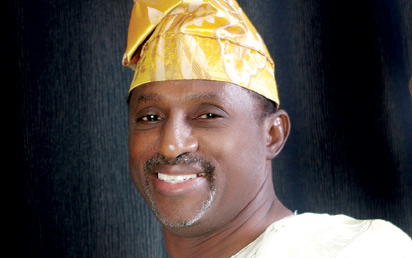
Chief Femi Lanlehin
*Says June 12 still evokes virtues and values of the struggle
Chief Femi Lanlehin is a self-effacing politician. But that does not mean he is not a tactician. He’s a lawyer
In the days of the National Democratic Coalition, NADECO, he was one of those operating from within the country, sometimes risking life to help establish contact between those abroad and their family members in the country – in fact, a very popular former state governor had Lanlehin as his contact person between the exiled politician and his family using Benin Republic as meeting point. But all that has gone with NADECO. He was in the House of Representatives during the still born Third Republic. Today, he is in the Senate, representing Oyo South.
In this interview, Lanlehin’s passion for ture federalism is laid bare. Being the son of a man who was the secretary of Obafemi Awolowo’s Action Group of the First Republic, this is understandable – although Lanlehin strayed into the Peoples Democratic Party, PDP, from the Alliance for Democracy, AD, pitching his tent with the Action Congress of Nigeria, ACN. He also espouses some virtues of senate president, David Mark, especially his leadership style which has seen a stable Senate in the last four years.
Excerpts:
By Jide Ajani, Deputy Editor
What feel did you get when you returned to the National Assembly?
I had that tremenduous feeling of honour, of being called to serve by the people.
As it was in the days when we went through what we went through in 1993, for the democratic structures that we put in place, one still felt that one was being honoured and called upon to render service in the legislature, to help move the nation forward.
As it was then, a lot of things are still very much needed to get our democratic experiment right and by now it shouldn’t be an experiment. One still felt what one felt at that time, the happiness of being called upon to serve and the excitement to do one’s best. The feeling was good.
One is determined to put forward one’s best for the nation.
In as much as we have practised democracy this far, since 1999, there are still many things that need to be put in place, both constitutionally and in terms of structural adjustments, in terms of engineering the polity and in terms of changing the psychological approach of our people to issues and thank God the people are catching on with contemporary realities of the day.
Which is?
It is good that our people have come to realize that democracy remains the best form of government no matter how imbalanced or imperfect.
It can be improved upon by all and sundry.
What are those things that you think we still need to do at this point to deepen our democracy?
What we need to do is to build the institutions of democracy.
And one of the best ways we can do this is by building the structures of the three arms of government.
You must have a legislature that believes in the policy of putting its best foot forward and must be willing to respect the laws of the land as contained in the Constitution of the nation and in the various Acts of parliament.

Chief Femi Lanlehin
The legislature must be willing to respect the rules and the orders of parliament – that is, the standing orders of the parliament. The system of committee work, the system of oversight function, the system of listening and gauging the mood of the people by way of public hearing must be institutionalized and it must be established and guaranteed in such a way that the it best engenders a process devoid of the grandstanding that has gone on for long.
Thank God that this time around we have a crop of legislators in both chambres, thrown up by the system through an election that has been considered fair.
The election was reasonably fair and credible that it threw up a number of people who are willing to serve and who are able to serve and who have the credential to serve and who have the mandate of their people to serve, as distinct from the shenanigans of the 2007 elections which threw up people of lesser standing, in a manner of speaking.
Our people suffered a lot to register and have their names in the voters register and to also queue and vote under some conditions that were painful and to follow up to the next level of counting and collation because of their yearnings for change and the sacrifices to maintain and nurture democracy, these sacrifices should not be taken for granted.
When you compare the caliber of legislators in the National Assembly today and those in 1993, what differences and similarities would you say exist?
The patriotism that we had in 1993, which was indicative of the total belief in democratic norms, is, to a large extent, at par with the amount of patriotism that can be deciphered in the present legislature – although there are lots of imperfection in the last elections that we had, but it was a large improvement compared to the ones we had since 1999. The level of patriotism and the level of education and the caliber and quality of people then and now can be comparable because the systems that threw them up were credible, free and fair and Nigerians were willing to take part now and then, unlike the situation a few years ago which, because of the violence, people stood back and decided not to take part. Today, that is different. People perceived that the elections were bound to be fairer and freer, so many credible people participated.
When you look at the issue of June 12, which is 18 years old, what significance would you draw?
An 18-year old person will obviously not have any strong feelings about what happened then and now. Possibly, he will be voting or registering for the first time in his life, so his comprehension of the political history will be low.
The only political experience he would have would probably be from say 2006, when he would have been 13 years then and may be in JSS 2. He would also have been used to the culture of corruption, impunity and violence which were so pervasive such that the fellow’s comprehension of governance would be about making money and engaging in violence.
Unlike what we experienced in our own time, listening to the likes of Obafemi Awolowo, Michael Okpara, Nnamdi Azikiwe, Tafawa Balewa, Ahmadu Bello – never mind that there were disagreements that led the First Republic to spin out of control. When Awolowo was governor in the Western Region and when we were in primary school, we grew up seeing the things he had done or started doing. We appreciated the things he did and built. I was lucky to have parents that could pay my fees, but I still attended non-fee paying schools because they were the best then and they were government schools. There, we had the children of the poor and rich learning together and we mixed well and we had the feeling that we were getting something from the system.
But now, go to the nooks and crannies and what do you see? I’ve gone round the country campaigning with presidential candidates and you still find boys in some places who have education but who believe that the only way they can exist is by constituting a nuisance in their community, people who make other peoples lives a living hell.
Before, the values and virtues of life were different. People are looking for ways to make money any which way now because that is the only examples they see around them. Our military men brought out the worst in our people. The negative legacies of the military are still thriving and that is what we are trying to make our people do away with; it is difficult but I believe we would be able to get there. The average Nigerian should be made to understand that it pays to be patriotic.
Looking at the polity and the issue of zoning, what would be your take and the House of Representatives’ election of their leaders?
I wouldn’t know what and how it happened in the House of Representatives but my party, from what I could see, voted in accordance with the collective decision of the leadership and membership of the party, the collective interest of the country.
But some are asking why ACN legislators would vote against South West interest in the House of Representatives?
The party leadership, in its wisdom, and, in conjunction with members of the House of Representatives after due consultations, felt that the interest of Yoruba would be best served by voting the way they did.
How?
I would not want to comment further.
In the Senate, there was no competition and it was more or less a coronation for David Mark?
The Senate has fewer members in its chambers, much less than the House of Representatives.
Again, nearly 70% of old senators did not return to the Senate.
So from the poll that is electable, going by the rules of the chambers, there were only 30% of the membership eligible for the position; to that extent, without fair or favour, David Mark met all the criteria needed. And irrespective of his military background (because some of us, judging by our bitter experience in the hands of military men), the man, to a large extent, carried himself well since 1999 to 2007 before he became Senate president. From 2007 to 2011, that he was Senate president, for the first time there was no splitting of hairs over unnecessary matters unlike what we had with all those before him where there was always one scandal or the other.
Paradoxically, a military man came in and he was able to stabilize this office and carry members through without any challenge to his moral or legal authority, there was no major financial scandal. I believe the man has done his best, so he deserved to be elected.
ACN as an opposition political party, what agenda is the party bringing to the table in the National Assembly?
You can capture it, in a very neat form from the attitude of AC N to governance.
You can capture the general attitude of AC N to governance by the invitation of the party to come and join the Federal Government and it was made clear that we would cooperate with the Federal Government in so far as we are all Nigerians, but we’ll make sure that in cooperating with the Federal Government, we don’t compromise out core values and this is exactly what the members of AC N are bringing to the Senate.
Okay, what does the AC N senator want?
He emerged in his party and got the mandate of his people fairly and credibly and he wants to represent his people very well. The provision of the basic necessities of life but you cannot do this in a country with a faulty structure, where there are structural faults, systemic faults and these can be properly handled and the most important word that is basic to us is that we must practice our federalism in a true manner as contained in the 1999 Constitution and as globally acceptable in the practice of federalism. There are things that have been inserted in the constitution in ways that should not be there and there are things that have been deliberately omitted from the constitution in ways that they should not have.
Give instances?
Look at the LG system. Each federating state has the right to govern, sustain, finance and maintain its LGs the best way it feels but what do we have? LGs were created by fiat in a very lopsided and unfair manner and methods of maintaining them were created in equally unfair manner, using landmass and these were inserted in the constitution.
Our federalism must understand that the federating units must be the states as we had in the First Republic and each unit had its constitution and all we did was have a common ground for labour, foreign policy, defence. But in terms of education, health and so on, you can determine how you regulate those ones at the federating unit level.
But now, the federalism aspect of our constitution has been eroded.
Two, the issue of fiscal federalism is, to a large extent, a mirage. It is both structurally and systemically faulty. You say that the man who keeps all the money is the man who shares it.
Section 162 says there must be a federation account into which all monies should be paid and you say the Accountant General of the Federation should now share it for all, he tells you how much comes in and how much is shared and he can never be fair because his general directive comes from the president; so there is no way he cannot but defer to his boss and you want him to be fair to all? It’s not possible. There should be a general pool.
Even the formular for sharing is wrong. Let’s even say the AG is a wonderful machine or robot, the formular for sharing says FG 52.86% and the states get around 26.72% and the LGs, which are the closest to the people, get 20% and if you look at the percentage that is shared vis-a-vis the duties and responsibilities, the FG has the least duties but gets the largest share. That is wrong.
Where does this optimism come from. When Olusegun Obasanjo, a fellow Yoruba man, was president, the Alliance for Democracy, AD, could not succeed in achieving the objective of true federalism. What hopes do you have now?
People are now beginning to realize that their primary responsibility is to their constituency and their constituents and this is across board – the interests of members coalesce in terms of what they believe would be in the best interest of their people and, therefore, they will join hands to work together.
When you look at the functions of the FG, there is nothing fantastic about it on the exclusive, concurrent and the residual lists. The responsibilities of the FG do not justify the amount of money that it gets and the LG funds are subject to all manner of control. I believe that our party will get the cooperation and let our people see that despite the difference in party affiliation, our people are Nigerians who need the basic things in every part of the country, from Kafanchan to Uyo, to Molete, to Kebbi, we are all the same and the needs of our people are basically the same.
My optimism lies in the fact that we are all supposed to work for the same goal for Nigerians.
We have a lopsided system that is wasteful and allows for corruption. That is what the AC N legislator wants to correct.
You moved from AD to PDP and now ACN?
Let’s say it’s a home coming. I’m a progressive and I believe in the need to serve humanity the best way one can and in that process you are serving yourself. If you’re providing for the security of people around you, then you’re providing for your own security too. My going into PDP was circumstantial and I had no choice than to return to my natural environment.
Disclaimer
Comments expressed here do not reflect the opinions of Vanguard newspapers or any employee thereof.