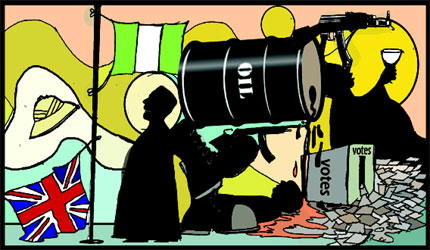
Oil
By Awa Kalu, SAN
The celebration this year to mark the 58th anniversary of Nigeria’s political independence from our colonial masters, has come and gone. By the way, our erstwhile colonial masters (Great Britain) is presently struggling to gain its own ‘independence’ from the European Union after a referendum in which its citizens chose to return to life before its association with the European Union.

It is possible that when BREXIT materialises, Britons as we call them, will choose a day on which to celebrate their new freedom for whatever it is worth.
As is the tradition, this annual celebration was preceded by an interdenominational
Christian service at the National Ecumenical Center and in other worship centers nationwide. The Vice- President, our sure-footed Prof. Yemi Osinbajo, SAN, was preeminent at that event and did not just lead the National Prayers for stability, peace and tranquility in our country but also assured Nigerians that the current administration is well equipped to take our dear country across the red sea. Our Muslim brethren gave us the same assurance from Mosques across the land. By the same token, our dear President, Muhammdu Buhari, also delivered through a national broadcast his own words of wisdom. In the past few years, the independence anniversary was celebrated without fanfare or pomp and pageantry in
acknowledgment of the global and widespread economic crisis that is top on the agenda of most developed, developing and least developed nations.
Having watched the celebration on national television, I can say that it was a display of what we have and what we can make better. Not being anywhere near the corridors of power, I cannot speculate on what led to a change of gear in staging the parts of the celebration which took place at the Eagle Square. It may be that the celebration was designed to encourage us as Nigerians to believe that our nation is in good condition, especially having regard to the state of our politics.
We must acknowledge the disquieting nature of the sudden surge of defections at the National Assembly where our Senators and members of the House of Representatives of the highest rank are changing their party affiliations.
We must also acknowledge the disquiet arising from the issuance of executive orders especially those that have been a bit on the controversial side. No one can forget in a hurry the invasion of the premises of the National Assembly by members of a security agency and no one can also forget that in the buildup to the celebration, two former Governors lost their freedom in different courts of the land on account of the determination of this administration to bring the high level of corruption in the country to the barest minimum.
As part of our preamble to highlight the importance of the celebration of our independence, we cannot also forget that the lives of many Nigerians have continued to be dislocated in the North-East where several members of our dear country have remained either in captivity or are living their lives as internally displaced persons.
Our prayer is that in the nearest future, all Nigerians will be able to celebrate independence in freedom and happiness. In the past, this column raised the same question as we do now i.e. Nigeria: 58 years of what?
It had been conceded that the argument of the majority, which is that we are yet to arrive at our destination, 58 years after the journey began, must remain part of our national conversation.
Does any nation ever arrive at its destination or is the life of a nation a continuous journey punctuated by events whether remarkable or not? Yet again, one may ask, when did the life of this country begin? Some would say it began in 1914 when the amalgamation of the Northern Protectorate with its counterpart, the Southern Protectorate was achieved. The fanfare with which the nation celebrated Lord Lugard’s amalgamation is an undeniable acknowledgement of the genesis of this would-be great nation, the land of plenty. At this juncture, it may simply be noted that what is presently known as the Federal Republic of Nigeria was not a country, at least prior to the amalgamation of 1914.
The indigenous and heterogeneous groups often derogatorily referred to as ‘tribes,’ which make up this country, existed independent of each other with different cultural and political systems. However, the colonial masters, largely for economic and administrative reasons, felt that there was a need to merge the Northern and Southern Protectorates into a single colony. The fusion was achieved by Lord Frederick Lugard, the then Governor- General. It has often been wondered in several quarters whether the amalgamation was a political master stroke or an unmitigated error.
The Jury is still out but our dear President, Muhammadu Buhari, as a statesman, will have no doubt that the amalgamation was divine.
As has been acknowledged, every journey has a beginning and it will be left to the discerning reader to determine whether our journey as a country truly began in 1914.
Snippets from our colonial history show that Lord Lugard made way for Sir. Hugh Clifford in 1919 or thereabout.
It was indeed Sir Clifford that laid the foundations of democracy in the colony in that the first Nigerian Constitution of 1922 was appropriately called the Clifford Constitution. ‘That Constitution introduced a Legislative Council and for the first time, enlightened Nigerians were afforded the opportunity of a say in the political affairs of their country.’
No matter how tenuous their emergence in government was, what cannot be contradicted is that the 1922 Constitution was the first of many in the annals of this country. Historians equally acknowledge that it was that Constitution that sowed the seeds of nationalist movements at that time.
The early Nationalists were the principal actors in the struggle against colonialism. Late Herbert Macaulay for instance, is often referred to as the father of Nigerian nationalism. He was later joined in the struggle by the likes of Dr. Nnamdi Azikiwe, Chief Obafemi Awolowo, the late Sardauna of Sokoto and so on. It is believed that even women were not left out of the agitations that eventually led to the ouster of the colonialists. What is popularly known as ‘the Aba women riots of 1929’ was a revolt against the involvement of women in the payment of tax. Of course, the effort of women in the achievement of political independence cannot be ignored and this has been touted as one of the reasons for presenting the Amazons of yester-years on the face of the proposed N5,000 currency (a proposal now in the cooler).
Even though suspended, it cannot be doubted that in the nearest future, an opportunity for acknowledging the efforts of women in nation-building will present itself. In some
quarters, the emergence of women in very prominent departments of government is believed to be a remarkable dividend for years of
unyielding sacrifice from our women.
It is believed that our President has named a few women in several positions of power or authority who have teamed up with other well meaning women to demonstrate their power in nation-building. It may even be argued that the capital market at one time responded to the footsteps of a very powerful woman. Our women of yesterday, who enjoyed dominance in the corridors of power, have been given more powerful positions abroad even though regrettably, one fell out of favour because of errors of miscalculation. Another powerful lady has also resigned from the Federal Executive Council following disagreements with her political party. Notwithstanding this development, there is no mistake in empowering our women.
They are rising and rising, just like their counterparts in developed democracies. Nevertheless, what needs to be repeated is that the combined pressure from men and women culminated in democratic self-rule, first, for the Western and Eastern Regions and later for the Northern Region as a prelude to the Independence of the nation from Great Britain.
However, in the light of the fact that what calls for celebration is the 58th anniversary of our independence from Great Britain, it would then seem incontestable that Nigeria was born on the 1st of October, 1960 and that it was on that date that its journey as a nation began.
A nation is akin to a human being, born naked and unable to do things for itself, assisted for many years, weaned and let loose to cater for his or herself.
For the human, it is those who bring the child into the world that are responsible for its upbringing including providing instruction as to how to survive in a competitive environment.
Disclaimer
Comments expressed here do not reflect the opinions of Vanguard newspapers or any employee thereof.