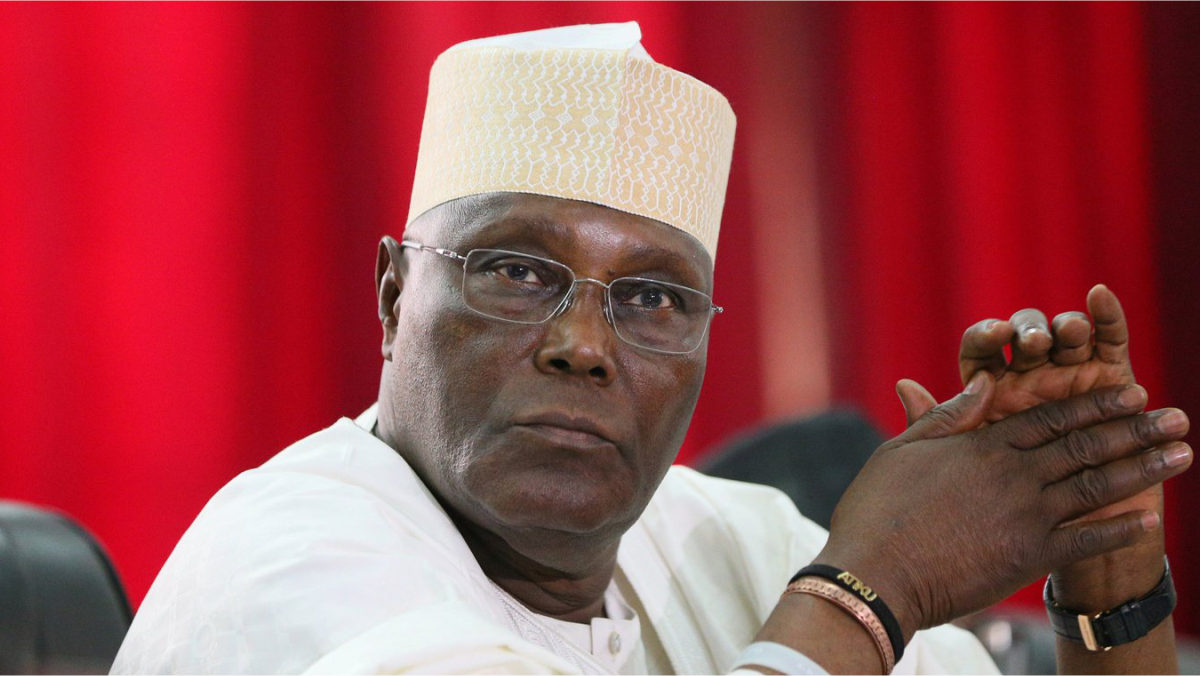
Former Vice President Atiku Abubakar
By Adelere Adeojo
Although it is not unlikely that more candidates and parties will declare in the approaching weeks their desires to contest next year’s presidential election, Alhaji Atiku Abubakar and Peter Obi, who already have divulged intents by openly aligning with the African Democratic Congress (ADC) and the Nigeria Democratic Congress (NDC) respectively, are most likely to be re-joining Senator Bola Tinubu of the All Progressives Congress (APC) in a race whose victory seems much less likely to be determined by presumed competencies and personal candor of contenders, and much more by their genealogies and ancestral leanings.
Factually, it is unsure if any new entry into the fray could alter such a big picture as thus far established by the three, regardless of which partisan platform may be hoisted to promote individual aspirations. While many have warned about intrinsic immorality in former president Goodluck Jonathan’s expressing interest in the presidency, and advancing to announce congruent plans, it is not certain the former president as yet realises his own intrinsic net worth as a comparatively less valuable political product. But the tortoise was asked, “When will you return home?” and he answered, “After meeting my shame at the market square.”
At this point, and given plausible admissibility of the trio as the most serious possible contenders with requisite political clout and logistical muscle to shape bourgeoning directions for the duel, it won’t be improper to beam light on each in turn for potential voters, at home and in the diaspora, to be sufficiently partnered in ensuing choices. Who knows how cautionary monitions disbursed early enough could sway the electorate in making decisions towards reviving the comatose destiny of our troubled fatherland? Such words again rely upon presumptions of stout belief that consequent polling shall be granted a fidelity quality significant enough not to ginger meagre suspicions that the outing had been a mere travesty.
We open the floor with NDC’s Peter Obi, whose controlling reformist posturing must wow ordinarily, but a cautionary view invites wonderment about a potential subversive of the horrendous category. Obi cuts a charismatic figure whose political popularity rapidly ascended mainly among a segment of the Nigerian populace craving departure from elitist, pro-establishment politics. Starting with a two-term governorship of Anambra State from 2006 to 2014, during which he reportedly implemented fiscal discipline and modest infrastructure development, Obi’s appeal stems largely from his anti-establishment deportment and the image of a financially abstemious leader. He resonates strongly with disillusioned youth and urban professionals who see him as a fresh, credible alternative, while his emphasis on data-driven arguments, prudence measures, and productivity stands in sturdy contrast to traditional political rhetoric.
The “Obidient” movement, a grassroots phenomenon driven mainly by social media, somewhat showcases his ability to mobilise a committed base that does not rely on orthodox party structures. But Obi is still handicapped by limited grassroots links in a country where such links become crucial against the well-oiled machinery of rival contenders, a reality well affirmed in his loss in 2023. Critics further noted the statistics he loves to reel out have often been found spurious and inconsistent, maintaining his frugality aspect was misplaced as this only abbreviated his infrastructural upgrades in his state, and wondering how, against the vaunted wealth of the state, he could still owe a section of workers whole 42 months’ salary during his tenure. He is further regarded as a pretentious nationalist who refused to condemn militant separatist IPOB’s killing spree across eastern states, mainly to protect his presidential ambition, even as the latter frequeAntly and brutally enforced Monday-to-Monday sit-at-home orders. Again, it is said his state-level political success should not be confused with competencies to resolve complex, extremely diverse issues of federated Nigeria. Indeed, many regard him as a core-Igbo apologist who, while regularly playing to the gallery, only silently awaits an opportunity to actualise long-standing secessionist schemes for a Biafra nation.
Next is Alhaji Atiku Abubakar, a towering figure in Nigerian politics, a serial presidential contestant whose journey dates back decades. His most prominent federal-level experience came as VicePresident to former President Olusegun Obasanjo from 1999 to 2007; prior to that he had a distinguished career in the Nigeria Customs Service and built a formidable business empire. Atiku, whose long-standing membership and influence within the Peoples Democratic Party (PDP) further underscore his deep entrenchment in the nation’s political establishment, has never held any number-one electoral position in Nigeria. Although he was voted governor of Adamawa State in the 1999 general elections, he was chosen by Obasanjo as vice, just before being sworn into office. His primary strength lies in his unparalleled federal administrative exposure and extensive national political machinery. His substantial financial resources have enabled robust nationwide campaign operations and genuine grassroots links. But Atiku’s long political career has been his most compelling vulnerability, as he is often seen as a pro-establishment embodiment of the “old politics” bloc, a bloc tagged as exemplifying clientelism and deal-making.
Welcome Senator Bola Ahmed Tinubu, sitting president and commanderinchief of Nigeria’s armed forces, whose ascent to the country’s highest office was a culmination of decades of strategic political manoeuvring, rising from his perceived impactful tenure as Lagos State governor to his role in forming the ruling All Progressives Congress. His journey to the presidency — which terminates in 2027, if unrenewed — clearly embodies tactical prowess that saw him initiate bold, and at times painful, economic reforms — notably fuel subsidy removal and exchange rate unification — that triggered immediate economic seismic waves. His massive infrastructural upgrades have been dismissed as coming at the expense of genuine enablement of a desolate populace reeling under consequences of his hasty fuel subsidy removal, which have yielded a catastrophic cost-of-living crisis and runaway inflation, plunging millions further into what global institutions have aptly captured as “multidimensional” penury.
Again, critics observe nationwide insecurity — from banditry to kidnappings — has only exacerbated rather than abated, contrary to his campaign pledges, while the naira’s drastic devaluation has crippled micro-level real earnings and purchasing power, amidst widespread unemployment and underemployment which continue to alienate significant youthful populations. Tinubu’s administration further faces accusations of opacity and disconnectedness from the basic yearnings of the public, and his palliative offers of direct cash and foodstuffs to households are carpeted as tokenistic, afterthought solutions to systemically rooted poverty.
Nigerians, in the coming months, will be deciding which side of the three to camp with. Can it favour incumbent Tinubu, who has proven his unabashed bigotry in service of an elite class of politicians and industrialists? Tribal bigotry and elitist irredentism — which sadly lie at the foundations of Nigeria’s inexcusable gridlock — are equally catastrophic plagues threatening to sound the lethal knell upon corporate Nigeria: the one was tasted in Lagos when Igbo youths and their Yoruba collaborators rampaged through major streets, cremating scores of cherished private business interests of mainly Yoruba people in the aftermath of killings of EndSARS protesters at Lekki Toll Plaza; the other has produced the very macroeconomic fiascos that have enforced closures upon common peoples’ dining sessions, and this just as the nouveau riche across the country continue to record quarter-on-quarter after-tax profits in billions, even trillions.
Atiku, most possibly gearing to become Nigeria’s version of America’s Abraham Lincoln, seems finally to be triumphing over oppositional voices, despite and amidst thick intrigues. As the country prepares for another round of 5050 dalliance with native hegemons whose plans are never known until unveiled, as rival interests collude with pseudo-spiritualists to purvey misguided advice to the contestant most probable to carry the ace, as citizen scientists begin to journey to heaven and back simply to argue the electorate away from doing science at such a time, as Atiku Abubakar (GCON), Wazirin Adamawa and Nigeria’s 11th vice president, possibly finally awaits his day of destiny, and as the whole world watches and awaits consequences of an exercise that may decide the very survival of our troubled enclave, one can only trust such message, as here modestly declaimed, shall offer Nigerians the beacon to navigate the labyrinths of critical decisions as they are confronted. One can only wish all the very best of luck.
*Adeojo, public affairs commentator, writes from Asokoro, Abuja
Disclaimer
Comments expressed here do not reflect the opinions of Vanguard newspapers or any employee thereof.